Example: bankruptcy
Lecture 15 - Zero Knowledge Proofs - Princeton University
terms, for a particular language). We will then talk about the de nition of zero knowledge proofs. Next lecture we will see that the extremely useful fact, shown by GMW, that any NP-statement can be proven in zero knowledge. Interactive probabilistic proofs. The standard mathematical notion of a proof is the following:
Tags:
Information
Domain:
Source:
Link to this page:
Documents from same domain
C Examples - Princeton University Computer Science
www.cs.princeton.eduC Examples! Jennifer Rexford! 2 Goals of this Lecture ! • Help you learn about:! • The fundamentals of C! • Deterministic finite state automata (DFA)!
C Examples - cs.princeton.edu
www.cs.princeton.edu3 Overview of this Lecture! • C programming examples! • Echo input to output! • Convert all lowercase letters to uppercase! • Convert first letter of each word to uppercase!
Chapter 9 Basic Signal Processing - cs.princeton.edu
www.cs.princeton.eduChapter 9 Basic Signal Processing ... Digital Signal Processing ... The key to understanding signal processing is to learn to think in the frequency do-
1 What is Machine Learning?
www.cs.princeton.educlassification predicted rule prediction algorithm machine learning example new examples training labeled Figure 1: Diagram of a typical learning problem.
Modules - Princeton University Computer Science
www.cs.princeton.edu1 Modules CS 217 The C Programming Language • Systems programming language originally used to write Unix and Unix tools data types and control structures close to most machines
Introduction to Stochastic Simulation with the Gillespie ...
www.cs.princeton.eduIntroduction to Stochastic Simulation with the Gillespie Method David Karig April 18, 2005. Stochastic Systems • Many systems driven by random, discrete interactions • Traditional deterministic models may not accurately describe such systems $ Example: The Lambda Switch
Go programming language - Princeton University
www.cs.princeton.eduGo programming language • history • basic constructs • simple programs • arrays & slices • maps • methods, interfaces • concurrency, goroutines

An Introduction to MCMC for Machine Learning
www.cs.princeton.eduemphasis on probabilistic machine learning. Second, it reviews the main building blocks of modern Markov chain Monte Carlo simulation, thereby providing and introduction to …

A Beginner’s Guide to LATEX September 12, 2005
www.cs.princeton.eduA Beginner’s Guide to LATEX David Xiao dxiao@cs.princeton.edu September 12, 2005 1 Introduction LATEX is the standard mathematical typesetting program.This document is for people who have never used LATEX before and just want a quick crash course to get started.I encourage all students in mathematics and

Insertion Sort - Princeton University Computer Science
www.cs.princeton.edu13 Data analysis. Plot time vs. input size on log-log scale. Regression. Fit line through data points ! a Nb. Hypothesis. Running time grows quadratically with input size.
Related documents
Game Theory Lecture Notes
personal.psu.eduGame Theory: Penn State Math 486 Lecture Notes Version 2.1.1 Christopher Gri n « 2010-2021 Licensed under aCreative Commons Attribution-Noncommercial-Share Alike 3.0 United States License

Mathematical Logic (Math 570) Lecture Notes
faculty.math.illinois.eduLecture Notes Lou van den Dries Fall Semester 2019. Contents 1 Preliminaries 1 ... Once we have mathematical de nitions of these notions, we can try to prove theorems about these formalized notions. If done with imagination, this process can lead to unexpected rewards. Of course, formalization tends to caricature
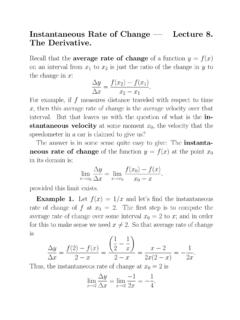
Instantaneous Rate of Change — Lecture 8. The Derivative.
pages.uoregon.eduInstantaneous Rate of Change — Lecture 8. The Derivative. Recall that the average rate of change of a function y = f(x) on an interval from x 1 to x 2 is just the ratio of the change in y to the change in x: ∆y ∆x = f(x 2)−f(x 1) x 2 −x 1. For example, if f …

Lecture 9: CNN Architectures
cs231n.stanford.eduLecture 9 - 1 May 2, 2017 Lecture 9: CNN Architectures. Fei-Fei Li & Justin Johnson & Serena Yeung Lecture 9 - 2 May 2, 2017 Administrative A2 due Thu May 4 Midterm: In-class Tue May 9. Covers material through Thu May 4 lecture. Poster session: Tue June 6, 12-3pm.
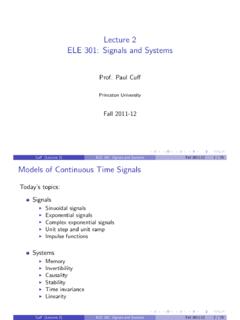
Lecture 2 Models of Continuous Time Signals
www.princeton.eduLecture 2 ELE 301: Signals and Systems Prof. Paul Cu Princeton University Fall 2011-12 ... Alternate de nitions of value exactly at zero, such as 1/2. 1 t u(t)!2 !1 0 1 2 Cu (Lecture 2) ELE 301: Signals and Systems Fall 2011-12 11 / 70 Uses for the unit step: Extracting part of another signal. For example, the piecewise-de ned
Lecture 10: Logistical Regression II— Multinomial Data
www.columbia.eduLecture 10: Logistical Regression II— Multinomial Data Prof. Sharyn O’Halloran Sustainable Development U9611 Econometrics II

Lecture 18 Solving Shortest Path Problem: Dijkstra’s Algorithm
www.ifp.illinois.eduLecture 18 One-To-All Shortest Path Problem We are given a weighted network (V,E,C) with node set V, edge set E, and the weight set C specifying weights c ij for the edges (i,j) ∈ E. We are also given a starting node s ∈ V. The one-to-all shortest path problem is the problem of determining the shortest path from node s to all the other ...