Example: quiz answers
Lesson Two Making Money
Child or adult care 5. Union dues adding up the benefits 1. Possible job benefits Health, dental, and eye care insurance Life insurance/disability insurance Flexible spending account Health savings account Tax-deferred retirement plan Paid vacation Paid holidays Parental leave Stock purchase plan Employee assistance plans
Tags:
Information
Domain:
Source:
Link to this page:
Documents from same domain
Lesson Two Living On Your Own - Practical Money Skills
www.practicalmoneyskills.comPersonal and financial goals Short-term Medium-term Long-term 2. Needs and wants Personal (e.g., nice view) Professional (e.g., proximity to work) 3. Income Current Expected income in the next few months Expected income in the next year 4. Practice setting up a budget Rent Moving costs Moving-in costs

Do you ever feel like money terms go right over your head ...
www.practicalmoneyskills.comUse the websites listed and the handout Money Matters: Know the Lingo to help you form a plan to present to the rest of the class. Scenario 2: Saving for college ... Saving for a car You want to buy a car in the next year so you can drive to your job …

Deal or No Deal: Understanding Car Loans
www.practicalmoneyskills.comDeal or No Deal: Understanding Car Loans LESSoN 3: STUDENT ACTIVIT y SHEET Time Required: 15 minutes Down payment, interest rate, loan term—the lingo involved with buying a car can seem

Lesson Six Banking Services - Practical Money Skills
www.practicalmoneyskills.combanking services lesson outline www.practicalmoneyskills.com banking services teacher’s guide 6-ii 6-G keeping a running balance: check transaction, debit card transaction 6-H reading a bank statement 6-I reconciling a checking account 6-J electronic banking services 6-K cashless transactions student activities 6-1 Choosing a Checking Account Using the guidelines provided …

Lesson Eight Credit Cards - Practical Money Skills
www.practicalmoneyskills.comcredit cards lesson outline www.practicalmoneyskills.com credit cards teacher’s guide 8-ii 8-G dealing with billing errors 8-H other credit card protections 8-I credit card dos and don’ts 8-J how much can you afford? (the 20-10 rule) student activities 8-1 Shopping for Credit Discuss how costs and features can vary between credit cards, and have students

Lesson Three Buying a Home - Practical Money Skills
www.practicalmoneyskills.comactivity teenagers young adults adults (14-18)(1-25)(26+) 9 Survey/Interview Student Activity 3-1 Student Activity 3-2 ... Few financial benefits in the form of tax deductions ... Jess, age 19, has just taken her first job as a sales representative trainee for a computer software company. RENT BUY DEPENDS 5: Barb and Frank, ages 54 and 57, are ...
Related documents

Quality Assurance and Performance Improvement Plan ...
www.hqi.solutionsgoals that your plan will strive to meet. Goals should align with overall organizational services and initiatives. For example: Memory care Disease management Specialized rehabilitation programs Transitions of care Quality workforce Goals should be specific, measurable, actionable, relevant, and have a timeline for completion.

The Nursing Process - MJC
www.mjc.eduAssessment data, diagnosis, and goals are written in the patient’s care plan so that nurses as well as other health professionals caring for the patient have access to it. Implementation Nursing care is implemented according to the care plan, so continuity of care for the patient during hospitalization and in

Time Management Worksheet
uiu.edudo in a day. Example: You spend time sleeping, so will need to include the total number of hours spent sleeping in your circle. Don’t forget all of the various responsibilities and activities you do each day: classes, studying, sleep, fitness, work, family, personal care, eating, transportation, relaxation/hobbies, etc.

Business Plan Template for a Startup Business
vhsbi.comworksheet/s. The last section in the instructions, “Refining Your Plan,” explains ways you may need to modify your plan for specific purposes, such as getting a bank loan, or for specific industries, such as retail. Proofread your completed plan (or have someone proofread it for you) to make sure it’s free of spelling and
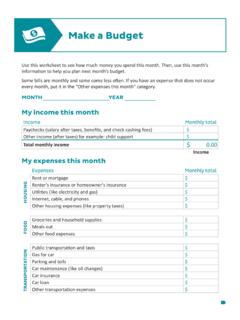
Make Budget Worksheet - Consumer Information
www.consumer.ftc.govUse this worksheet to see how much money you spend this month. Then, use this month’s . information to help you plan next month’s budget. Some bills are monthly and some come less often. If you have an expense that does not occur . every month, put it in the “Other expenses this month” category. MONTH YEAR. My income this month

Guide for Developing Purpose, Guiding Principles, and ...
www.cms.govorganization. The team completing this worksheet should include senior leadership. Taking time to articulate the purpose, develop guiding principles, and define the scope will help you to understand how QAPI will be used and integrated into your organization. This information will also help your organization to develop a written QAPI plan.
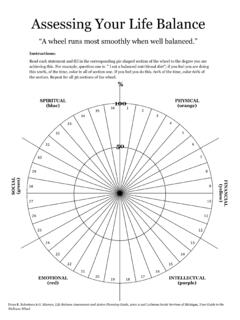
Instructions
studentwellness.uci.eduAssessing Your Life Balance “A wheel runs most smoothly when well balanced.” From R. Robertson & G. Microys, Life Balance Assessment and Action Planning Guide, 2001-2 and Lutheran Social Services of Michigan, Your Guide to the Wellness Wheel. Instructions: Read each statement and fill in the corresponding pie shaped section of the wheel to the degree you are

Interest Groups - eNetLearning
www.enetlearning.orgInterest Groups Learning Objectives. Students will be able to: Identify three ways groups and organizations can influence the actions of government. Explain how individuals, public opinion, associations and groups form and carry out public policy. Describe the position of opposing groups on a public policy issue.