Transcription of LIGHTHOUSE
1 LIGHTHOUSEThe Science of Pharmaceutical ManufacturingHeadspace oxygen monitoring and container closure integrity testing of pre-filled syringesApplication Note 104 Headspace oxygen monitoring and container closure integrity testing of pre-filled syringesIntroductionThe need to monitor headspace oxygen levels in pre-filled syringes arises from the require-ment to ensure the stability and potency of oxygen-sensitive product. Besides a loss of efficacy and reduction in shelf life, exposure of such products to oxygen can result in prod-uct discoloration, changes in dissolution rate and profile, and even toxicity or other phar-macological properties associated with nega-tive side inspection of headspace oxygen in syring-es having a purged nitrogen headspace can also be used to determine whether the con-tainer closure integrity of the syringe has been maintained. A pre-filled syringe that has suf-fered from a container closure integrity fail-ure will immediately begin to diffuse air into the headspace.
2 This ingress of air results in headspace oxygen levels that are elevated compared to syringes that have maintained closure integrity . Defective syringes with high levels of headspace oxygen can then be detect-ed and removed in an inspection Application Note describes how laser-based headspace analysis is used for the rapid non-destructive determination of headspace oxygen levels in pre-filled syringes. Data is presented demonstrating two major applica-tions of this technique: 1) headspace oxygen monitoring on a pre-filled syringe line filling oxygen-sensitive product, and 2) container closure testing of pre-filled Oxygen Determination in Pre-filled SyringesTraditional analytical methods for determin-ing headspace oxygen levels in parenteral containers are slow and/or destructive. This results in headspace oxygen analysis which is both time and resource intensive.
3 Conven-tional destructive techniques, such as electro-chemical methods or gas chromatography, are difficult to implement at- or in-line for immediate feedback about the filling process. LIGHTHOUSEThe Science of Pharmaceutical ManufacturingApplication Note 1041 LIGHTHOUSEThe Science of Pharmaceutical ManufacturingThe destructive nature of the measurement also means that these conventional methods cannot be utilized for 100% inspection of product. Once the septum of the container is pierced to take a headspace sample, container integrity is compromised and the sample must be disposed of. Pre-filled syringes pro-vide additional challenges for traditional headspace analysis techniques because of the small headspace volumes and the difficulty in accurately extracting the headspace gas for laser-based headspace systems enable rapid non-destructive headspace oxy-gen analysis in pre-filled syringes.
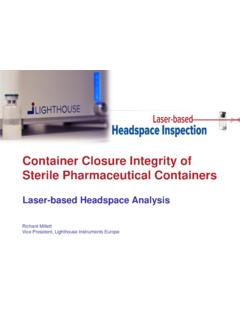
4 Benchtop systems are used in formulation, packaging, and process development as well as for QC activities. The robustness and easy operation of the platforms allow for at-line or automat-ed in-line implementation in the Production environment. The rapid non-destructive nature of the measurement allows for imme-diate feedback to the filling process, 100% inspection of containers, and there is no dis-posal of destroyed product. The patented LIGHTHOUSE platforms utilize a high sensitivity detection technique known as Frequency Modulation Spectroscopy (FMS). Light from a near-infrared semiconductor laser is tuned to match the internal vibration-al frequency of the oxygen molecule. Measur-ing the absorption of the laser light after it Figure 1. The LIGHTHOUSE Headspace Oxygen Inspection systems. LIGHTHOUSEThe Science of Pharmaceutical Manufacturing2passes through the syringe headspace allows for the determination of the headspace oxy-gen concentration.
5 Sophisticated modula-tion techniques are applied to the output of the diode laser and to the signal processing, making the method ten thousand times more sensitive than methods based on first order radiation absorption such as key parameter for making good headspace oxygen measurements in pre-filled syringes is the size of available headspace. Because of the difficulties in controlling and measuring headspace oxygen levels in syringes with older filling line technology and analytical methods, a standard approach for filling oxy-gen-sensitive product has been to minimize the syringe headspace as much as possible. Vacuum methods for stoppering syringes minimize the headspace volume to a small bubble of air, therefore minimizing the amount of oxygen in contact with the prod-uct. The disadvantage of this approach is that it is impossible to actually measure the oxy-gen levels to prove and validate that the pro-cess is being controlled to specification for stability of the product.
6 In the past few years, filling line technology has progressed to the point that lines for pre-filled syringes are delivered with purging systems that can con-sistently purge the syringe headspace to oxy-LIGHTHOUSEThe Science of Pharmaceutical ManufacturingApplication Note 1043 Laser diodeContainer(Tubing, Molded, Clear, Amber)DetectorFigure 2. The LIGHTHOUSE Laser-based Headspace Inspection MethodLIGHTHOUSEThe Science of Pharmaceutical ManufacturingSTND20%8%4%2%1%0% headspaceSTND20%8%4%2%1%0% headspaceTable 1. Measurements on syringe oxygen standards having a headspace of 12mmTable 2. Measurements on syringe oxygen standards having a headspace of 2mmgen levels < 5%. Nitrogen purging needles are used to purge the syringe before and during filling as well as at stoppering to achieve low levels of oxygen. Filling in an isolator that is also overlayed with nitrogen allows the fill-ing and purging process to reach headspace oxygen levels down to 2%.
7 To achieve consis-tent, controllable purging, these filling lines usually stopper the syringes with headspace volumes having heights of 3 to 10 mm between the stopper and the liquid study was done to investigate the perfor-mance of the LIGHTHOUSE FMS-Oxygen Head-space Analyzer as a function of syringe headspace volume. A standard 1 ml glass syringe with a diameter of 8 mm was used for the experiment. To manufacture certified oxygen standards, empty syringes were evac-uated and then backfilled with certified gas mixtures having oxygen contents of 0, 1, 2, 4, 8, and 20% oxygen. The syringes were then flame-sealed to make NIST traceable syringe standards at known oxygen levels. Masks were made having slits of different sizes rang-ing from 2 to 12 mm. The masks were placed over the oxygen standards to simulate head-space volumes having heights of 2 to 12 mm. Each standard was then measured ten times with each mask to characterize the perfor-mance of the oxygen analyzer as a function of headspace size at the different levels of oxy-gen.
8 The results for the 12 mm and 2 mm masks are show in Tables 1 & 2 and show that LIGHTHOUSEThe Science of Pharmaceutical ManufacturingApplication Note 1044 LIGHTHOUSEThe Science of Pharmaceutical Manufacturingoxygen analysis can be performed even for a syringe headspace as small as 2 conclusion, recent advances enable the possibility to quantitatively define and con-trol the oxygen levels for product being filled in syringes. Key advantages to the laser-based headspace oxygen analysis method are the fact that the measurement is both rapid and non-destructive. A single sample can be non-destructively measured multiple times sav-ing valuable product. The method itself is rapid and straightforward the headspace system operator needs no special expertise to run the equipment and perform headspace oxygen of rapid non-destructive headspace oxygen analysis in pre-filled syringesThe ability to make headspace oxygen mea-surements in pre-filled syringes means that the stability of oxygen-sensitive product in syringes, and the quality of the syringe filling process with respect to adequate purging, can be efficiently characterized and validated.
9 It is also possible to use the headspace oxygen measurement to perform container closure LIGHTHOUSEThe Science of Pharmaceutical ManufacturingApplication Note 1045 integrity testing of pre-filled syringes that have a purged oxygen monitoringMaking multiple measurements on the same sample is especially advantageous when per-forming stability studies to determine the oxygen-sensitivity of a formulation. Figure 3 shows the results of a simple experiment per-formed with two common antioxidant for-mulations, sodium ascorbate and ascorbic acid. Three samples of each formulation were sealed under a headspace of air. The head-space oxygen levels were then measured and monitored over a period of ten days. The results show how the laser-based headspace method enables the determination of the full oxidation curve for these two formulations. The rapid non-destructive nature of the meth-od required a total of only six samples (three of each formulation).
10 The total time required for the sixty measurements (one measure-ment per sample over ten days) was less than ten minutes. These results demonstrate the efficiency of stability studies using laser-based headspace analysis as the savings in material and time are significant when com-LIGHTHOUSEThe Science of Pharmaceutical ManufacturingLIGHTHOUSEThe Science of Pharmaceutical Manufacturingpared to doing the same study using tradi-tional destructive methods for oxygen the oxygen specification of a formula-tion has been determined, a filling process must be designed and optimized to ensure that headspace oxygen levels are kept below specification. Optimizing and validating the filling and purging process with respect to achieved headspace oxygen levels can be a time-consuming exercise when using tradi-tional headspace oxygen analysis methods. These are slow and require being set up in an analytical laboratory instead of at-line in the filling area.