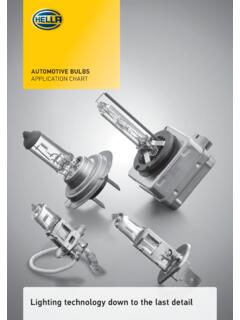
Transcription of LIGHTING THE FUTURE STANDARD AND HIGH …
1 LIGHTING THE FUTURESTANDARD AND HIGH PERFORMANCEAUTOMOTIVE HALOGEN BULBSP roduct / Technical InformationHELLA has been setting innovative milestones and is inextricably linked to the development of the technology is one of our core busi-ness areas and the company stands proud as a recognised worldwide leader in this field. HELLA represents not only innovation but outstanding quality, intelligent design and LIGHTING performance - all crucial safety factors when considering the wide product range on offer. HELLA, a brand that offers so much more. A vision of the futureHELLA BULBSS tandard and High Performance3 CONTENTSLIGHT SOURCESB asic LIGHTING termsFilament and halogen bulbsFunctioningLight sourcesFilament bulbStandard halogen bulbsMain components of halogen bulbsCyclic process inside a halogen bulbInfluencing factors on a bulbHigh Intensity Discharge bulbs (HID)FuntioningMain components of High Intensity Discharge bulbs Halogen / Xenon technology comparisionColour temperatureLife expectancy of a bulbReplacement and installationTested qualityBULBS SUMMARY - PRODUCT RANGEH alogen STANDARD bulbsMiniature bulbs High Intensity Discharge bulbs (HID)HIGH PERFORMANCE automotive BULBSLong LifeNight Vision +Platinum +50 Daymaker +80 Xenon BlueHigh Performance Bulb range45678910111214151920222324252627 HELLA HIGH PERFORMANCE BULBSLIGHT SOURCESS ight is the most important sense for safety in road traffic.
2 This can be impaired under certain circumstances, at twilight, in adverse weather conditions, by soiled windscreens etc. Therefore, the risk of an accident is comparatively high under such driving conditions. Dear customer:This HELLA STANDARD and High Performance bulbs brochure, provides a technical specification overview. We have also included specific technical reference applicable to our STANDARD and high performance bulb covers a wide range of applications for all kinds of vehicles; passenger cars, trucks, special purpose vehicles and motorbikes. HELLA s vast range includes headlights, sundry lights, interior LIGHTING , classical halogen light as well as xe-non light and all available at attractive trust you will find this brochure informative and enhance your understanding of how HELLA STANDARD and High Performance bulbs HELLA AutomotiveSouth Africa TeamThe changing and continually increasing mobility and traffic density linked to this represent a further potential hazard.
3 To meet these challenges successfully, work is continually being done on improving existing LIGHTING systems as well as develo-ping new technical LIGHTING SOURCES BASIC LIGHTING TERMSHere is a summary of the most important basic terms in LIGHTING technology and the respective units of measure for bulb and light flux Unit: Lumen [lm]Luminous flux F is the term used todescribe the complete light outputradiated from a light output Unit: Lumen per Watt [lm/W]Light output h specifies the rate of efficiency with which theconsumed electrical power is transformed into sourcesLight sources are radiators of temperatures which produce light through heat energy. This means the more strongly a light source is heated up, the higher its luminous intensity will be. The low efficiency (8 % light radiation) only allows a relatively low light output in comparison with gas discharge lamps (28 % light radiation).
4 Recently, LEDs have started to be used as light source in front intensity IUnit: Candela [cd]Part of the luminous flux which radiatesin a certain EUnit: Lux [lx]Illuminance E specifies the ratio of theimpinging luminous flux to theilluminated surface. Illuminance is 1 lxwhen a luminous flux of 1 lm impinges anarea of 1 LUnit: Candela per square metre [cd/m2]Luminance L is the impression ofbrightness the eye has from a luminousor illuminated SourcesHELLA automotive BULBSAs a technological leader in the field of intelligent light distribution, (be it halogen, xenon or full-LED headlights) and as a partner to renowned international vehicle manufacturers, HELLA always fulfills the highest expectations in product quality and THE FUTURESTANDARD automotive HALOGEN BULBSA bulbs range benchmark is: top technology with no compromise in quality, founded on rigorous testing.
5 This means optimum visibility thanks to top light quality and minimum failure rates thanks to durable and long lasting products. FUNCTIONINGThe LIGHTING system of a motor vehicle consists of LIGHTING and signalling devices mounted or integrated to the front, sides, rear, and in some cases the top of the motor vehicle. The purpose of this system is to provide illumination for the driver to operate the vehicle safely a er dark, increase vehicle visibility, display information about the vehicle s presence, position, size, direction of travel and driver s intentions regarding direction and speed of bulb can be considered as a replace-ment part with a limited service life. Yet the bulb is part of the LIGHTING system. It is an active component of a unit where all the elements should be perfectly matched to one another. LIGHT SOURCESL ight sources are thermal radiators which convert heat energy into light.
6 This means that the hotter a light source is, the higher the luminous intensity. FILAMENT BULBF ilament bulbs (vacuum bulbs ) are thermal radiators and the supply of electric energy makes a tungsten filament glow. Generally, the light output of a STANDARD bulb is low. Additionally, evaporated tungsten particles considerably blacken the bulb (see photo-graph below) and reduce all LIGHTING values as well as service filament bulb (le ) andold blacken filament bulb (right). STANDARD halogen bulb, type H4 LIGHT SOURCESFILAMENT AND HALOGEN BULBSSTANDARD HALOGEN BULBSBy adding small amounts of halogen atoms such as iodine, the blackening of the bulb is reduced. The so-called cyclic process enables operation of halogen bulbs at higher temperatures and thus with improved efficiency with the same useful are basically two different typesof halogen bulbs available. The types H1, H3, H7, H9, H11, HB3 and HB4 only have one filament.
7 They are used for low beam and high beam. In comparison to H1 bulbs , H7 bulbs have a higher luminance, lower power consumption and better light quality. The second type is the H4 bulb with two filaments, one for low beam and one for high beam. h beam. CYCLIC PROCESS INSIDE A HALOGEN bulbs upply of electronic energy makes the filament glow and metal evaporates off the filament. A halogen filling (iodine or bromine) inside the bulb lets the filament temperature rise to near the melting point of the tungsten (around 3 400 C) and this causes the high light output. In the immediate vicinity of the hot bulb wall, the evaporated tungsten combines with the filling gas (tungsten halogenide) to form a gas which is , once the gas gets back near the filament, it disintegrates due to the high filament temperature and forms an even tungsten layer. For the cyclic process to stop, the outer temperature of the bulb must be 300 C.
8 The bulb made of quartz glass must closely enclose the advantage is that a higher filling pressure can be used to counteract the evaporation of the tungsten. The gas composition in the bulb is also a major factor controlling the light output. Inclusion of a small amount of a noble gas such as xenon reduces the heat 7 Filament forhigh beamFilament forlow beamAntiglare capGas compositionand adapted pressureShellLampUV cut quartz glasswith optical coatingBaseTerminalStainless steel H4 Type Bulbtransfer away from the filament. However, despite the regeneration process inside the bulb, the tungsten filament is slowly consumed and thus service life is FACTORS ON A BULBN egative influencing factors Mechanical stress due to impacts and vibration High temperatures Switching-on process Glitches and excessive on-board voltage High luminance due to extreme filament densityPositive influencing factors Filling pressure Filling gasCross-section of temperature zones Cross-section through the temperature ( C) zones of a halogen view - Lamp700 1 000 1 300 1 500 3 000 500 Tungsten filamentHalogen filling (iodine or bromine)Evaporated tungstenTungsten halogenideTungsten deposits12345 LIGHT SOURCES HALOGEN BULB - MAIN COMPONENTSL ight SourcesThe filament for low beam is fitted with a shell.
9 This has the purpose of covering the dazzling share of the light and producing the cut-off SOURCESHIGH INTENSITY DISCHARGE bulbs (HID)FUNCTIONINGHigh-intensity discharge (HID) headlamps use the physical principle of electric discharge and produce light with an electric arc rather than a glowing filament. The high intensity of the arc comes from metallic salts that are vaporized within the arc chamber. An ignition voltage (up to 23 kV in the case of 3rd generation electronic ballasts) ionises the gas between the bulb s electrodes and makes the bulb glow based on an the controlled supply of an alter-nating current (around 400 Hz) the liquid and solid matter in the discharge chamber evaporate due to the high temperatures. To prevent destruction of the lamp through uncontrolled increases in current, the cur-rent is limited by a ballast. Once the full light output has been reached, an operating voltage (not the ignition voltage) of only 85 V is necessary to keep up the physical HID lamps were introduced in 1991.
10 They are commonly called xenon headlamps , though they are actually metal halide lamps that contain xenon xenon gas allows the lamps to pro-duce minimally adequate light imme-diately upon power up, and accelerates the lamps run-up time. However the full intensity is reached 20 to 30 seconds later once the salts of sodium and scandium are vaporized by the heat of the xenon arc. HID bulbs produce more light for a given level of power consumption than ordinary tungsten and tungsten-halogen of the increased amounts of light available from HID bulbs relative to halo-gen bulbs , HID headlamps producing a given beam pattern can be made smaller than halogen headlamps producing a comparable beam , the larger size can be re-tained, in which case the xenon headlamp can produce a more robust beam lamp envelope is small and the arc spans only a few outer hard glass tube blocks the escape of ultraviolet radiation that would tend to damage plastic headlamp pole withceramic tubeCrownOuter bulbDischarge chamberwith fillingTungsten electrodesBaseCollar500 Luminance cd / cm21000 2000 40006000 10000 Contact ringFastening camsD2R Bulb (HID)HELLA automotive BULBSC omparison between filament bulb (halogen) / light arc gas discharge lamp (xenon)