Example: stock market
Logistic Regression in Stata
Logistic Regression in STATA The logistic regression programs in STATA use maximum likelihood estimation to generate the logit (the logistic regression coefficient, which corresponds to the natural log of the OR for each one-unit increase in the level of the regressor variable). The resulting ORs are maximum-likelihood estimates
Tags:
Information
Domain:
Source:
Link to this page:
Related documents

Lecture 13 Estimation and hypothesis testing for logistic ...
courses.washington.edu• Review of maximum likelihood estimation • Maximum likelihood estimation for logistic regression • Testing in logistic regression BIOST 515, Lecture 13 1. Maximum likelihood estimation Let’s begin with an illustration from a simple bernoulli case. In this case, we observe independent binary responses, and

Conditional Logistic Regression - NCSS
ncss-wpengine.netdna-ssl.comLogistic regression analysis studies the association between a binary dependent variable and a set of independent (explanatory) variables using a logit model (see Logistic Regression). ... Maximum Likelihood Estimation The estimation procedure used in NCSS makes use of the relationship between CLR and Cox Regression. This

Title stata.com logit — Logistic regression, reporting ...
www.stata.comAlso see[R] logistic; logistic displays estimates as odds ratios. Many users prefer the logistic command to logit. Results are the same regardless of which you use—both are the maximum-likelihood estimator. Several auxiliary commands that can be run after logit, probit, or logistic estimation are described in[R] logistic postestimation. Quick ...
Lecture 10: Logistical Regression II— Multinomial Data
www.columbia.eduAbout Logistic Regression It uses a maximum likelihood estimation rather than the least squares estimation used in traditional multiple regression. The general form of the distribution is assumed. Starting values of the estimated parameters are used and the likelihood that the sample came from a population with those parameters is computed.
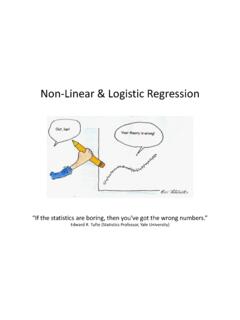
Non-Linear & Logistic Regression
sites.ualberta.caparameters – we are using maximum likelihood estimation • We can however calculate a pseudo R2 - Lots of options on how to do this, but the best for logistic regression appears to be McFadden's calculation Logistic Regression (a.k.a logit …

Maximum Likelihood Estimation of Logistic Regression ...
czep.netMaximum Likelihood Estimation of Logistic Regression Models 2 corresponding parameters, generalized linear models equate the linear com-ponent to some function of the probability of a given outcome on the de-pendent variable. In logistic regression, that function is the logit transform: the natural logarithm of the odds that some event will occur.
Lecture 15 Introduction to Survival Analysis
www.stat.columbia.eduEstimation for parametric S(t) We will use maximum likelihood estimation to estimate the unknown parameters of the parametric distributions. • If Y i is uncensored, the ith subject contributes f(Y i) to the likelihood • If Y i is censored, the ith subject contributes Pr(y > Y i) to the likelihood. The joint likelihood for all n subjects is ...

Logistic Regression - Stanford University
web.stanford.eduLogistic regression is a classification algorithm1 that works by trying to learn a function that approximates P(YjX). ... estimation(MLE).Assuchwearegoingtohavetwosteps:(1)writethelog-likelihoodfunction ... In this section we provide the mathematical derivations for the gradient of log-likelihood. The
Title stata.com lrtest — Likelihood-ratio test after ...
www.stata.comlrtest— Likelihood-ratio test after estimation 3 Remarks are presented under the following headings: Nested models Composite models Nested models lrtestmay be used with any estimation command that reports a log likelihood, including heckman, logit, poisson, stcox, and streg. You must check that one of the model specifications implies a

An Introduction to Logistic and Probit Regression Models
www.liberalarts.utexas.eduInterpretation • Logistic Regression • Log odds • Interpretation: Among BA earners, having a parent whose highest degree is a BA degree versus a 2-year degree or less increases the log odds by 0.477. • However, we can easily transform this into odds ratios by exponentiating the coefficients: exp(0.477)=1.61