Transcription of ‘Malnutrition Universal Screening Tool’ MAG - …
1 MUST is a five-step Screening tool to identify adults, who are malnourished, at risk of malnutrition (undernutrition), or obese. It also includes management guidelines which can be used to developa care plan. It is for use in hospitals, community and other care settings and can be usedby all care guide contains: A flow chart showing the 5 steps to use for Screening and management BMI chart Weight loss tables Alternative measurements when BMI cannot be obtained by measuring weight and refer to The MUST Explanatory Booklet for more information when weight and height cannot be measured, and when Screening patient groups in which extra care in interpretation is needed ( those with fluid disturbances, plaster casts, amputations, critical illness and pregnant or lactating women).
2 The booklet can also be used for training. See The MUST Report for supporting evidence. Please note that MUST has not been designed to detect deficiencies or excessive intakes of vitamins and minerals and is of use only in 5 MUST Steps Step 1 Measure height and weight to get a BMI score using chart provided. If unable to obtainheight and weight, use the alternative procedures shown in this 2 Note percentage unplanned weight loss and score using tables 3 Establish acute disease effect and 4 Add scores from steps 1, 2 and 3 together to obtain overall risk of 5 Use management guidelines and/or local policy to develop care Advisory GroupA Standing Committee of BAPENMAGMUST malnutrition Universal Screening tool Alternative measurements.
3 Instructions and tables MUST BAPEN is registered charity number 1023927 BAPENStep 1 BMI score (& BMI)Height (feet and inches)Weight (stones and pounds)Weight (kg)Height (m)Note : The black lines denote the exact cut off points (30,20 and kg/m2), figures on the chart have been rounded to the nearest whole number. BAPENS core 0(obese)Weight (stones and pounds)Score 0 Weight (stones and pounds)Score 1), figures on the chart have been rounded to the nearest whole number. BAPENS core 24'9 4'10 4'115'05'0 5'1 5'25'35'45'4 5'5 5'65'75'7 5'8 5'9 5'105'115'11 6'0 6'16'26'36'3 6'4.
4 1 BMI score+Step 2 Weight loss scoreStep 3 Acute disease effect score+0 Low Risk1 Medium Risk2 or moreHigh RiskStep 5 Management guidelinesObserve Document dietary intake for 3 days If adequate little concern and repeat Screening Hospital weekly Care Home at least monthly Community at least every 2-3 months If inadequate clinical concern follow local policy, set goals, improve and increase overall nutritional intake, monitor and review care plan regularlyTreat* Refer to dietitian, Nutritional Support Team or implement local policy Set goals, improve and increase overall nutritional intake Monitor and review care plan Hospital weeklyCare Home monthly Community monthly* Unless detrimental or no benefit is expected from nutritional support imminent death.
5 If unable to obtain height and weight, see reverse for alternative measurements and use of subjective criteriaAcute disease effect is unlikely to apply outside hospital. See MUST Explanatory Booklet for further informationStep 4 Overall risk of malnutritionAdd Scores together to calculate overall risk of malnutritionScore 0 Low Risk Score 1 Medium Risk Score 2 or more High RiskRe-assess subjects identified at risk as they move through care settingsSee The MUST Explanatory Booklet for further details and The MUST Report for supporting evidence.
6 All risk categories: Treat underlying condition and provide help and advice on food choices, eating and drinking when necessary. Record malnutrition risk category. Record need for special diets and follow local : Record presence of obesity. For those with underlying conditions, these are generally controlled before the treatment of kg/m2 Score>20 (>30 Obese) = 20 = 1< = 2 % Score <5 = 0 5 -10 = 1 >10 = 2 Unplanned weight loss in past 3-6 monthsIf patient is acutely ill and there has been or is likelyto be no nutritionalintake for >5 days Score 2 Routine clinical care Repeat Screening Hospital weekly Care Homes monthly Community annually for special groups those >75 yrsRe-assess subjects identified at risk as they move through care settingsSee The MUST Explanatory Booklet Explanatory Booklet All risk categories.
7 Treat underlying condition and provide help and advice on food choices, eating and drinking when malnutrition risk need for special diets and follow local 2 BAPENStep 2 Weight loss score BAPENS core 0 Wt loss < 5%Score 1 Wt loss 5 - 10%Score 2 Wt loss > 10%Weight loss in last 3 to 6 monthskgLess than (kg)Between (kg)More than (kg) - - - - - - - - - - - - - - - - - - - - - - - - - - - - - - - - - - - 0 Wt loss < 5%Score 1 Wt loss 5 - 10%Score 2 Wt loss > 10%Weight loss in last 3 to 6 monthskgLess than (kg)Between (kg)More than (kg)
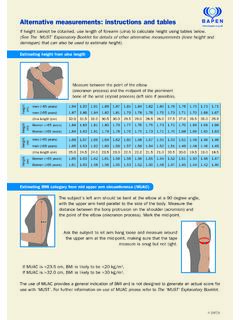
8 - - - - - - - - - - - - - - - - - - - - - - - - - - - - - - - - - - - weightStep 1: BMI (body mass index)If height cannot be measured Use recently documented or self-reported height (if reliable and realistic). If the subject does not know or is unable to report their height, use one of the alternative measurements to estimate height (ulna, knee height or demispan).
9 Step 2: Recent unplanned weight lossIf recent weight loss cannot be calculated, use self-reported weight loss (if reliable and realistic).Subjective criteriaIf height, weight or BMI cannot be obtained, the following criteria which relate to them can assist your professional judgement of the subject s nutritional risk category. Please note, these criteria should be used collectively not separately as alternatives to steps 1 and 2 of MUST and are not designed to assign a score. Mid upper arm circumference (MUAC) may be used to estimate BMI category in order to support your overall impression of the subject s nutritional BMI Clinical impression thin, acceptable weight, overweight.
10 Obvious wasting (very thin) and obesity(very overweight) can also be Unplanned weight loss Clothes and/or jewellery have become loose fitting (weight loss). History of decreased food intake, reduced appetite or swallowing problems over 3-6 months and underlying disease or psycho-social/physical disabilities likely to cause weight Acute disease effect Acutely ill and no nutritional intake or likelihood of no intake for more than 5 details on taking alternative measurements, special circumstances and subjective criteria can be found in The MUST Explanatory Booklet.