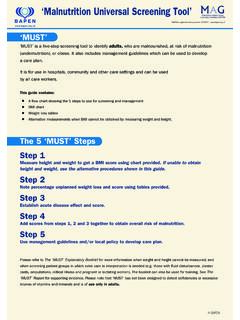
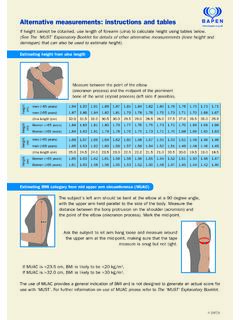
Transcription of THE‘MUST’REPORT - BAPEN
1 The MUST ReportTHE MUST REPORTN utritional screening of adults: a multidisciplinary responsibilityDevelopment and use of the Malnutrition Universal Screening Tool ( MUST ) for adults Professor Marinos Elia Chairman of MAG and EditorAdvancing Clinical NutritionReg. Charity No: 1023927 THE MUST REPORTN utritional screening of adults: a multidisciplinary responsibilityDevelopment and use of the Malnutrition Universal Screening Tool ( MUST ) for adults Professor Marinos Elia Chairman of MAG and EditorThe British Association for parenteral and Enteral nutrition BAPEN is a multi-professional association and registered charity established in1992. Its membership is drawn from doctors, dietitians, nurses, patients,pharmacists and from the health policy, industry, public health and researchsectors. The Malnutrition Advisory Group (MAG) is a Standing Committee ofBAPEN.
2 For membership details, contact the BAPEN office or log on to the BAPEN 's principal functions are to: Enhance understanding and management of malnutrition Establish a clinical governance framework to underpin the nutritional management of all patients Enhance knowledge and skills in clinical nutrition through education and training Communicate the benefits of clinical and cost-effective optimal nutritional care to all healthcare professionals, policy-makers and the public Fund a multi-professional research programme BAPEN Office, Secure Hold Business CentreStudley Road, Redditch, Worcs B98 7 LGTel: MUST is supported by the British Dietetic Association, The Royal College ofNursing and the Registered Nursing Home Association BAPEN 2003 ISBN 1 899467 70 XPublished by BAPEN , registered charity number 1023927. All rights reserved.
3 This document may be photocopied for dissemination and training purposes as long as the source is credited and recognised. Copy may be reproduced for thepurposes of publicity and promotion. Written permission must be sought from BAPEN if substantial reproduction or adaptation is required. Publications available from BAPEN :APositive Approach to nutrition as Treatment (Kings Fund Centre Report)ISBN 1 857170 16 5 (Published January 1992)Organisation of Nutritional Support in Hospitals ISBN 1 899467 00 9 (Published November 1994)Home parenteral nutrition - Quality Criteria for Clinical Services and the Supply ofNutrient Fluids and EquipmentISBN 1 899467 15 7 (Published June 1995)Standards and Guidelines for Nutritional Support of Patients in HospitalsISBN 1 899467 10 6 (Published April 1996)Current Perspectives on parenteral nutrition in AdultsISBN 1 899467 20 3 (Published August 1996)Ethical and Legal Aspects of Clinical Hydration and Nutritional SupportISBN - 1 899467 25 4 (Published 1998)Current Perspectives on Enteral nutrition in AdultsISBN 1 899467 30 0 (Published March 1999)Hospital Food as TreatmentISBN 1 899467 35 1 (Published May 1999)
4 Clinical NutritionVolume 18 Supplement 2. Benefits of Nutritional Support in Hospitals and the CommunityISSN 0261-5614 (Published Aug 1999)Current Perspectives on Paediatric parenteral NutritionISBN 1 899467 40 8 (Published February 2000)BANS - Trends in Artificial nutrition Support in the UK During 1996 - 2000 ISBN 1 899467 50 5 (Published September 2001)Guidelines for the Detection and Management of MalnutritionISBN 1 899467 45 9 (Published 2000)Current Aspects of Artificial nutrition Support in the UK. ISBN 1 899467 60 2 (Published November 2002) Malnutrition Universal Screening Tool ( MUST )ISBN 1 899467 85 8 (Published November 2003)The MUST Explanatory Booklet: AGuide to the Malnutrition Universal Screening Tool ( MUST ) for AdultsISBN 1 899467 65 3 (Published November 2003)The MUST Report: Nutritional Screening of Adults - a multidisciplinary responsibilityISBN 1 899467 70 X (Published November 2003)Trends in Artificial nutrition Support in the UK between 1996 and 2002 ISBN 1 899467 70 0 (Published December 2003) BAPEN Office, Secure Hold Business Centre, Studley Road, Redditch, Worcs B98 7LG.
5 Tel: 01527-457850 Key , used here to mean under- nutrition , affects at least 2 million peoplein the UK, detrimentally affecting their health, wellbeing, and ability to is under-recognised and under-treated. It leads to disease, delaysrecovery, increases visits to GPand increases the frequency and length of hospital care would improve with adoption of a screening tool which coulddetect malnutrition and guide action in all care MUST can detect over- nutrition (overweight and obesity) as well as under- nutrition and is linked to a flexible care plan, which varies according tohealthcare setting, patient group, and local a tool has been developed by the Malnutrition Advisory Group (MAG) ofBAPEN. It is called the Malnutrition Universal Screening Tool ( MUST ) toindicate that it can be applied to all types of adult patients in all care MUST is valid, reliable, and easy to use, and, with cautious interpretation, canbe applied to all adult patients, even those who cannot have their weight orheight measured, who have fluid disturbances, amputations, plaster casts, or whoare pregnant and MUST has been made user friendly through extensive field testing by a widerange of professionals in different health care MUST promotes multidisciplinary care and responsibility, with consequentimprovements in clinical MUST could be appropriately used to implement the nutritional screening thatis recommended or required by key initiatives in the UK, such as the NationalFramework for Older people, Essence of Care, Care Homes for Older People(Care Standards Act)
6 , and Food, Fluid and Nutritional Care in Hospitals(Scotland).10. MUST would be most effective if deployed in a healthcare system that prioritised nutrition strategies, training, and MUST ReportCONTENTSE xecutive summary1A. Nutritional screening ..1B. Validity, reliability and practicality of using the Malnutrition Universal Screening Tool ( MUST ) ..3C. Guidance on undertaking measurements and using MUST ..8 .. need for nutritional screening .. 13 : barriers to implementing effective nutritional screening programmes .. : criteria for screening ..23 for obesity in adults .. screening during pregnancy and lactation .. screening in children .. and training .. , reliability and practicality of using the MUST and aims .. Development of MUST from the original community tool .. of MUST.
7 And internal consistency of MUST .. aspects of MUST .. of evidence for the components of MUST and associated care plans ..83 1: Further evidence based considerations ..83 2: Kappa (Cohen s kappa) .. on undertaking and interpreting measurements obtained using MUST ..96 measurements .. of BMI, weight loss and acute disease categories .. overall risk of malnutrition .. Training and competence .. (Malnutrition Advisory Group) Committee: membership and acknowledgements (Malnutrition Advisory Group) membership .. 124 ..125 F. Review date 127v1 Executive summaryExecutive summaryThis report examines the need to screen for malnutrition in clinical practice, sets outthe criteria that need to be fulfilled, and describes the development and use of the Malnutrition Universal Screening Tool ( MUST ) for adults, which takes thesecriteria into account.
8 The tool primarily aims to identify risk of poor protein-energystatus, rather than status of individual nutrients. It is linked to a care plan, whichcan vary according to healthcare setting, local policies, and resources. Guidance onundertaking measurements using MUST is : Nutritional screening 1. Malnutrition (undernutrition) and overweight/obesity as majorclinical andpublic health problems in the Malnutrition (undernutrition):Underweight (BMI <20 kg/m2) is typicallypresent in 10-40% of patients admitted to hospital, but malnutrition risk, establishedusing the MUST , is even greater. In the general population, it is estimated that onein seven subjects aged 65 years and over has a medium or high risk of malnutrition,but the prevalence is higher in subjects who are institutionalised than those who arefree living ( living in their own homes).
9 Malnutrition predisposes to disease,delays recovery from illness, and adversely affects body function, well-being andclinical outcome. There is no formal economic evaluation of disease-relatedmalnutrition but it is estimated that the cost is greater than that of obesity. Obesity:The incidence of obesity (body mass index (BMI) >30 kg/m2) isincreasing in both adults and children, and currently affects one in five adults. Itpredisposes to many health problems, including heart disease, diabetes, high bloodpressure and osteoarthritis, with an estimated annual cost to the economy of over 2billion, of which billion represents a direct cost to the National Health Malnutrition (undernutrition): under-recognised and undertreated Malnutrition is often unrecognised and untreated in hospitals (both in-patients andout-patients), nursing homes and in the community, causing concern among a widerange of health professionals, national organisations and colleges, UK governmentdepartments, and the Council of Europe.
10 Despite this, there are no nationalguidelines for commissioners and planners of Inadequate nutritional care Nutritional care is frequently inadequate because of diffuseness of responsibility,lack of an integrated infrastructure for dealing with nutritional problems within andbetween different healthcare settings, poor education, and lack of consistent criteriato identify and treat malnutrition. There are well over 50 published nutritionscreening tools and many more unpublished tools in clinical use, taking anythingfrom two minutes to over thirthy minutes to complete. These differ in the criteriathey use, the weighting factors applied to the criteria, the scoring systems, theintended users (who are sometimes not specified), and the tool s practicalacceptability in routine clinical practice. Many have not been tested for reliability orvalidity, and many lack an evidence base.