Transcription of Massive Transfusion Protocol - SurgicalCriticalCare.net
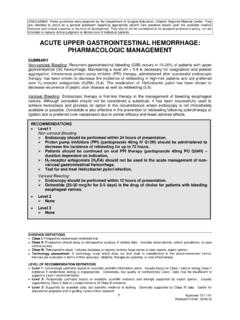
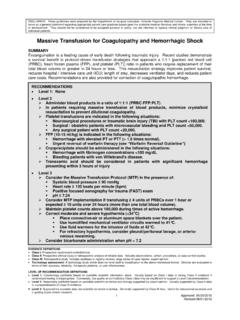
1 DISCLAIMER: These guidelines were prepared by the Department of Surgical Education, Orlando Regional Medical Center. They are intended to serve as a general statement regarding appropriate patient care practices based upon the available medical literature and cli nical expertise at the time of development. They should not be considered to be accepted Protocol or policy, nor are intended to replace clinical judgment or dictate care of individual patients. Massive Transfusion FOR COAGULOPATHY AND. HEMORRHAGIC SHOCK. SUMMARY. Exsanguination is a leading cause of early death following traumatic injury. Protocol -driven Transfusion strategies that approach a 1:1:1 [packed red blood cell (PRBC), fresh frozen plasma (FFP), and platelet (PLT)] ratio in patients who require Massive Transfusion improve patient survival, reduce hospital /.
2 Intensive care unit (ICU) length of stay, decrease ventilator days, and reduce patient care costs. RECOMMENDATIONS. Level 1: None Level 2. Administer blood products in a ratio of 1:1:1 (PRBC:FFP:PLT). In patients requiring Massive Transfusion of blood products, minimize crystalloid resuscitation to prevent dilutional coagulopathy. Platelet transfusions are indicated in the following situations: Neurosurgical procedures or traumatic brain injury (TBI) with PLT count <100,000. Surgical / obstetric patients with microvascular bleeding and PLT count <50,000. Any surgical patient with PLT count <20,000. FFP (10-15 ml/kg) is indicated in the following situations: Hemorrhage with elevated PT or PTT (> times normal).
3 Urgent reversal of warfarin therapy (see Warfarin Reversal Guideline ). Cryoprecipitate should be administered in the following situations: Hemorrhage with fibrinogen concentrations <100 mg/dL. Bleeding patients with von Willebrand's disease. Tranexamic acid should be considered in patients with significant hemorrhage Initial dose: 1 gram IV over 10 minutes A second gram of TXA (either bolus or continuous infusion over 8 hours) may be considered in the presence of ongoing transfusions or hyperfibrinolysis Level 3. Consider the Massive Transfusion Protocol (MTP) in the presence of hemorrhage and Systolic blood pressure 90 mmHg Heart rate 120 beats per minute (bpm). Positive focused sonography for trauma (FAST) exam pH Consider MTP implementation if transfusing 4 units of PRBCs over 1 hour or expected Transfusion of 10 units over 24 hours (more than one total blood volume).
4 Maintain platelet counts above 100,000 during times of active hemorrhage Correct moderate and severe hypothermia (<34 oC) using convective air blankets, humidified heated ventilator circuits, and warmed fluid infusions Ionized calcium (iCa) should be monitored at baseline and after the completion of each MTP cooler (6 units PRBC, 6 units FFP, 1 apheresis unit PLT). Calcium chloride is the preferred calcium salt form for replacement during MTP. 3 grams calcium chloride IV should be given after completing each MTP cooler EVIDENCE DEFINITIONS. Class I: Prospective randomized controlled trial. Class II: Prospective clinical study or retrospective analysis of reliable data.
5 Includes observational, cohort, prevalence, or case control studies. Class III: Retrospective study. Includes database or registry reviews, large series of case reports, expert opinion. Technology assessment: A technology study which does not lend itself to classification in the above-mentioned format. Devices are evaluated in terms of their accuracy, reliability, therapeutic potential, or cost effectiveness. LEVEL OF RECOMMENDATION DEFINITIONS. Level 1: Convincingly justifiable based on available scientific information alone. Usually based on Class I data or strong Class II evidence if randomized testing is inappropriate. Conversely, low quality or contradictory Class I data may be insufficient to support a Level I recommendation.
6 Level 2: Reasonably justifiable based on available scientific evidence and strongly supported by expert opinion. Usually supported by Class II data or a preponderance of Class III evidence. Level 3: Supported by available data, but scientific evidence is lacking. Generally supported by Class III data. Useful for educational purposes and in guiding future clinical research. 1 Approved 05/25/2010. Revised 08/01/2012, 11/2/2017. INTRODUCTION. Patient mortality following traumatic injury has decreased over the past 30 years due to improved damage control procedures. Mortality rates continue to be elevated during the first hours following trauma center arrival, however, among patients with uncontrolled hemorrhage (1).
7 This continued high mortality rate is attributable to ongoing hemorrhagic shock as a result of the self-perpetuating triad of coagulopathy, acidosis, and hypothermia (2). Measures to stop this process have long been a part of trauma resuscitation, including hypothermia management, surgical control of ongoing bleeding, and treatment of coagulopathy with blood products. In the past decade, there has been a progressive trend towards increased use of blood products during trauma resuscitation, including plasma, platelets, and cryoprecipitate, due to the military experience with whole blood resuscitation in soldiers requiring Massive Transfusion . Massive Transfusion is universally accepted as the replacement of a patient's blood volume, or Transfusion of 10 units of PRBCs, over a 24-hour period (3-9).
8 Similar damage control resuscitation is required in approximately 2-5% of civilian trauma. Such early intervention has been demonstrated to translate into a significant improvement in patient outcome (5-9). Damage control resuscitation is designed to treat coagulopathy prior to its clinical manifestation, therefore stopping the self-perpetuating loop of coagulopathic hemorrhage or the deadly triad . The strategy of utilizing higher PRBCs:plasma:platelets ratios is not new and has been shown to have modest improvements in patient mortality (4-6). Most recently, there has been significant interest in protocolization of this Transfusion process. Studies demonstrate improved patient outcome with implementation of a Massive Transfusion Protocol (MTP) when compared to physician/lab driven resuscitation (4,5,8,9).
9 This improved mortality has been attributed to reduced time to first Transfusion of products, thus addressing the fundamental problem of coagulopathy. Riskin et al. have shown that a Protocol -driven process improves communication among departments, improves the availability of and reduces delays in obtaining blood products, and improves patient outcome (5). Additionally, improved outcomes can be attributed to reducing the use of uncrossmatched blood which has been shown to be an independent predictor of mortality (10). Multiple military and civilian trauma studies of Massive Transfusion protocols suggest that a 1:1:1 ratio of PRBC to FFP and platelets is optimal and associated with the best outcomes (4,5,8,11-16).
10 Holcomb et al. suggested that trying to achieve a 1:1:1 ratio is optimal as this will most closely approximate a 1:2 goal PRBC:FFP given delays in treatment (6). As for platelets, most studies suggest that transfusing platelets at a 1:1 ratio with PRBCs and trying to achieve a platelet count of greater than 100,000/dL is most beneficial in stopping the coagulopathic cycle and increasing clot formation (5,6). There are a few studies addressing the need for cryoprecipitate and some suggest that transfusing with adequate amounts of FFP. will obviate the need for cryoprecipitate (Table 1); however, most studies suggest checking fibrinogen levels in patients who continue to demonstrate coagulopathic hemorrhage with maintenance of a level greater than 100 mg/dL (5,11).