Transcription of MATERIAL SAFETY DATA SHEET - Asahimas Chemical
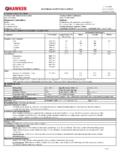
1 MATERIAL SAFETY data SHEET HYDROCHLORIC ACID 33% SECTION 1 Chemical PRODUCT AND COMPANY IDENTIFICATION PRODUCT IDENTIFIER: HYDROCHLORIC ACID 33% SOLUTION RECOMMENDED USAGE: Steel pickling and Scale Removal Ore Refining Hydrolyzing Agent Food Processing Activation of Petroleum Wells Catalyst in Organic Process Removal of Heavy metal from Carbon Black and Activated Carbon Leaching alumina from Crystalline Zeolities Manufacturing of Chlorine Dioxide Water Treatment MANUFACTURER: PT Asahimas Chemical Ds Gunung Sugih, Jalan Raya Anyer Km-122 Cilegon 42447 Banten - Indonesia Tel: +62 254 601252 Fax: +62 254 602027 Contact Department: CVT Department EMERGENCY PHONE NUMBER: +62 254 601252 SECTION 2 HAZARDS IDENTIFICATION GHS Classification.
2 Health Environmental Physical Acute Toxicity - Category 3 Eye Corrosion - Category 1A Skin Corrosion - Category 1A Skin Sensitization - Category 1 Mutagenicity - Category 1A Carcinogenicity - Category 1B Reproductive/Developmental - Category 1A Target Organ Toxicity (Repeated) - Category 1 Aquatic Toxicity: Acute 1 Chronic 1 Substance which in contact with water emit flammable gasses - Category 1 GHS Label: Symbols: skull and crossbones, corrosion, health hazard Hazard Statements DANGER! EXTREMELY CORROSIVE Fatal if inhaled.
3 Precautionary Statements Causes eye and skin burns Keep container tightly closed. Wear protective gloves and eye/face protection. MATERIAL SAFETY data SHEET HYDROCHLORIC ACID 33% Avoid to swallowed. Causes severe skin burns and eye damage. Can cause blindness, permanent scarring and death. Toxic if swallowed and in contact with skin Suspected of damaging the unborn child. Suspected of causing genetic defects. May cause damage to cardiovascular, respiratory, nervous, and gastrointestinal systems and liver and blood through prolonged or repeated exposure.
4 Harmful to aquatic life. Possible sensitizer. Hygroscopic Store container tightly closed in cool/ well-ventilated place. Wash thoroughly after handling. SECTION 3 COMPOSITION, INFORMATION ON INGREDIENTS CAS# Chemical Name Percent EINECS/ELINCS 7647-01-0 Hydrogen chloride 33 231-595-7 7732-18-5 Water 67 231-791-2 Synonyms: Muriatic acid; Chlorohydric acid; Hydrogen chloride; Spirits of salt Hazard Symbols: C Risk Phrases: 34 SECTION 4 FIRST AID MEASURES INHALATION: Get medical aid immediately.
5 Remove from exposure to fresh air immediately. If breathing is difficult, give oxygen. Do NOT use mouth-to-mouth resuscitation. If breathing has ceased apply artificial respiration using oxygen and a suitable mechanical device such as a bag and a mask. SKIN CONTACT: Get medical aid immediately. Immediately flush skin with plenty of soap and water for at least 15 minutes while removing contaminated clothing and shoes. Wash clothing before reuse. Destroy contaminated shoes. EYE CONTACT: Get medical aid immediately. Do NOT allow victim to rub or keep eyes closed.
6 Extensive irrigation with water is required (at least 30 minutes). SPEEDY ACTION IS CRITICAL! INGESTION: Do NOT induce vomiting. If victim is conscious and alert, give 2-4 cupfuls of milk or water. Never give anything by mouth to an unconscious person. Get medical aid immediately. NOTES TO PHYSICIAN: Do NOT use sodium bicarbonate in an attempt to neutralize the acid. ANTIDOTE: Do NOT use oils or ointments in eye. SECTION 5 FIRE FIGHTING MEASURES - GENERAL INFORMATION: As in any fire, wear a self-contained breathing apparatus in pressure-demand, MSHA/NIOSH (approved or equivalent), and full protective gear.
7 Water runoff can cause environmental damage. Dike and collect water used to fight fire. During a fire, irritating and highly toxic gases may be generated by thermal decomposition or combustion. Not flammable, but reacts with most metals to form flammable hydrogen gas. Use water spray to keep fire-exposed containers cool. Vapors may be heavier than air. They can spread along the ground and collect in low or confined areas. Reaction with water may generate much heat which will increase the concentration of fumes in the air. Containers may explode when heated.
8 - SUITABLE EXTINGUISTING MEDIA: For large fires, use water spray, fog, or alcohol-resistant foam. Substance is non combustible; use agent most appropriate to extinguish surrounding fire. Do NOT get water MATERIAL SAFETY data SHEET HYDROCHLORIC ACID 33% inside containers. Do NOT use straight streams of water. Most foams will react with the MATERIAL and release corrosive/toxic gases. Cool containers with flooding quantities of water until well after fire is out. For small fires, use carbon dioxide (except for cyanides), dry Chemical , dry sand, and alcohol-resistant foam.
9 SECTION 6 ACCIDENTAL RELEASE MEASURES - PERSONAL PRECAUTIONS, PROTECTIVE EQUIPMENT & EMERGENCY PROCEDURES: Use proper personal protective equipment as indicated in Section 8. - METHODS & MATERIALS FOR CONTAINMENT & CLEANING UP SPILLS / LEAKS: Large spills may be neutralized with dilute alkaline solutions of soda ash, or lime. Avoid runoff into storm sewers and ditches which lead to waterways. Clean up spills immediately, observing precautions in the Protective Equipment section. Remove all sources of ignition. Provide ventilation. Do not get water inside containers.
10 A vapor suppressing foam may be used to reduce vapors. Cover with dry earth, dry sand, or other non-combustible MATERIAL followed with plastic SHEET to minimize spreading and contact with water. SECTION 7 HANDLING AND STORAGE - PRECAUTIONS FOR SAFE HANDLING: Wash thoroughly after handling. Remove contaminated clothing and wash before reuse. Use only in a well-ventilated area. Contents may develop pressure upon prolonged storage. Do not breathe dust, vapor, mist, or gas. Do not get in eyes, on skin, or on clothing. Keep container tightly closed.