Transcription of Material Safety Data Sheet Lead(II) nitrate
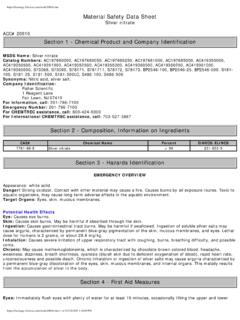
1 Safety data Sheet Lead(II) nitrate ACC# 12660 Section 1 - Chemical Product and Company IdentificationMSDS Name: Lead(II) nitrate Catalog Numbers: AC193320000, AC193320100, AC211560000, AC211560010, AC211560050, AC211565000, AC423850000, AC423850050, AC423855000, S71959, S73056, S75326, S75329, S93274, L61-3, L62-100, L62-500 Synonyms: Lead dinitrate; Nitric acid, lead(2+) salt; Plumbous nitrate . Company Identification: Fisher Scientific 1 Reagent Lane Fair Lawn, NJ 07410 For information, call: 201-796-7100 Emergency Number: 201-796-7100 For CHEMTREC assistance, call: 800-424-9300 For International CHEMTREC assistance, call: 703-527-3887 Section 2 - Composition, Information on Ingredients CAS#Chemical NamePercentEINECS/ELINCS10099-74-8 Lead nitrate >99 233-245-9 Section 3 - Hazards Identification EMERGENCY OVERVIEWA ppearance: white solid.
2 Danger! Strong oxidizer. Contact with other Material may cause a fire. May cause harm to the unborn child. Harmful if inhaled or swallowed. Impairs the oxygen carrying capacity of the blood. Possible risk of impaired fertility. May cause cancer based on animal studies. May cause kidney damage. May cause central nervous system effects. Danger of cumulative effects. Marine pollutant. Target Organs: Blood, kidneys, central nervous system, reproductive system. Potential Health Effects Eye: Causes eye irritation. Skin: Causes skin irritation. Ingestion: Harmful if swallowed. Ingestion of nitrate containing compounds can lead to methemoglobinemia. Ingestion of lead compounds can cause toxic effects in the blood-forming organs, kidneys and central nervous system. Ingestion of lead compounds can produce symptoms of lead poisoning.
3 Symptoms of lead poisoning or plumbism include weakness, weight loss, lassitude, insomnia, and hypotension. It also includes constipation, anorexia, abdominal discomfort and colic. Inhalation: Harmful if inhaled. Methemoglobinemia is characterized by dizziness, drowsiness, headache, shortness of breath, cyanosis (bluish discoloration of skin due to deficient oxygenation of the blood), rapid heart rate and chocolate-brown blood. May cause methemoglobinemia. Chronic: May cause methemoglobinemia, which is characterized by chocolate-brown colored blood, headache, weakness, dizziness, breath shortness, cyanosis (bluish skin due to deficient oxygenation of blood), rapid heart rate, unconsciousness and possible death. Chronic exposure to lead may result in plumbism which is characterized by lead line in gum, headache, muscle weakness, mental changes.
4 Lead salts have been reported to cross the placenta and induce embryo- and feto- mortality. Chronic expsoure to lead may cause adverse effects on human reproduction, embryonic and fetal development and postnatal ( , mental) development. (1 of 6)7/23/2007 1:08:23 4 - First Aid Measures Eyes: In case of contact, immediately flush eyes with plenty of water for a t least 15 minutes. Get medical aid. Skin: In case of contact, flush skin with plenty of water. Remove contaminated clothing and shoes. Get medical aid if irritation develops and persists. Wash clothing before reuse. Ingestion: If swallowed, do not induce vomiting unless directed to do so by medical personnel. Never give anything by mouth to an unconscious person. Get medical aid. Inhalation: If inhaled, remove to fresh air. If not breathing, give artificial respiration.
5 If breathing is difficult, give oxygen. Get medical aid. Notes to Physician: Treat symptomatically and supportively. Section 5 - Fire Fighting Measures General Information: As in any fire, wear a self-contained breathing apparatus in pressure-demand, MSHA/NIOSH (approved or equivalent), and full protective gear. Strong oxidizer. Contact with other Material may cause fire. During a fire, irritating and highly toxic gases may be generated by thermal decomposition or combustion. Extinguishing Media: Use water only! Flash Point: Not applicable. Autoignition Temperature: Not applicable. Explosion Limits, Lower:Not available. Upper: Not available. NFPA Rating: (estimated) Health: 2; Flammability: 0; Instability: 0; Special Hazard: OX Section 6 - Accidental Release Measures General Information: Use proper personal protective equipment as indicated in Section 8.
6 Spills/Leaks: Vacuum or sweep up Material and place into a suitable disposal container. Avoid generating dusty conditions. Provide ventilation. Keep combustibles (wood, paper, oil, etc.,) away from spilled Material . Section 7 - Handling and Storage Handling: Wash thoroughly after handling. Remove contaminated clothing and wash before reuse. Use with adequate ventilation. Minimize dust generation and accumulation. Avoid contact with eyes, skin, and clothing. Keep from contact with clothing and other combustible materials. Do not breathe dust. Inform laundry personnel of contaminant's hazards. Storage: Do not store near combustible materials. Keep away from reducing agents. Section 8 - Exposure Controls, Personal Protection Engineering Controls: Use process enclosure, local exhaust ventilation, or other engineering controls to control airborne levels below recommended exposure limits.
7 Facilities storing or utilizing this Material should be equipped with an eyewash facility and a Safety shower. Exposure Limits Chemical NameACGIHNIOSHOSHA - Final PELsLead nitrate mg/m3 TWA (as Pb) (listed under Lead, inorganic compounds). mg/m3 TWA (as Pb) (listed under Lead compounds). 50 g/m3 TWA (as Pb); 30 g/m3 Action Level (as Pb. Poison - see 29 CFR 25) (listed under Lead, inorganic compounds). (2 of 6)7/23/2007 1:08:23 Vacated PELs: Lead nitrate : No OSHA Vacated PELs are listed for this chemical. Personal Protective Equipment Eyes: Wear appropriate protective eyeglasses or chemical Safety goggles as described by OSHA's eye and face protection regulations in 29 CFR or European Standard EN166. Skin: Wear appropriate gloves to prevent skin exposure. Clothing: Wear appropriate protective clothing to prevent skin exposure.
8 Respirators: Follow the OSHA respirator regulations found in 29 CFR or European Standard EN 149. Use a NIOSH/MSHA or European Standard EN 149 approved respirator if exposure limits are exceeded or if irritation or other symptoms are experienced. Refer to 29 for regulations on respiratory protection required during exposure to lead and lead compounds. Section 9 - Physical and Chemical Properties Physical State: Solid Appearance: white Odor: odorless pH: 3-4 (20% aq soln) Vapor Pressure: Negligible. Vapor Density: Not available. Evaporation Rate:Negligible. Viscosity: Not available. Boiling Point: Not available. Freezing/Melting Point:470 deg C Decomposition Temperature:470 deg C Solubility: Soluble. Specific Gravity/ Molecular Formula:N2O6Pb Molecular Section 10 - Stability and Reactivity Chemical Stability: Stable under normal temperatures and pressures.
9 Conditions to Avoid: Dust generation, excess heat. Incompatibilities with Other Materials: Strong reducing agents, combustible organics. Hazardous Decomposition Products: Nitrogen oxides, lead/lead oxides, lead fumes. Hazardous Polymerization: Will not occur. Section 11 - Toxicological Information RTECS#: CAS# 10099-74-8: OG2100000 LD50/LC50: Not available. Oral LDLo guinea pig: 500 mg/kg. Carcinogenicity: CAS# 10099-74-8: l ACGIH: A3 - Confirmed animal carcinogen with unknown relevance to humans (listed as 'Lead, inorganic compounds'). l California: carcinogen, initial date 10/1/92 (listed as Lead compounds). l NTP: Suspect carcinogen (listed as Lead compounds). l IARC: Group 2A carcinogen (listed as Lead, inorganic compounds). (3 of 6)7/23/2007 1:08:23 : Repeated exposure to lead has caused many toxic effects including: neurological changes, kidney damage, and blood abnormalities.
10 Teratogenicity: No data available. Reproductive Effects: No data available. Mutagenicity: No data available. Neurotoxicity: Repeated exposure to lead has caused neurological changes. Other Studies: Section 12 - Ecological Information Ecotoxicity: No data available. No information available. Environmental: No information available. Physical: No information available. Other: Marine pollutant. Section 13 - Disposal Considerations Chemical waste generators must determine whether a discarded chemical is classified as a hazardous waste. US EPA guidelines for the classification determination are listed in 40 CFR Parts Additionally, waste generators must consult state and local hazardous waste regulations to ensure complete and accurate classification. RCRA P-Series: None listed. RCRA U-Series: None listed.