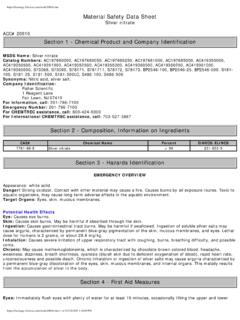
Transcription of SAFETY DATA SHEET SILVER NITRATE, 0 - Algoma MSDS …
1 Version: Date: Dec-25-2017 Previous Date: May-31-2016 SAFETY data SHEETSILVER nitrate , IdentificationSILVER nitrate , means of #This SDS has been prepared by SUEZ Regulatory Department (1-215-355-3300).Prepared byL6073L codeDec-25-2017 Revision dateMay-31-2016 Supersedes dateField test reagentRecommended useNone restrictionsSUEZ Water Technologies & Solutions Canada3239 Dundas Street WestOakville, Ontario, L6M 4B2T 905-465-3030 Emergency telephone(800) 877-1940 Company/undertaking identification2. Hazard(s) identificationNot hazardsCategory 2 Skin corrosion/irritationHealth hazardsCategory 2 Serious eye damage/eye irritationCategory 3 respiratory tract irritationSpecific target organ toxicity, single exposureLabel elementsSignal wordWarningHazard statementCauses skin irritation.
2 Causes serious eye irritation. May cause respiratory statementPreventionAvoid breathing mist or vapor. Wash thoroughly after handling. Use only outdoors or in awell-ventilated area. Wear eye protection/face protection. Wear protective on skin: Wash with plenty of water. If inhaled: Remove person to fresh air and keep comfortablefor breathing. If in eyes: Rinse cautiously with water for several minutes. Remove contact lenses,if present and easy to do. Continue rinsing. Call a poison center/doctor if you feel unwell. If skinirritation occurs: Get medical advice/attention. If eye irritation persists: Get medicaladvice/attention. Take off contaminated clothing and wash before in a well-ventilated place. Keep container tightly closed. Store locked of contents/container in accordance with local/regional/national/international hazardsNone : 1 / 7 Supplemental Composition/information on ingredientsMixturesComponentsCAS #Percent (wt/wt)7761-88-81 - nitrateInformation for specific product ingredients as required by the WHMIS Regulations is listed.
3 Referto additional sections of this SDS for our assessment of the potential hazards of this comments4. First-aid measuresRemove victim to fresh air and keep at rest in a position comfortable for breathing. Call a POISONCENTER or doctor/physician if you feel with plenty of soap and water. If skin irritation occurs: Get medical advice/attention. Washcontaminated clothing before contactImmediately flush eyes with plenty of water for at least 15 minutes. Remove contact lenses, ifpresent and easy to do. Continue rinsing. Get medical attention if irritation develops and contactDo not feed anything by mouth to an unconscious or convulsive victim. Do NOT induce vomiting!Rinse mouth. Get medical attention if symptoms eye irritation. Symptoms may include stinging, tearing, redness, swelling, and blurredvision.
4 May cause respiratory irritation. Skin irritation. May cause redness and importantsymptoms/effects, acute anddelayedProvide general supportive measures and treat symptomatically. Keep victim under may be of immediatemedical attention and specialtreatment neededIf you feel unwell, seek medical advice (show the label where possible). Ensure that medicalpersonnel are aware of the material(s) involved, and take precautions to protect information5. Fire-fighting measuresWater fog. Foam. Dry chemical powder. Carbon dioxide (CO2).Suitable extinguishing mediaDo not use water jet as an extinguisher, as this will spread the extinguishingmediaDuring fire, gases hazardous to health may be hazards arising fromthe chemicalWear full protective clothing, including helmet, self-contained positive pressure or pressuredemand breathing apparatus, protective clothing and face protective equipmentand precautions for firefightersIn case of fire and/or explosion do not breathe fumes.
5 Use standard firefighting procedures andconsider the hazards of other involved materials. Move containers from fire area if you can do sowithout risk. Cool containers / tanks with water fightingequipment/instructionsUse standard firefighting procedures and consider the hazards of other involved methodsNo unusual fire or explosion hazards fire hazards6. Accidental release measuresKeep unnecessary personnel away. Keep people away from and upwind of spill/leak. Wearappropriate protective equipment and clothing during clean-up. Avoid breathing mist or vapor. Donot touch damaged containers or spilled material unless wearing appropriate protective adequate ventilation. Local authorities should be advised if significant spillages cannot becontained. For personal protection, see section 8 of the precautions,protective equipment andemergency proceduresLarge Spills: Stop the flow of material, if this is without risk.
6 Dike the spilled material, where this ispossible. Cover with plastic SHEET to prevent spreading. Absorb in vermiculite, dry sand or earthand place into containers. Following product recovery, flush area with Spills: Wipe up with absorbent material ( cloth, fleece). Clean surface thoroughly toremove residual return spills to original containers for re-use. For waste disposal, see section 13 of the and materials forcontainment and cleaning upAvoid discharge into drains, water courses or onto the precautions7. Handling and storageAvoid breathing mist or vapor. Avoid contact with eyes, skin, and clothing. Avoid prolongedexposure. Provide adequate ventilation. Wear appropriate personal protective equipment. Observegood industrial hygiene for safe handlingPage: 2 / 7 Version number: name: SILVER nitrate , locked up.
7 Store in original tightly closed container. Store away from incompatible materials(see Section 10 of the SDS). Protect from freezing. Keep tightly for safe storage,including any incompatibilities8. Exposure controls/personal protectionOccupational exposure limitsUS. ACGIH Threshold Limit mg/m3silver nitrate (CAS7761-88-8)Canada. Alberta OELs (Occupational Health & SAFETY Code, Schedule 1, Table 2) mg/m3silver nitrate (CAS7761-88-8)Canada. British Columbia OELs. (Occupational Exposure Limits for Chemical Substances, Occupational Health andSafety Regulation 296/97, as amended) mg/m3silver nitrate (CAS7761-88-8) mg/m3 Canada. Manitoba OELs (Reg. 217/2006, The Workplace SAFETY And Health Act) mg/m3silver nitrate (CAS7761-88-8)Canada. Ontario OELs.
8 (Control of Exposure to Biological or Chemical Agents) mg/m3silver nitrate (CAS7761-88-8)Canada. Quebec OELs. (Ministry of Labor - Regulation Respecting the Quality of the Work Environment) mg/m3silver nitrate (CAS7761-88-8)No biological exposure limits noted for the ingredient(s).Biological limit valuesEye wash facilities and emergency shower must be available when handling this engineeringcontrolsIndividual protection measures, such as personal protective equipmentSplash proof chemical protectionSkin protectionWear appropriate chemical resistant gloves. The choice of an appropriate glove does not onlydepend on its material but also on other quality features and is different from one producer to theother. Suitable gloves can be recommended by the glove supplier.
9 Glove selection must take intoaccount any solvents and other hazards protectionWear appropriate chemical resistant engineering controls do not maintain airborne concentrations below recommended exposurelimits (where applicable) or to an acceptable level (in countries where exposure limits have notbeen established), an approved respirator must be protectionWear appropriate thermal protective clothing, when hazardsAlways observe good personal hygiene measures, such as washing after handling the materialand before eating, drinking, and/or smoking. Routinely wash work clothing and protectiveequipment to remove hygieneconsiderations9. Physical and chemical propertiesLiquidAppearanceColorlessColor NoneOdorOdor thresholdNot (concentrated product) point/freezing pointNot : 3 / 7 Version number: name: SILVER nitrate , boiling point and boilingrangeNot point> 200 F (> 93 C) P-M(CC)Evaporation rate< 1 (Ether = 1)Not (solid, gas)Upper/lower flammability or explosive limitsFlammability limit - lower(%)Not limit - upper(%)Not limit - lower (%)Not limit - upper (%)Not pressureNot density(Air = 1)Relative densityNot density temperature70 F (21 C)Solubility(ies)Solubility (water)Not coefficient(n-octanol/water)Not temperatureNot temperatureNot temperature70 F (21 C)Other informationNot propertiesNot properties10.
10 Stability and reactivityThe product is stable and non-reactive under normal conditions of use, storage and is stable under normal stabilityHazardous polymerization does not of hazardousreactionsAvoid temperatures exceeding the flash point. Contact with incompatible materials. None undernormal to avoidStrong oxidizing materialsNitrogen oxides (NOx).Hazardous decompositionproducts11. Toxicological informationInformation on likely routes of exposureInhalationMay cause irritation to the respiratory system. Prolonged inhalation may be contactCauses skin contactCauses serious eye cause slight gastrointestinal related to thephysical, chemical andtoxicological characteristicsSevere eye irritation. Symptoms may include stinging, tearing, redness, swelling, and blurredvision.