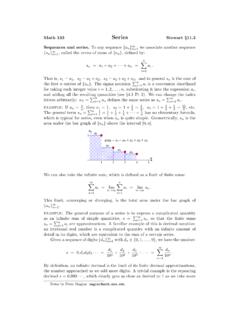
Transcription of Math 133 Taylor Series
1 math 133 Taylor SeriesStewart representation of a main purpose of Series is to write agiven complicated quantity as an infinite sum of simple terms; and since the termsget smaller and smaller, we can approximate the original quantity by taking only thefirst few terms of the Series . In this section, we finally develop the tool that lets us dothis in most cases: a way to write any reasonable function as an explicit power will allow us to compute outputs of the function by plugging into the functions must behave decently near the center point of the desired powerseries. We sayf(x) isanalyticatx=aif it is possible to writef(x) = n=0cn(x a)nfor some coefficientscn, with positive radius of convergence. In practice, any formulainvolving standard functions and operations defines an analytic function, providedthe formula gives real number values in a small interval aroundx=a.
2 For example1x aisnotanalytic atx=a, because it gives atx=a; and x aisnotanalyticatx=abecause forxslightly smaller thana, it gives the square root of a negativenumber. Taylor Series Theorem:Letf(x) be a function which is analytic atx= we can writef(x) as the following power Series , called theTaylorseriesoff(x) atx=a:f(x) =f(a)+f (a) (x a)+f (a)2!(x a)2+f (a)3!(x a)3+f (a)4!(x a)4+ ,valid forxwithin a radius of convergence|x a|< RwithR >0, orconvergent for we write thenth derivative off(x) asf(n)(x), this becomes:f(x) = n=0cn(x a)nwith coefficientscn=f(n)(a)n!.warning:The coefficients areconstantswith nox, soc1=f (a),notf (x). hypothesisf(x) is analytic, sof(x) = n=0cn(x a)nforsomecn; wewill derive the desired formula for these coefficients. Sincef(a) = n=0cn(a a)n=c0+c1(0) +c2(02) + , we getc0=f(a). Next, by the Theorem in , we havef (x) = n=0ncn(x a)n 1, sof (a) =c1+ 2c2(0) + 3c3(02) + , andc1=f (a).
3 Next,f (x) = n=0n(n 1)cn(x a)n 2, sof (a) = (2)(1)c2andc2=12f (a).Continuing, we get:f(N)(x) = n=1n(n 1) (n N+1)cn(x a)n by Peter The function3 x ais also not analytic nearx=a, ever though it gives real number problem is that it has a vertical tangent atx=a, so it is not terms forn= 0,1,..,N 1 are all zero because of the factorsn(n 1) (n N+1), so the first non-zero term is forn=N. Plugging inx=agives:f(N)(a) =N(N 1) (1)cN, andcN=1N!f(N)(a) as desired. we have a power Series forf(x) with known coefficientscn=f(n)(a)n!, we canapproximatef(x) by taking a finite partial sum of the Series up to some cutoff termN. This partial sum is called aTaylor polynomial, denotedTN(x):f(x) TN(x) =N n=0cn(x a)n=f(a) +f (a)(x a) + +f(N)(a)N!(x a) thatT1(x) =f(a) +f (a)(x a) is just the linear approximation nearx=a,whose graph is the tangent line (Calculus I ).
4 We can improve this approximationoff(x) in two ways: Take more terms, increasingN. Take the centeraclose tox, giving small (x a) and tiny (x a) Taylor Series centered ata= 0 is specially named aMaclaurin : sine find Taylor Series for a functionf(x), we must de-terminef(n)(a). This is easiest for a function which satisfies a simple differentialequation relating the derivatives to the original function. For example,f(x) = sin(x)satisfiesf (x) = f(x), so coefficients of the Maclaurin Series (centera= 0) are:n01234567f(n)(x)sin(x)cos(x) sin(x) cos(x)sin(x)cos(x) sin(x) cos(x)f(n)(0)010 1010 1cn=f(n)(0)n!010 13!015!0 17!That is:sin(x) =x x33!+x55! x77!+ = n=0( 1)nx2n+1(2n+1)!.To find the domain of convergence, we apply the Ratio Test ( ):L= limn an+1an = limn x2(n+1)+1(2(n+1)+1)!/x2n+1(2n+1)! = limn |x|2n+3|x|2n+1 (2n+1)!
5 (2n+3)!= limn |x|2(2n+2)(2n+3)= 0for any fixedx6= 0. SinceL= 0<1 regardless ofx, the Series converges for formula for sin(x) astonishes because the right side is a simple algebraicseries having no apparent relation to trigonometry. We can try to understand andcheck the Series by graphically comparing sin(x) with its first few Taylor polynomialapproximations: The Taylor polynomialT1(x) =x(in red) is just the linear approximation ortangent line ofy= sin(x) at the center pointx= 0. The curve and line areclose (to within a couple of decimal places) near the point of tangency and upto about|x| Once they veer apart, the approximation is useless. The next Taylor polynomialT3(x) =x x33!=x 16x3(in green) matchesy= sin(x) in its first three derivatives atx= 0, and stays close to the originalcurve up to about|x| . The nextT5(x) =x x33!
6 +x55!=x 16x3+1120x5is even closer tof(x) for evenlargerx. Taking enough terms in the Taylor Series will give a good approxima-tion foranyx, since the Series converges :Compute sin(10 ). A geometric method would be to construct a righttriangle with a 10 angle, and measure the opposite side divided by the hypotenuse;but this would only work for a couple of decimal places of accuracy. Of course, acalculator can produce many decimal places, but how does it know? By Taylor Series !As always when doing calculus on trig functions, we must first convert to radians(see end of ): 10 =2 360(10) = 18. Here|x|= 18 16is small, so the Maclaurinseries centered at 0 should converge quickly, giving very accurate approximations:sin( 18) T3( 18) = 18 16( 18)3 turns out this is correct to 5 decimal places (underlined), using only two non-zero terms of the Taylor Series and a good estimate for.
7 We could verify this bytaking more terms and seeing that these 5 digits do not change; or by the RemainderEstimates : square compute 2 to 5 decimal places. First, we mustconsider 2 to be an output of the functionf(x) = xatx= 2. Next, we mustchoose the centerafor its Taylor Series . a= 0 does not work because xis not analytic atx= 0. Indeed, if therewere a convergent Taylor Series x=c0+c1x+c2x2+ , we could plug inx= to get: =c0+c1( ) +c2( )2+ , a real value for thesquare root of a negative number! a= 1 is too far fromx= 2: it turns out|x a|=|2 1|= 1 is beyond the radiusof convergence of the Taylor Series . a= 2 is useless, since writing the Taylor Series requires us to knowf(n)(2),includingf(2) = 2, the same number we are trying to compute. A useful choice ofarequires:a >0 so that the Taylor Series exists;ais closetox= 2, making|x a|small so the Series converges quickly; andf(a) = ais easy to compute so we can find the coefficients.
8 A value satisfying all threeconditions is:a= we have:n01234f(n)(x)x1/212x 1/2 1 12 2x 3/21 1 32 2 2x 5/2 1 1 3 52 2 2 2x 7/2f(n)(94)3213 227481 40729cn=f(n)(94)n!3213 1272243 52187 Hence: x=32+13(x 94) 127(x 94)2+2243(x 94)3 52187(x 94)4+ =32+13(x 94) + n=2( 1)n 1(2n 3)!!n!2n 132n 1(x 94)n,where we use the odd factorial notation (2n 3)!! = (1)(3)(5) (2n 3). Forx= 2,we havex 94= 14, so: 2 =32+13( 14) 127( 14)2+2243( 14)3 52187( 14)4+ , 32 1314 127142 2243143 52187144 ,which is correct to 5 decimal places (underlined). We saw another very good algorithm for this in Calculus I : Newton s Method, in which wefound approximate solutions to equations likex2 2 = 0 by repeatedly taking a linear approximationtof(x) =x2 2. However, Newton s Method does not help to compute values of sin(x).Common Taylor Series 11 x= n=0xnfor|x|<1 (Geometric Series ).
9 Ln(1+x) = n=1( 1)n 1xnnfor|x|<1. (1+x)p= n=0p(p 1) (p n+1)n!xnfor|x|<1 (Binomial Series ). exp(x) = n=0xnn!for allx. sin(x) = n=0( 1)nx2n+1(2n+1)!for allx. cos(x) = n=0( 1)nx2n(2n)!for Topic: Irrationality , we saw that repeating decimals representrational numbers (fractions), and every fraction can be written by long division asa repeating decimal. Thus, the non-repeating infinite decimals are the real numberswhich cannot be written as fractions: they areirrational. However, it is diffficult toprove that any given number (such as or 2) is can use our Series to prove the irrationality of the constante= .To prove the negative proposition thateis not equal to any possible fractionab, weuse themethod of contradiction: that is, we assume that thereweresome fractionwithe=ab, and use this to deduce an impossible statement, which will show thatthe original assumptione=abis also , using the Taylor Series definition fore, we assume the possibility:1 +11!
10 +12!+13!+ def=e= is easy to show 2< e <3, soeis not a whole number, and would have denominatorb >1. Consider thebthorder Taylor approximation:1 +11!+12!+13!+ +1b!+Rb=e, Rb= n=b+11n!.We multiply byb! to clear denominators up to the1b!term:b! +b!1!+b!2!+ +b!b!+b!Rb=b!e=b!ab= (b 1)! termsb!,b!1!,b!2!,..,b!b!on the left are whole numbers, and (b 1)!aon the right isa whole number, so the remainderb!Rbmust also be a whole number. But it mustalso be very small, as we can see from a simple geometric Series comparison: b!Rb= n=b+1b!n!=1b+1+1(b+1)(b+2)+1(b+1)(b+2)(b +3)+ <1b+1+1(b+1)2+1(b+1)3+ =1b+111 1b+1=1b+1b+1b+1 1=1b< , the same positive numberb!Rbwould be both a whole number and less than1, which is impossible. Thus the original assumptione=abis also impossible. We do not need the powerful Lagrange remainder formula here.