Example: quiz answers
Mathematical Logic - web.stanford.edu
Propositional Logic Propositional logic is a mathematical system for reasoning about propositions and how they relate to one another. Every statement in propositional logic consists of propositional variables combined via propositional connectives. Each variable represents some proposition, such as “You liked it” or “You should have put a ring on it.”
Tags:
Information
Domain:
Source:
Link to this page:
Documents from same domain
Chemical Engineering 160/260 Important …
web.stanford.eduChemical Engineering 160/260 Important Concepts, Lecture 9-16 Lecture 9: Introduction to Thermodynamic Models for Polymer/Solvent (and Polymer/Polymer
Game Review | The Legend of Zelda
web.stanford.eduTech Specs: like nuthin' your mama has ever seen. Two chip technologies in particular are responsible for LoZ's technological prowess: MMC (Memory
Assignment 1: Game Review “The Legend of Zelda”
web.stanford.eduNitin Chopra Assignment 1: Game Review “The Legend of Zelda” 1. Identify the Game I have chosen to do my Game Review on “The Legend of Zelda” because I …
Lecture 12 Feedback control systems: static analysis
web.stanford.eduLecture 12 Feedback control systems: ... sensors: radar altimeter; ... Feedback control systems: static analysis 12{4. Example
Credit Risk Modeling with Affine Processes
web.stanford.educredit-risk modeling (emphasizing the valuation of corporate debt and credit derivatives) with an introduction to the analytical tractability and richness of affine state processes. This is not a general survey of either topic, but rather

OBIEE Upgrade from 11G Oracle Business …
web.stanford.eduOracle Business Intelligence 12c is a unique platform that enables customers to uncover new insights and make faster, ... Oracle BI Enterprise Edition ...
Introduction to Quantum Mechanics - Stanford …
web.stanford.eduIntroduction to Quantum Mechanics Gary Oas Education Program for Gifted Youth, Stanford University March 23, 2008 Introduction This two week course on quantum mechanics is meant to give a quantitative introduction to the theory and explore its
Lecture #3 Quantum Mechanics: Introduction
web.stanford.edu2 Classical versus Quantum NMR • QM is only theory that correctly predicts behavior of matter on the atomic scale, and QM effects are seen in vivo.
Reprogramming to a muscle fate by fusion …
web.stanford.eduResearch Article 1045 Introduction We have extended our earlier studies of nuclear reprogramming in heterokaryons to enhance our understanding of the mechanistic basis
Journal of Teacher Education, Vol. 51, No. 3, …
web.stanford.eduON THE NATURE OF TEACHING AND TEACHER EDUCATION ... isolation is to create a vision of learning to teach as a private ordeal (Lortie, 1975) and a vision of
Related documents

TRANSLATIONS IN SENTENTIAL LOGIC - UMass
courses.umass.eduformulas using connectives, atomic formulas are structureless, they are simply upper case letters (of the Roman alphabet). Formulas are strings of symbols. In sentential logic, the symbols include all the upper case letters, the five connective symbols, as …
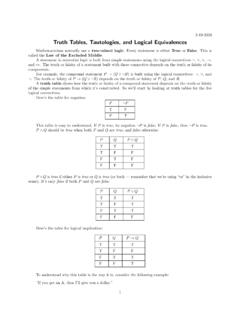
TruthTables,Tautologies,andLogicalEquivalences
sites.millersville.eduA statement in sentential logic is built from simple statements using the logical connectives ¬, ∧, ∨, →, and ↔. The truth or falsity of a statement built with these connective depends on the truth or falsity of its components. For example, the compound statement P → (Q∨ ¬R) is built using the logical connectives →, ∨, and ¬.

Scope & Sequence - Lexia Learning
www.lexialearning.com• Using Evidence • Application of Higher-Order Comprehension Skills • Vocabulary and Knowledge Building • Connection and Integration of Ideas Within and Across Texts • Grammar Concepts for Comprehension • • Building and Combining • Sentences • Parts of Speech and Functions • Pronoun Reference • Connectives and Signal

LECTURE 7: PROPOSITIONAL LOGIC (1)
www.cs.ox.ac.uk2.1 The Connectives Now, the study of atomic propositions is pretty boring. We therefore now introduce a number of connectives which will allow us to build up complex propositions. The connectives we introduce are: ^ and (& or .) _ or (jor +): not (˘))implies (˙or !),iff (Some books use other notations; these are given in parentheses.) Mike ...

Logical Connectives - Millersville University of Pennsylvania
sites.millersville.eduThe order of precedence of the logical connectives is: 1. Negation 2. Conjunction 3. Disjunction 4. Implication 5. Double implication As usual, parentheses override the other precedence rules. In most cases, it’s best for the sake of clarity to use parentheses even if they aren’t required by the precedence rules. For example, it’s better ...
Using suffixes -er -ar -or to make nouns
www.skillsworkshop.orgRs/E3.2 use implicit and explicit knowledge of different types of word e.g. connectives, nouns, verbs, adjectives, of word order, and of possible plausible meanings, to help decode unfamiliar words and predict meaning. Writing sentences Ws/E3.1 write in complete sentences.