Transcription of MCHW VOLUME 2 - NOTES FOR GUIDANCE ON …
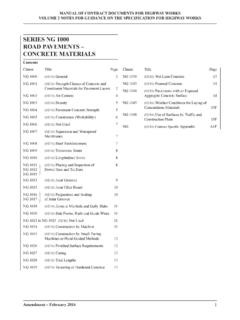
1 Amendment - May 2005 MANUAL OF CONTRACT DOCUMENTS FOR HIGHWAY WORKSVOLUME 2 NOTES FOR GUIDANCE ON THE specification FOR HIGHWAY WORKSSERIES NG 5000 MAINTENANCE PAINTING OFSTEELWORKC ontentsClauseTitlePageNG 5001 Introduction2NG 5002 Surface Preparation - GeneralRequirements3#NG 5003 Surface Preparation - Materialsand Methods4NG 5004 Surface Preparation -Workmanship Standards5NG 5005 Metal Coatings6NG 5006 Testing of Metal Spray Coatings7#NG 5007 Paint and Similar ProtectiveCoatings7NG 5008 Surface Preparation andProtective Systems8#NG 5009 Testing of Paints12NG 5010 Storage Requirements andKeeping Periods for Paints14NG 5011 Procedure Trials15NG 5012 Application of Paint15#NG 5013 Form HA/P1 (Maintenance)Paint System Sheet(Appendix 50/1)Form HA/P2 Paint Data Sheet(Appendix 50/3)16NG 5014 Access, Containment andLighting16NG 5015(11/03) Additional Requirements forthe Protection of CCTV Masts,Cantilever Masts, Steel LightingColumns and Bracket Arms17#NGAppendices and SampleAppendicesA11 NATIONAL ALTERATIONS OF THEOVERSEEING ORGANISATIONS OFSCOTLAND, WALES AND NORTHERNIRELANDS cotlandClauseTitlePageNG 5013SE Form HA/P1 (Maintenance)Paint System Sheet(Appendix 50/1)Form HA/P2 Paint Data Sheet(Appendix 50/3)S1NG SEAppendix 50/4 SESA1 Northern IrelandNG 5003NI Surface Preparation-Materialsand MethodsN1NG 5009NI Testing of PaintsN3NG NIAppendix 50/4 NINA1#denotes a Clause or Sample Appendix which has a substituteNational Clause or Sample Appendix for one or more of theOverseeing Organisations of Scotland, Wales or 2 NOTES for GUIDANCE on the specification for Highway WorksSeries NG 5000 Maintenance Painting of SteelworkMAINTENANCE PAINTING OF STEELWORK2NG 5001 Introduction1(11/03)
2 The Series 5000 Clauses cater for surfacepreparation and protective coating requirements formaintenance painting of steelwork for protectionagainst Clauses are applicable to steel sections andfabricated steelwork in bridges, parapets, gantries andother highway structures, including bearings, CCTV masts, cantilever masts, steel lighting columns andbracket arms, (but excluding traffic sign posts), whichare to be protected with the protective systemsdescribed in Clause 5007. Clause 5015 is concernedsimilarly with steel CCTV masts, cantilever masts, steellighting columns, (but excluding traffic sign posts), andbracket detailed requirements for surface preparation,the coatings and their application are specified bymeans of appropriate Series NG 5000 Appendices. Theformat is flexible and can cater for a single componentcontract, from a length of parapet, up to theinvolved requirements of a bridge strengthening andwidening (05/05) The information on environment,accessibility, type and condition of existing protectivesystem and expected durability will give the Contractorguidance on the constraints and extent of the work to becarried out.
3 The Required Durability is a means ofalerting the paint manufacturer as to the performanceexpected from the protective system and Additional Clauses4 Clauses 5001 to 5015, should be scrutinised toensure that all aspects of the Contract can be coveredsatisfactorily. When, exceptionally, Substitute orAdditional Clauses are required, the alterations shouldbe made after agreement with the Technical ApprovalAuthority and, where appropriate, after consultationwith the Overseeing on Health Hazards andEnvironmental Restrictions5(05/05) Health hazards associated with pollution ofthe atmospheric environment have to be taken intoaccount during surface preparation and the applicationof protective coatings. Unless necessary precautions aretaken and any limitations on the Contractor s method ofworking (Appendix 1/23) are observed, people may beadversely affected, also the site ground area andwaterways may become contaminated to anunacceptable extent.
4 The precautions to be taken duringthe application of protective coatings are usually statedby the suppliers, ventilation to remove strongsolvent vapour. In the case of blast cleaning with non-metallic abrasives, particularly if large surface areas areinvolved, plans should be discussed with theEnvironmental Health Officer, the Health and SafetyExecutive, the Environment Agency and otherinterested parties and clearance obtained for theproposals. The debris produced by combined wet anddry blast cleaning (see sub-Clauses and 19) canusually be contained satisfactorily. However, in somecases it may be necessary to use dry blast cleaning only, to clean up a thermally sprayed metal coating basedsystem. This method is usually acceptable for astructure in an unpopulated area, even over a a structure near or over a river, it may be necessaryto prevent any debris from falling into the water or evenon the ground nearby.
5 In other areas, for example near adust sensitive industrial process, the spreading of anydust in the atmosphere near the plant would , although operators can usually be protected fromthe effects of spray application, it may be necessary insome cases to protect the immediate environment fromoverspray (see Clause NG 124); it may even beexpedient to specify brush application as a result of investigation it is clear that sidesheeting or close boarded scaffolding is required toreduce or prevent dust and debris being released intothe atmosphere or from falling into a river, say, thisshould be stated in Appendix 50 Contractor should ensure that all his operationsfully comply with the Control of Lead at WorkRegulations 2002, or Control of Lead at WorkRegulations (Northern Ireland) (05/05) Dry blast cleaning on its own breaks up anexisting protective system into small particles andthese, together with the spent abrasive, form a densedust cloud which may also contain toxic material, from lead paints.
6 Dust from dry abrading maysometimes be toxic dust from fungus spores insidebox girders, but the VOLUME of dust is much and supervisors who work in theseAmendment - May 2005 VOLUME 2 NOTES for GUIDANCE on the specification for Highway WorksSeries NG 5000 Maintenance Painting of Steelwork3conditions should be suitably protected. Althoughprotection during wet abrasive blast cleaning is alsonecessary, the wetted particles are more easilycontained in the Work the existing paint system on the structure isfound to contain lead the use of closed circuit ultra highpressure water blasting (which combines water blasting,filtration and vacuum) should be (05/05) Highly volatile solvents can cause illnessvery quickly during paint application. Less volatile butstrong smelling solvents may not be so injurious but canbe temporarily almost as disabling. Some pigments andmedia are also toxic. Appropriate protection and controlmeasures, in accordance with the paint manufacturer shealth and safety data sheets, should therefore be takenby personnel likely to be affected by either handling orthe close proximity of paints.
7 Adequate ventilation isnecessary particularly in enclosed spaces such as insidebox the maintenance painting is to beundertaken over a road open to traffic, the need fortraffic management and other measures to protect roadusers should be 5002 Surface Preparation - GeneralRequirements1In most cases the use of a cleaning agent followedby rinsing is considered to be more effective than theuse of a solvent. If traces of oil or grease remain afterthe first attempt, further cleaning may be , if wetting of the surface is not permissible,use of a solvent may be (05/05) It should be ensured that, throughout theduration of the Work, clean water is used for wetcleaning and rinsing. Generally, potable water will besatisfactory, but there should be a check that the water(or the cleaning agent) does not leave harmful residueson the surface. Warm water may be used should also be a check that the cleaningagents offered do clean satisfactorily and do notthemselves leave harmful residues on the surface afterfinal rinsing.
8 Abrasives should be checked for freedomfrom impurities, which could contaminate the surface tobe should be ensured that the necessary informationand equipment for the optical and chemical checking ofsurfaces for freedom from corrosion products andcontamination are available (see Clause NG 5004).The appearance of surfaces prepared to clean steel orsound metal coating can be checked satisfactorily forresidues of rust and other corrosion products orimpacted dirt with a 10x illuminated magnifying a magnifying glass can also be used on drysurfaces for an initial check for soluble salts, a finalcheck has to be made using reagents, especially afterwet blast cleaning or cleaning cases of heavy contamination, more intensive orrepeated surface preparation may be necessary. TheContractor will be expected to have sufficient expertiseto recognise such areas when the extent of the work methods or closed circuit wet methods ofsurface preparation should be specified for the inside ofbox girders otherwise excessive water will accumulateon the bottom surfaces especially between ventilation should be provided as surfacesmay remain wet for some time and delay painting.
9 Theinternal surfaces of hollow sections which are to becoated should be free from dust and debris as far the initial surface preparation may havebeen satisfactory, and all dust and debris removed,further dust may well collect on the cleaned surface. Inharsh environments further pollutants may also bedeposited. It is essential, therefore, to check surfacesimmediately before part of good practice feathering of existingpaint should take place, exposing weak otherwise specified fasteners should beprepared and painted to the same standard as adjacentmain surfaces, if special treatment of fasteners isrequired, this should be specified in Appendix 50 or two typical joints should be included in theprocedure trials to verify the efficiency of techniquesfor freeing joints of water or for preventing its a wet joint is suspected, dry compressed air should beused to free the joint of water, after the surfacepreparation at the joint has been completed.
10 If paintingis undertaken in winter months, then it may benecessary to apply heat to dry out joints. During drywarm weather, the problem will be less severe althoughit should be ensured that water penetrating the joint as aresult of surface preparation, is use of sealants which set hard should be avoidedunless they are known to adhere well and not to - May 2005 VOLUME 2 NOTES for GUIDANCE on the specification for Highway WorksSeries NG 5000 Maintenance Painting of Steelwork4#NG 5003 Surface Preparation-Materials andMethodsAbrading1(05/05) Abrading and blast cleaning are the twobasic methods for removal of unsound and wire brushing alone will not achieve anadequate standard of cleanliness and are thereforeconsidered as no more than an aid in removing thickrust scale, encrusted dirt and paint from areas whichshould then be abraded. Other methods such as flamecleaning may be specified by the introduction ofadditional clauses.