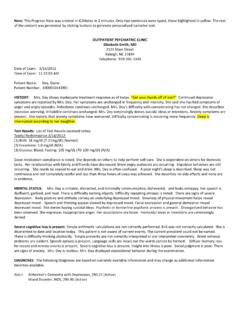
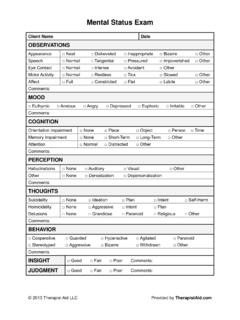
Transcription of Mental Status Exam Checklist - For Mental Health Clinicians
1 Mental Status Exam Checklist1. AppearanceHygiene and GroomingWould you describe your client's hygiene and grooming as:CleanShavenHair UnbrushedNeatUnshavenDisheveledHair BrushedDressIs your client's clothing:CasualImmaculateNeatBusinessFas hionableBizarreInappropriateRaggedDirtyS tainedDistinguishing FeaturesDoes your client have any distinguishing features, such as:TattoosPiercingsScarsApparent AgeDoes your client appear:Older than their stated ageYounger than their stated age2. General BehaviorEye ContactIs your client's eye contact:AppropriateDecreasedHeightenedAv oidantBody Mass IndexIs your client's habitus:NormalUnderweightOverweightObese Facial ExpressionsDoes your client appear:CalmAngryPerplexedSadAnxiousTardi ve Dyskinesia Does your client display unusual movements in the jaw, face or tongue, such as:GrimacingTongue writhingLip smackingLip pursingChewingMotor ActivityDoes your client display:Normal activityAgitationSlowedTensionDecreased activityRestlessTICSLimpUse a cane, crutches or another deviceShuffleUnsteady3.
2 Speech and LanguageGeneralDoes your client speak clearly or have an:AccentStutterLispCooperativeness and AttitudeDoes your client exhibit an appropriate level of cooperation, or are they:EvasiveGuardedPassiveSullenWithdraw nDemandingHostileOverly friendlyRelaxedOpenShyPlayfulCandidSuspi ciousMovementsDoes your client display any unusual or repetitive movements, such as:TicsTwitchesPosturingMannerismsTremor Body-rockingHead-noddingFinger-tappingAr m- flappingWavingPacingRhythmIs your client's speech:ArticulateSlurredMonotoneDysarthr icRateIs your client's rate of speech:NormalSlowFastDelayed onset4.
3 EmotionsMoodDoes your client say they feel:DepressedSadAngryIrritableGoodFanta sticAffectDoes your client seem to be:EuthymicDepressedIrritableAngryAnxiou sElatedEuphoricVolumeIs your client's speech:SoftLoudMuteContentIs your client:LoquaciousFluentImpoverishedRange Is your client's affect range:BroadRestrictedFlatLabileAnhedonic CongruencyIs your client's affect:Congruent to their moodIncongruent to their moodGoal-directedImpoverishedRapidIllogi calIncoherentDistractibleBlockingCircums tantialPerseverativeTangentialLooseFligh t of ideasWord salad6. CognitionAlertnessIs your client:AlertLethargicComatoseObtundedIn a stuporPerceptionIs your client experiencing:No hallucinationsAuditory hallucinationsVisual hallucinationsTactile hallucinationsDerealizationDepersonaliza tionOlfactory hallucinationsIllusions5.
4 Thought and PerceptionThought ProcessWould you describe your client's thought process as:Suicidal ideationHomicidal ideationDistortionsObsessionsWorriesComp ulsionsPhobiasRuminationsGrandiose, somatic, paranoid or other delusionsThought ContentDo your client's thoughts consist of:OrientationDoes your client know:Their nameTheir current locationThe dateThe timeDoes your client display:No impairmentShort-term impairmentLong-term impairmentMemoryTo test your client's memory, you might ask them to do the following:Repeat three words immediately and again in five minutesSign their name while answering unrelated questionsTell you their birthday, where they were born and their parents' well does your client understand the reasons for their behavior?
5 How well does your client appreciate how they contribute to a problem?Does your client recognize or acknowledge the severity of an issue?What do they perceive is the best way to address a problem?InsightDescribe your client's insight or their awareness of their situation or condition:AttentionDoes your client's attention seem:NormalDistractedIs your client's insight:GoodFairPoor7. EnvironmentJudgmentConsider if your client anticipates the consequences of their behavior and makes decisions to safeguard their well-being and that of others. Is their judgment:GoodFairPoorConsider your client's reliability and accuracy as they share details about their situation.
6 Do you consider your client to be:ReliableUnreliableIf part of your Mental Status exam includes assessing the client's living environment, you may want to describe their surroundings. Ask yourself the following:Have they made odd decisions, such as blocking doors or windows with furniture?Are there unusual decorations or wires that lead nowhere?Are they using any household objects inappropriately?Is their home extremely cluttered or dirty?Do they collect junk or garbage?GoodFairPoorImpulse ControlDoes your client show:Normal impulse controlImpaired impulse controlMotivationWould you describe your client's motivation level as:Reliability