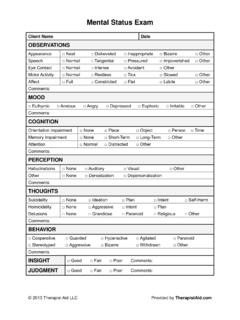
Transcription of The Mental Status Examination - At Health
1 1 Case Management: The Mental Status Examination Part 1: Introduction The Mental Status Examination (MSE) is based on your observations of the client. It is not related to the facts of the client's situation, but to the way the person acts, how the person talks, and how the person looks while in your presence. A Mental Status Examination can be an abbreviated assessment done because someone appears to be in obvious need of hospitalization, or it can be an elongated process that takes place over several interviews. The MSE always has the same content, and you write your observations in roughly the same order each time. Although a formal MSE would be done by a physician or psychologist, you can do an informal MSE in which you systematically look at the person's thinking process, feeling state, and behavior.
2 You will want to understand the way the person functions emotionally and cognitively. Much of the Examination is done by observing how people present themselves at the interview and the manner in which they spontaneously give information about themselves and their situations. The Examination is not done separately but is an integral part of the assessment interview. Questions that relate to Mental Status are framed as part of the overall assessment and not as a separate pursuit. There will be times when you or a clinician might ask for psychological testing to confirm your evaluation of the person, but during your own MSE of the person, this is not done. Some of the terms you learn in this chapter are not necessarily words you will use in describing your clients and their appearance or behavior.
3 This chapter is meant to familiarize you with the way some professional practitioners describe their clients and patients. If you know these terms, you will be able to follow the notes and discussions better. Part 2: Observing the Client What to Observe Your Mental Status Examination of the individual involves observations of the following: General appearance Behavior Thought process and content Affect Impulse control Insight Cognitive functioning Intelligence Reality testing Suicidal or homicidal ideation Judgment A good case manager is a good observer. You pick up many details about the person, all of which are relevant to understanding the client's Mental Status .
4 In a sense, you watch for the most obvious and the most subtle visual and verbal clues as to who your client is. Use what you see and hear to give you direction in regard to what questions to ask. 2 How to Observe Throughout the interview note how the person communicates verbally and nonverbally and how the person behaves. In addition, you look at the content of the communication. You are looking at both what the person tells you and how the person tells it. As people talk about why they came to your agency for services and about the main problems they are confronting, you will make some judgments about how they functioned in the past and how well they are functioning currently.
5 You will note how they tell their stories. Is the person cooperative and friendly? Does he appear to be relieved and eager to talk to you, or is he mute, guarded, and uncooperative? Is she weepy and hesitant as she speaks, or is she forthright and stern? Does the person twist a tissue in her hands or rock back and forth in her chair, or does she use appropriate gestures? Does he relax during the interview or remain guarded and uncooperative? At times you may need to assess the client's Mental Status through the observations of others who are close to them. Your clients may not always be able to tell you much about past events or functioning, and you will need to turn to others for that information.
6 If there is no reliable source, you may not be able to perform a complete MSE that has a clear degree of certainty. Documenting Your Observations To back up your observations, use both descriptions of the individual's behavior during the interview and direct quotes made by the person in the interview. In this way, you carefully document your observations and your resulting conclusions. When you describe the person, be sure that your values and prejudices do not appear in your notes. Use adjectives that describe the individual, but are objective. All editorial comments and value judgments should be omitted. Figure defines some general terms that are commonly used when documenting observations of clients.
7 FIGURE General terms used in documentation Primary language: When you see this on a form, give the person's native language, and if it is not English, tell how well the person functions with English. Presenting problem: In one or two sentences, tell why the person is coming to see you now. Use the person's own way of telling about it. Past psychiatric history: Use incomplete sentences. Give dates, approximately how long, and summarize if there is much detail. Functional ability: Note particularly if the person is able to display and carry out age- and stage-appropriate skills and tasks. Also note any recent change. Moods/emotions: What does the person or the person's family say? How do they seem to you?
8 Physiologic: What does the person or the family say about the person's appetite, sleep, and sexual activity? Thinking: What is the person saying about how she is thinking? Are you able to follow her thinking? Does the story make sense? Are there delusions? 3 Perception: Are there any hallucinations? Orientation/cognition/memory: Does the person think he can find his way? Does he know where he is? Does he remember well? Does he know what day this is? Mental Status Examination : This is a word picture that tells what the person looks like now, not all the time. Part 3: Mental Status Examination Outline Anthony LaBruzza (1994), in his book Using DSM-IV, provides a good outline for the Mental Status report that you will complete after the interview.
9 He stated that his outline is not meant to be followed precisely, but it does give the major points and a framework to determine what is important. The outline in Figure [not shown here] provides the major categories you must cover in a Mental Status report. This section discusses the outline for the Mental Status Examination and report in detail, defining terms to use and identifying items on which to focus for each category you will cover in Mental Status examinations and reports. Pay particular attention to the terms that have Always in boldface in the descriptor, as these are important items to which you must always give attention. I. General Description A. Appearance 1. Dress and Grooming.
10 You may find the person's appearance to be average, meticulous, slightly unkempt, or disheveled. The person may have body odor, no makeup, makeup that is skillfully applied, or garish makeup. Meticulous: The appearance is perfect, unusually so. Skillfully applied: The person is made up [skillfully]. Garish: The person looks outlandish. Self-neglect: Always indicate when you think this is present. It involves such things as having body odor or looking disheveled and unkempt. Dress would be dirty, stained, or rumpled. This can be a sign of a Mental illness such as depression or schizophrenia. Dress: You may find it casual, business, fashionable, unconventional, immaculate, neat, stained, dirty, rumpled.