Transcription of Methanol - labchem.com
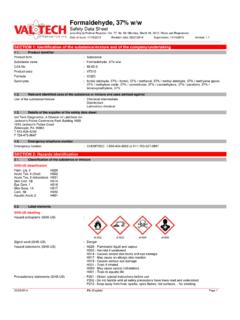
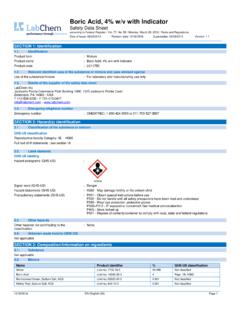
1 Methanol Safety Data Sheet according to Federal Register / Vol. 77, No. 58 / Monday, March 26, 2012 / Rules and Regulations issue date: 07/03/2013 Revision date: 07/21/2020 Supersedes: 03/08/2019 Version: 07/21/2020 EN (English US) Page 1 SECTION 1: Identification Identification Product form : Substance Substance name : Methanol CAS-No. : 67-56-1 Product code : VT430 Formula : CH4O Synonyms : acetone alcohol / alcohol C1 / alcohol, methyl / carbinol / colonial spirits / columbian spirits / green wood spirits / manhattan spirits / methyl alcohol / methyl hydrate / methyl hydroxide / methylen / methylol / monohydroxymethane / pyroligneous spirit / pyroxylic spirit / wood alcohol / wood naphtha Recommended use and restrictions on use Use of the substance/mixture : Solvent Recommended use : Laboratory chemicals Restrictions on use : Not for food, drug or household use Supplier Val Tech Diagnostics, A Division of LabChem Inc Jackson's Pointe Commerce Park Building 1000 1010 Jackson's Pointe Court Zelienople, PA 16063 T 412-826-5230 F 724-473-0647 Emergency telephone number Emergency number : CHEMTREC.
2 1-800-424-9300 or +1-703-741-5970 SECTION 2: Hazard(s) identification Classification of the substance or mixture GHS US classification Flammable liquids Category 2 H225 Highly flammable liquid and vapor Acute toxicity (oral) Category 3 H301 Toxic if swallowed Acute toxicity (dermal) Category 3 H311 Toxic in contact with skin Acute toxicity (inhalation) Category 3 H331 Toxic if inhaled Specific target organ toxicity (single exposure) Category 1 H370 Causes damage to organs (liver, kidneys, central nervous system, optic nerve) (Dermal, oral) Full text of H statements : see section 16 GHS Label elements, including precautionary statements GHS US labeling Hazard pictograms (GHS US) : Signal word (GHS US) : Danger Hazard statements (GHS US) : H225 - Highly flammable liquid and vapor H301+H311+H331 - Toxic if swallowed, in contact with skin or if inhaled H370 - Causes damage to organs (liver, kidneys, central nervous system, optic nerve) (Dermal, oral) Precautionary statements (GHS US) : P210 - Keep away from heat, sparks, open flames, hot surfaces.
3 - No smoking. P233 - Keep container tightly closed. P240 - Ground/bond container and receiving equipment. P241 - Use explosion-proof electrical, ventilating, lighting equipment. P242 - Use only non-sparking tools. P243 - Take precautionary measures against static discharge. P260 - Do not breathe mist, vapors, spray. Methanol Safety Data Sheet according to Federal Register / Vol. 77, No. 58 / Monday, March 26, 2012 / Rules and Regulations 07/21/2020 EN (English US) 2/10 P264 - Wash exposed skin thoroughly after handling. P270 - Do not eat, drink or smoke when using this product. P271 - Use only outdoors or in a well-ventilated area. P280 - Wear protective gloves, protective clothing, eye protection, face protection. P301+P310 - IF SWALLOWED: Immediately call a POISON CENTER or doctor/physician. P303+P361+P353 - IF ON SKIN (or hair): Remove/Take off immediately all contaminated clothing.
4 Rinse skin with water/shower. P304+P340 - IF INHALED: Remove person to fresh air and keep comfortable for breathing. P330 - If swallowed, rinse mouth P363 - Wash contaminated clothing before reuse. P370+P378 - In case of fire: Use carbon dioxide (CO2), powder, alcohol-resistant foam to extinguish P403+P235 - Store in a well-ventilated place. Keep cool. P405 - Store locked up. P501 - Dispose of contents/container to comply with local, state and federal regulations. Other hazards which do not result in classification Other hazards not contributing to the classification : None. Unknown acute toxicity (GHS US) Not applicable SECTION 3: Composition/Information on ingredients Substances Substance type : Mono-constituent Name Product identifier % GHS US classification Methanol (Main constituent) (CAS-No.)
5 67-56-1 100 Flam. Liq. 2, H225 Acute Tox. 3 (Oral), H301 Acute Tox. 3 (Dermal), H311 Acute Tox. 3 (Inhalation), H331 STOT SE 1, H370 Full text of hazard classes and H-statements : see section 16 Mixtures Not applicable SECTION 4: First-aid measures Description of first aid measures First-aid measures general : Check the vital functions. Unconscious: maintain adequate airway and respiration. Respiratory arrest: artificial respiration or oxygen. Cardiac arrest: perform resuscitation. Victim conscious with labored breathing: half-seated. Victim in shock: on his back with legs slightly raised. Vomiting: prevent asphyxia/aspiration pneumonia. Prevent cooling by covering the victim (no warming up). Keep watching the victim. Give psychological aid. Keep the victim calm, avoid physical strain. First-aid measures after inhalation : Remove the victim into fresh air.
6 Immediately consult a doctor/medical service. First-aid measures after skin contact : Wash immediately with lots of water. Soap may be used. Do not apply (chemical) neutralizing agents. Remove clothing before washing. Consult a doctor/medical service. First-aid measures after eye contact : Rinse with water. Remove contact lenses, if present and easy to do. Continue rinsing. Take victim to an ophthalmologist if irritation persists. First-aid measures after ingestion : Rinse mouth with water. Immediately after ingestion, give alcohol to drink. Give nothing to drink. Do not induce vomiting. Immediately consult a doctor/medical service. Take the container/vomit to the doctor/hospital. Call Poison Information Centre ( ). Most important symptoms and effects (acute and delayed) Potential Adverse human health effects and symptoms : Toxic in contact with skin.
7 Toxic if swallowed. Toxic if inhaled. Symptoms/effects after inhalation : EXPOSURE TO HIGH CONCENTRATIONS: Coughing. Symptoms similar to those listed under ingestion. Symptoms/effects after skin contact : Symptoms similar to those listed under ingestion. Symptoms/effects after eye contact : Redness of the eye tissue. Lacrimation. Methanol Safety Data Sheet according to Federal Register / Vol. 77, No. 58 / Monday, March 26, 2012 / Rules and Regulations 07/21/2020 EN (English US) 3/10 Symptoms/effects after ingestion : Nausea. Vomiting. AFTER ABSORPTION OF LARGE QUANTITIES: FOLLOWING SYMPTOMS MAY APPEAR LATER: Change in the blood composition. Headache. Feeling of weakness. Abdominal pain. Muscular pain. Central nervous system depression. Dizziness. Mental confusion. Drunkenness. Coordination disorders. Disturbed motor response.
8 Disturbances of consciousness. Visual disturbances. Blindness. Respiratory difficulties. Cramps/uncontrolled muscular contractions. Chronic symptoms : Red skin. Dry skin. Skin rash/inflammation. Headache. Disturbed tactile sensibility. Visual disturbances. Sleeplessness. Gastrointestinal complaints. Cardiac and blood circulation effects. Immediate medical attention and special treatment, if necessary Immediately after ingestion, give a glass of strong drink, beer or wine to drink. Hospitalize at once for treatment with the right antidotes. SECTION 5: Fire-fighting measures Suitable (and unsuitable) extinguishing media Suitable extinguishing media : Quick-acting ABC powder extinguisher. Quick-acting BC powder extinguisher. Quick-acting class B foam extinguisher. Quick-acting CO2 extinguisher. Class B foam (alcohol-resistant).
9 Water spray if puddle cannot expand. Unsuitable extinguishing media : Water (quick-acting extinguisher, reel); risk of puddle expansion. Water; risk of puddle expansion. Specific hazards arising from the chemical Fire hazard : DIRECT FIRE HAZARD. Highly flammable liquid and vapour. Gas/vapor flammable with air within explosion limits. INDIRECT FIRE HAZARD. May be ignited by sparks. Explosion hazard : DIRECT EXPLOSION HAZARD. Gas/vapour explosive with air within explosion limits. INDIRECT EXPLOSION HAZARD. may be ignited by sparks. Reactions with explosion hazards: see "Reactivity Hazard". Hazardous decomposition products in case of fire : Upon combustion: CO and CO2 are formed. Special protective equipment and precautions for fire-fighters Firefighting instructions : Cool tanks/drums with water spray/remove them into safety.
10 Do not move the load if exposed to heat. Take account of toxic fire-fighting water. Use water moderately and if possible collect or contain it. Protection during firefighting : Do not enter fire area without proper protective equipment, including respiratory protection. SECTION 6: Accidental release measures Personal precautions, protective equipment and emergency procedures General measures : No flames, no sparks. Eliminate all sources of ignition. No naked lights. No smoking. Dike and contain spill. For non-emergency personnel Protective equipment : Gas-tight suit. Emergency procedures : Keep upwind. Mark the danger area. Consider evacuation. Close doors and windows of adjacent premises. Stop engines and no smoking. No naked flames or sparks. Spark- and explosion-proof appliances and lighting equipment.