Transcription of METHOD 200.8 DETERMINATION OF TRACE ELEMENTS IN …
1 OF TRACE ELEMENTS IN WATERS AND WASTESBY inductively coupled plasma - mass SPECTROMETRYR evision Long (Technology Applications Inc.), Martin, and Martin - METHOD ,Revisions and (1990) Long (Technology Applications Inc.) and Martin - METHOD , Revision (1991) Creed, Brockhoff, and Martin - METHOD , Revision (1994)ENVIRONMENTAL MONITORING SYSTEMS LABORATORYOFFICE OF RESEARCH AND ENVIRONMENTAL PROTECTION AGENCYCINCINNATI, OHIO 45268 METHOD OF TRACE ELEMENTS IN WATERS AND WASTESBY inductively coupled plasma - mass AND METHOD provides procedures for DETERMINATION of dissolved ELEMENTS inground waters, surface waters and drinking water.
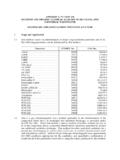
2 It may also be used fordetermination of total recoverable element concentrations in these waters as wellas wastewaters, sludges and soils samples. This METHOD is applicable to thefollowing ELEMENTS :AnalyteRegistry Number (CASRN)Chemical Abstract ServicesAluminum(Al)7429-90-5 Antimony(Sb)7440-36-0 Arsenic(As)7440-38-2 Barium(Ba)7440-39-3 Beryllium(Be)7440-41-7 Cadmium(Cd)7440-43-9 Chromium(Cr)7440-47-3 Cobalt(Co)7440-48-4 Copper(Cu)7440-50-8 Lead(Pb)7439-92-1 Manganese(Mn)7439-96-5 Mercury(Hg)7439-97-6 Molybdenum(Mo)7439-98-7 Nickel(Ni)7440-02-0 Selenium(Se)7782-49-2 Silver(Ag)7440-22-4 Thallium(Tl)7440-28-0 Thorium(Th)7440-29-1 Uranium(U)7440-61-1 Vanadium(V)7440-62-2 Zinc(Zn)7440-66-6 Estimated instrument detection limits (IDLs) for these ELEMENTS are listed inTable 1.
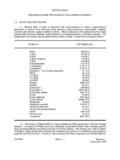
3 These are intended as a guide to instrumental limits typical of a systemoptimized for multielement determinations and employing commercialinstrumentation and pneumatic nebulization sample introduction. However,actual METHOD detection limits (MDLs) and linear working ranges will bedependent on the sample matrix, instrumentation and selected operatingconditions. Given in Table 7 are typical MDLs for both total recoverabledeterminations by "direct analysis" and where sample digestion is reference where this METHOD is approved for use in compliance monitoringprograms [ , Clean Water Act (NPDES) or Safe Drinking Water Act (SDWA)]consult both the appropriate sections of the Code of Federal Regulation (40 CFRPart 136 Table 1B for NPDES, and Part 141 for drinking water), and thelatest Federal Register announcements.
4 ELEMENTS are determined after suitable filtration and acid order to reduce potential interferences, dissolved solids should not (w/v) (Section ). the exception of silver, where this METHOD is approved for the determinationof certain metal and metalloid contaminants in drinking water, samples may beanalyzed directly by pneumatic nebulization without acid digestion if the sampleshave been properly preserved with acid and have turbidity of <1 NTU at the timeof analysis. This total recoverable DETERMINATION procedure is referred to as"direct analysis". the DETERMINATION of total recoverable analytes in aqueous and solid samplesa digestion/extraction is required prior to analysis when the ELEMENTS are not insolution ( , soils, sludges, sediments and aqueous samples that may containparticulate and suspended solids).
5 Aqueous samples containing suspended orparticulate material 1% (w/v) should be extracted as a solid type sample(Section ). total recoverable sample digestion procedure given in this METHOD is notsuitable for the DETERMINATION of volatile organo-mercury compounds. However,for "direct analysis" of drinking water (turbidity <1 NTU), the combinedconcentrations of inorganic and organo-mercury in solution can be determined by"direct analysis" pneumatic nebulization provided gold is added to both samplesand standards alike to eliminate memory interference is only slightly soluble in the presence of chloride unless there is asufficient chloride concentration to form the soluble chloride complex.
6 Therefore,low recoveries of silver may occur in samples, fortified sample matrices and evenfortified blanks if determined as a dissolved analyte or by "direct analysis" wherethe sample has not been processed using the total recoverable mixed aciddigestion. For this reason it is recommended that samples be digested prior tothe DETERMINATION of silver. The total recoverable sample digestion proceduregiven in this METHOD is suitable for the DETERMINATION of silver in aqueous samplescontaining concentrations up to mg/L. For the analysis of wastewatersamples containing higher concentrations of silver, succeeding smaller volume,well mixed sample aliquots must be prepared until the analysis solution contains< mg/L silver.
7 The extraction of solid samples containing concentrations ofsilver >50 mg/kg should be treated in a similar total recoverable sample digestion procedure given in this METHOD willsolubilize and hold in solution only minimal concentrations of barium in thepresence of free sulfate. For the analysis of barium in samples having unknown concentrations of sulfate, analysis should be completed as soon aspossible after sample METHOD should be used by analysts experienced in the use of inductivelycoupled plasma mass spectrometry (ICP-MS), the interpretation of spectral andmatrix interferences and procedures for their correction.
8 A minimum of sixmonths experience with commercial instrumentation is of the METHOD data should state the data-quality objectives prior to of the METHOD must document and have on file the required initialdemonstration performance data described in Section prior to using themethod for analysis. OF aliquot of a well mixed, homogeneous aqueous or solid sample is accuratelyweighed or measured for sample processing. For total recoverable analysis of asolid or an aqueous sample containing undissolved material, analytes are firstsolubilized by gentle refluxing with nitric and hydrochloric acids.
9 After cooling,the sample is made up to volume, is mixed and centrifuged or allowed to settleovernight prior to analysis. For the DETERMINATION of dissolved analytes in afiltered aqueous sample aliquot, or for the "direct analysis" total recoverabledetermination of analytes in drinking water where sample turbidity is <1 NTU,the sample is made ready for analysis by the appropriate addition of nitric acid,and then diluted to a predetermined volume and mixed before analysis. METHOD describes the multi-element DETERMINATION of TRACE ELEMENTS by ICP-MS. Sample material in solution is introduced by pneumatic nebulization into1-3a radiofrequency plasma where energy transfer processes cause desolvation,atomization and ionization.
10 The ions are extracted from the plasma through adifferentially pumped vacuum interface and separated on the basis of their mass -to-charge ratio by a quadrupole mass spectrometer having a minimum resolutioncapability of 1 amu peak width at 5% peak height. The ions transmitted throughthe quadrupole are detected by an electron multiplier or Faraday detector and theion information processed by a data handling system. Interferences relating tothe technique (Section ) must be recognized and corrected for. Such correctionsmust include compensation for isobaric elemental interferences and interferencesfrom polyatomic ions derived from the plasma gas, reagents or sample drift as well as suppressions or enhancements of instrumentresponse caused by the sample matrix must be corrected for by the use of Blank - A volume of reagent water acidified with the same acidmatrix as in the calibration standards.