Transcription of METHOD 200.9 DETERMINATION OF TRACE …
1 OF TRACE ELEMENTS BY stabilized TEMPERATUREGRAPHITE furnace atomic ABSORPTIONR evision Creed, Martin, Lobring, and O'Dell - METHOD , Revision (1991) Creed, Martin, and O'Dell - METHOD , Revision (1994) ENVIRONMENTAL MONITORING SYSTEMS LABORATORY OFFICE OF RESEARCH AND ENVIRONMENTAL PROTECTION AGENCYCINCINNATI, OHIO OF TRACE ELEMENTS BY stabilized TEMPERATUREGRAPHITE furnace atomic AND METHOD provides procedures for the DETERMINATION of dissolved and total1recoverable elements by graphite furnace atomic absorption (GFAA) in groundwater, surface water, drinking water, storm runoff, industrial and domesticwastewater.
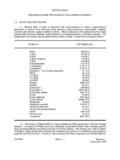
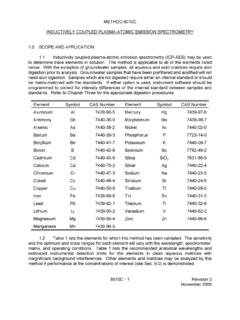
2 This METHOD is also applicable to the DETERMINATION of totalrecoverable elements in sediment, sludges, and soil. This METHOD is applicableto the following analytes:AnalyteRegistry Number (CASRN)Chemical Abstract ServicesAluminum(Al)7429-90-5 Antimony(Sb)7440-36-0 Arsenic(As)7440-38-2 Beryllium(Be)7440-41-7 Cadmium(Cd)7440-43-9 Chromium(Cr)7440-47-3 Cobalt(Co)7440-48-4 Copper(Cu)7440-50-8 Iron(Fe)7439-89-6 Lead(Pb)7439-92-1 Manganese(Mn)7439-96-5 Nickel(Ni)7440-02-0 Selenium(Se)7782-49-2 Silver(Ag)7440-22-4 Thallium(Tl)7440-28-0 Tin(Sn) reference where this METHOD is approved for use in compliance monitoringprograms [ , Clean Water Act (NPDES) or Safe Drinking Water Act (SDWA)]
3 ]consult both the appropriate sections of the Code of Federal Regulation (40 CFRPart 136 Table 1B for NPDES, and Part 141 for drinking water), and thelatest Federal Register announcements. analytes can be determined in aqueous samples after suitable filtrationand acid the exception of silver, where this METHOD is approved for the determinationof certain metal and metalloid contaminants in drinking water, samples may beanalyzed by direct injection into the furnace without acid digestion if the samplehas been properly preserved with acid, has turbidity of <1 NTU at the time ofanalysis, and is analyzed using the appropriate METHOD matrix modifiers.
4 Thistotal recoverable DETERMINATION procedure is referred to as "direct analysis".However, in the DETERMINATION of some primary drinking water metalcontaminants, such as arsenic and thallium preconcentration of the sample maybe required prior to analysis in order to meet drinking water acceptanceperformance criteria (Section ). the DETERMINATION of total recoverable analytes in aqueous and solid samplesa digestion/extraction is required prior to analysis when the elements are not insolution ( , soils, sludges, sediments and aqueous samples that may containparticulate and suspended solids).
5 Aqueous samples containing suspended orparticulate material 1% (w/v) should be extracted as a solid type is only slightly soluble is the presence of chloride unless there is a sufficientchloride concentration to form the soluble chloride complex. Therefore, lowrecoveries of silver may occur in samples, fortified sample matrices and evenfortified blanks if determined as a dissolved analyte or by "direct analysis" wherethe sample has not been processed using the total recoverable digestion. For thisreason it is recommended that samples be digested prior to the DETERMINATION ofsilver.
6 The total recoverable sample digestion procedure given in this METHOD issuitable for the DETERMINATION of silver in aqueous samples containingconcentrations up to mg/L. For the analysis of wastewater samplescontaining higher concentrations of silver, succeeding smaller volume, well mixedaliquots should be prepared until the analysis solution contains < mg/L extraction of solid samples containing concentrations of silver >50 mg/kgshould be treated in a similar detection limits and instrument operating conditions for the applicableelements are listed in Table 2.
7 These are intended as a guide and are typical ofa system optimized for the element employing commercial , actual METHOD detection limits and linear working ranges will bedependent on the sample matrix, instrumentation and selected sensitivity and limited linear dynamic range (LDR) of GFAA often impliesthe need to dilute a sample prior to analysis. The actual magnitude of thedilution as well as the cleanliness of the labware used to perform the dilution candramatically influence the quality of the analytical results. Therefore, samplestypes requiring large dilutions (>50:1) should be analyzed by an anotherapproved test procedure which has a larger LDR or which is inherently lesssensitive than of the METHOD data should state the data-quality objectives prior to of the METHOD must document and have on file the required performance data described in Section prior to using themethod for analysis.
8 OF aliquot of a well mixed, homogeneous aqueous or solid sample is accuratelyweighed or measured for sample processing. For total recoverable analysis of asolid or an aqueous sample containing undissolved material, analytes are firstsolubilized by gentle refluxing with nitric and hydrochloric acids. After cooling,the sample is made up to volume, is mixed and centrifuged or allowed to settleovernight prior to analysis. For the DETERMINATION of dissolved analytes in afiltered aqueous sample aliquot, or for the "direct analysis" total recoverabledetermination of analytes where sample turbidity is <1 NTU, the sample is madeready for analysis by the appropriate addition of nitric acid, and then diluted toa predetermined volume and mixed before analysis.
9 Analytes listed in this METHOD are determined by stabilized temperatureplatform graphite furnace atomic absorption (STPGFAA). In STPGFAA, thesample and the matrix modifier are first pipetted onto the platform or a devicewhich provides delayed atomization. The furnace chamber is then purged witha continuous flow of a premixed gas (95% argon - 5% hydrogen) and the sampleis dried at a relatively low temperature (about 120 C) to avoid spattering. Oncedried, the sample is pretreated in a char or ashing step which is designed tominimize the interference effects caused by the concomitant sample matrix.
10 Afterthe char step the furnace is allowed to cool prior to atomization. The atomizationcycle is characterized by rapid heating of the furnace to a temperature where themetal (analyte) is atomized from the pyrolytic graphite surface into a stopped gasflow atmosphere of argon containing 5% hydrogen. (Only selenium is determinedin an atmosphere of high purity argon.) The resulting atomic cloud absorbs theelement specific atomic emission produced by a hollow cathode lamp (HCL) oran electrodeless discharge lamp (EDL). Following analysis the furnace issubjected to a cleanout period of high temperature and continuous argon the resulting absorbance usually has a nonspecific component associatedwith the actual analyte absorbance, an instrumental background correction deviceis required to subtract from the total signal the component which is nonspecificto the analyte.