Transcription of METHOD 3051 MICROWAVE ASSISTED ACID …
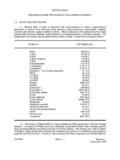
1 CD-ROM3051 - 1 Revision 0 September 1994 METHOD 3051 MICROWAVE ASSISTED acid digestion OF SEDIMENTS, SLUDGES, SOILS, AND SCOPE AND This METHOD is applicable to the MICROWAVE ASSISTED acid digestion ofsludges, sediments, soils, and oils for the following elements:Aluminum Cadmium Iron Molybdenum SodiumAntimony Calcium Lead Nickel StrontiumArsenic Chromium Magnesium Potassium ThalliumBoron Cobalt Manganese Selenium VanadiumBarium Copper Mercury Silver This METHOD is provided as an alternative to METHOD 3050. It isintended to provide a rapid multielement acid leach digestion prior to analysisso that decisions can be made about site cleanup levels, the need for TCLP testing of a waste and whether a BDAT process is providing acceptableperformance.
2 If a decomposition including hydrochloric acid is required forcertain elements, it is recommended that METHOD 3050A be used. Digests producedby the METHOD are suitable for analysis by flame atomic absorption (FLAA),graphite furnace atomic absorption (GFAA), inductively coupled plasma emissionspectroscopy (ICP-ES) and inductively coupled plasma mass spectrometry (ICP-MS).Due to the rapid advances in MICROWAVE technology, consult your manufacturer'srecommended instructions for guidance on their MICROWAVE digestion system andrefer to the SW-846 "DISCLAIMER" when conducting analyses using METHOD SUMMARY OF A representative sample of up to g is digested in 10 mL ofconcentrated nitric acid for 10 min using MICROWAVE heating with a suitablelaboratory MICROWAVE unit.
3 The sample and acid are placed in a fluorocarbon (PFAor TFM) MICROWAVE vessel. The vessel is capped and heated in the MICROWAVE cooling, the vessel contents are filtered, centrifuged, or allowed tosettle and then diluted to volume and analyzed by the appropriate SW-846 METHOD (Ref. 1). Very reactive or volatile materials that may create high pressureswhen heated may cause venting of the vessels with potential loss of sample andanalytes. The complete decomposition of either carbonates, or carbon basedsamples, may cause enough pressure to vent the vessel if the sample size isgreater than g when used in the 120 mL vessels with a pressure relief devicethat has an upper limit of atm (110 10 psi).
4 CD-ROM3051 - 2 Revision 0 September APPARATUS AND MICROWAVE apparatus The MICROWAVE unit provides programmable power with a minimumof 574 W, which can be programmed to within 10 W of the required units provide a nominal 600 W to 1200 W of power. Pressure, orespecially temperature, monitoring and control of the MICROWAVE unit aredesirable. The MICROWAVE unit cavity is corrosion resistant and All electronics are protected against corrosion for safe The system requires fluorocarbon (PFA or TFM) digestionvessels (120 mL capacity) capable of withstanding pressures up to atm (110 10 psi) and capable of controlled pressure relief atpressures exceeding atm (110 10 psi).
5 A rotating turntable is employed to insure homogeneousdistribution of MICROWAVE radiation within the unit. The speed of theturntable should be a minimum of 3 : Those laboratories now using or contemplating theuse of kitchen type MICROWAVE ovens for this METHOD should beaware of several signifant safety issues. First, when an acidsuch as nitric is used to assist sample digestion in microwaveunits in open vessels, or sealed vesselsequippedres, there isthe potential for the acid gases released to corrode thesafety devices that prevent the MICROWAVE magnetron fromshutting off when the door is opened. This can result inoperator exposure to MICROWAVE energy.
6 Use of a unit withcorrosion resistant safety devices prevents this : The second safety concern relates to the use ofsealed containers without pressure relief valves in the is the important variable controlling thereaction. Pressure is needed to attain elevated temperaturesbut must be safely contained. However, many digestion vesselsconstructed from certain fluorocarbons may crack, burst, orexplode in the unit under certain pressures. Only unlinedfluorocarbon (PFA or TFM) containers with pressure reliefmecahnisms or containers with PFA-fluorocarbon liners andpressure relief mechanisms are considered acceptable - 3 Revision 0 September 1994 Users are therefore advised not to use kitchen type microwaveovens or to use sealed containers without pressure reliefvalves for MICROWAVE acid digestions by this METHOD .
7 Use oflaboratory-grade MICROWAVE equipment is required to preventsafety hazards. For further details consult reference : There are many safety and operationalrecommendations specific to the model and manufacturer of themicrowave equipment used in individual laboratories. Thesespecific suggestions are beyond the scope of this METHOD andrequire the analyst to consult the specific equipment manual,manufacturer and literature for proper and safe operation ofthe MICROWAVE equipment and Volumetric graduated cylinder, 50 or 100 mL capacity or Filter paper, qualitative or Filter funnel, glass or disposable polypropylene. Analytical balance, 300 g capacity, and minimum All acids should be sub-boiling distilled where possible to minimizethe blank levels due to metallic contamination.
8 Other grades may be used,provided it is first ascertained that the reagent is of sufficient purity topermit its use without lessening the accuracy of the determination. If thepurity of a reagent is questionable, analyze the reagent to determine the levelof impurities. The reagent blank must be less than the MDL in order to be Concentrated nitric acid , HNO. acid should be analyzed to3determine levels of impurity. If the METHOD blank is less than the MDL,the acid can be Reagent Water. Reagent water shall be interference free. Allreferences to water in the METHOD refer to reagent water unless otherwisespecified (Ref. 3). SAMPLE COLLECTION, PRESERVATION, AND All samples must have been collected using a sampling plan thataddresses the considerations discussed in Chapter Nine of this All sample containers must be prewashed with detergents, acids andwater.
9 Plastic and glass containers are both suitable. See Chapter Three, of this manual, for further Samples must be refrigerated upon receipt and analyzed as soon - 4 Revision 0 September Calibration of MICROWAVE EquipmentNOTE: If the MICROWAVE unit uses temperature feedback controlcapable of replicating the performance specifications of the METHOD ,then the calibration procedure may be Measurement of the available power for heating is evaluatedso that absolute power in watts may be transferred from one MICROWAVE unitto another. For cavity type MICROWAVE equipment, this is accomplished bymeasuring the temperature rise in 1 kg of water exposed to microwaveradiation for a fixed period of time.
10 The analyst can relate power inwatts to the partial power setting of the unit. The calibration formatrequired for laboratory MICROWAVE units depends on the type of electronicsystem used by the manufacturer to provide partial MICROWAVE power. Fewunits have an accurate and precise linear relationship between percentpower settings and absorbed power. Where linear circuits have beenutilized, the calibration curve can be determined by a three-pointcalibration METHOD ( ), otherwise, the analyst must use the multiplepoint calibration METHOD ( ). The multiple point calibration involves the measurement ofabsorbed power over a large range of power settings. Typically, for a 600W unit, the following power settings are measured; 100, 99, 98, 97, 95,90, 80, 70, 60, 50, and 40% using the procedure described in section This data is clustered about the customary working powerranges.