Transcription of MIPS Assembly Language Guide
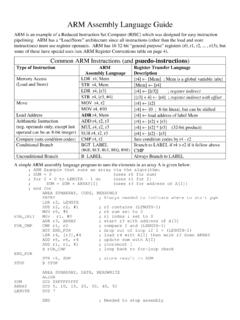
1 MIPS Assembly Language Guide MIPS is an example of a Reduced Instruction Set Computer (RISC) which was designed for easy instruction pipelining. MIPS has a Load/Store architecture since all instructions (other than the load and store instructions) must use register operands. MIPS has 32 32-bit general purpose registers ($0, $1, $2, .. , $31), but some of these have special uses (see MIPS Register Conventions table). Common MIPS Instructions (and psuedo-instructions). Type of Instruction MIPS Register Transfer Language Assembly Language Description Memory Access lw $4, Mem $4 [Mem].
2 (Load and Store) sw $4, Mem Mem $4. lw $4, 16($3) $4 [Mem at address in $3 + 16]. sw $4, 16($3) [Mem at address in $3 + 16] $4. Move move $4, $2 $4 $2. li $4, 100 $4 100. Load Address la $5, mem $4 load address of mem Arithmetic Instruction add $4, $2, $3 $4 $2 + $3. (reg. operands only) mul $10, $12, $8 $10 $12 * $8 (32-bit product). sub $4, $2, $3 $4 $2 - $3. Arithmetic with Immediates addi $4, $2, 100 $4 $2 + 100. (last operand must be an integer) mul $4, $2, 100 $4 $2 * 100 (32-bit product). Conditional Branch bgt $4, $2, LABEL Branch to LABEL if $4 > $2.
3 (bge, blt, ble, beq, bne). Unconditional Branch j LABEL Always Branch to LABEL. A simple MIPS Assembly Language program to sum the elements in an array A is given below: .data array: .word 5, 10, 20, 25, 30, 40, 60. length: .word 7. sum: .word 0. # Algorithm being implemented to sum an array # sum = 0 (use $8 for sum). # for i := 0 to length-1 do (use $9 for i). # sum := sum + array[i] (use $10 for length-1). # end for (use $11 for base addr. of array)..text .globl main main: li $8, 0 # load immediate 0 in reg. $8 (sum). la $11, array # load base addr.
4 Of array into $11. for: lw $10, length # load length in reg. $10. addi $10, $10, -1 # $10 = length - 1. li $9, 0 # initialize i in $9 to 0. for_compare: bgt $9, $10, end_for # drop out of loop when i > (length-1). mul $12, $9, 4 # mult. i by 4 to get offset within array add $12, $11, $12 # add base addr. of array to $12 to get addr. of array[i]. lw $12, 0($12) # load value of array[i] from memory into $12. add $8, $8, $12 # update sum addi $9, $9, 1 # increment i j for_compare end_for: sw $8, sum li $v0, 10 # system code for exit syscall MIPS Guide Page 2 of 10.
5 MIPS Logical Instructions and $4, $5, $6 $4 $5 (bit-wise AND) $6. andi $4, $5, 0x5f $4 $5 (bit-wise AND) 5f16. or $4, $5, $6 $4 $5 (bit-wise OR) $6. ori $4, $5, 0x5f $4 $5 (bit-wise OR) 5f16. xor $4, $5, $6 $4 $5 (bit-wise Exclusive-OR) $6. xori $4, $5, 0x5f $4 $5 (bit-wise Exclusive-OR) 5f16. nor $4, $5, $6 $4 $5 (bit-wise NOR) $6. not $4, $5 $4 NOT $5 #inverts all the bits MIPS Shift and Rotate Instructions sll $4, $5, 3 $4 shift left $5 by 3 positions. Shift in zeros (only least significant 5-bits of immediate value are used to shift).
6 Sllv $4, $5, $6 Similar to sll, but least significant 5-bits of $6 determine the amount to shift. srl $4, $5, 3 $4 shift right $5 by 3 positions. Shift in zeros srlv $4, $5, $6 Similar to srl, but least significant 5-bits of $6 determine the amount to shift. sra $4, $5, 3 $4 shift right $5 by 3 positions. Sign-extend (shift in sign bit). srav $4, $5, $6 Similar to sra, but least significant 5-bits of $6 determine the amount to shift. rol $4, $5, 3 $4 rotate left $5 by 3 positions rol $4, $5, $6 Similar to above, but least significant 5-bits of $6 determine the amount to rotate.
7 Ror $4, $5, 3 $4 rotate right $5 by 3 positions ror $4, $5, $6 Similar to above, but least significant 5-bits of $6 determine the amount to rotate. Common usages for shift/rotate and logical instructions include: 1. To calculate the address of element array[i], we calculate (base address of array) + i * 4 for an array of words. Since multiplication is a slow operation, we can shift the value left two bit positions. For example: la $3, array # load base address of array into $3. sll $10, $2, 2 # logical shift i's value in $2 by 2 to multiply its value by 4.
8 Add $10, $3, $10 # finish calculation of the address of element array[i]. lw $4, 0($10) # load the value of array[i] into $4. 2. Sometimes you want to manipulate individual bits in a string of bits . For example, you can represent a set of letters using a bit-string. Each bit in the bit-string is associated with a letter: bit position 0 with A', bit position 1 with B', .., bit position 25 with Z'. Bit-string bits are set to 1' to indicate that their corresponding letters are in the set. For example, the set { A', B', D', Y' } would be represented as: unused 'Z' 'Y' 'X'.
9 'E' 'D' 'C' 'B' 'A'. { 'A', 'B', 'D', 'Y' } is 000000 0 1 0 0 1 0 1 1. bit position: 25 24 23 4 3 2 1 0. To determine if a specific ASCII character, say C' (6710) is in the set, you would need to build a mask . containing a single 1 in bit position 2. The sequence of instructions li $3, 1 followed by sll $3, $3, 2 . would build the needed mask in $3. If the bit-string set of letters is in register $5, then we can check for the character C' using the mask in $3 and the instruction and $6, $5, $3 . If the bit-string set in $5 contained a C', then $6 will be non-zero; otherwise $6 will be zero.
10 MIPS Guide Page 3 of 10. High-level Language Programmer's View main: CalculatePowers(In: integer numLimit, integer Power( In: integer n, integer e). integer powerLimit). maxNum = 3 integer result maxPower = 4 integer num, pow if e = 0 then result = 1. CalculatePowers(maxNum, maxPower) for num := 1 to numLimit do else if e = 1 then (*) for pow := 1 to powerLimit do result = n .. else end main print num raised to pow power is result = Power(n, e - 1)* n Power(num, pow) end if end for pow return result end for num end Power Compiler uses registers to avoid accessing the run-time stack in memory as much as HLL View of Run-time Stack possible.