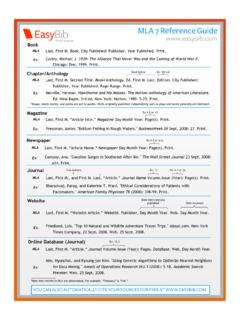
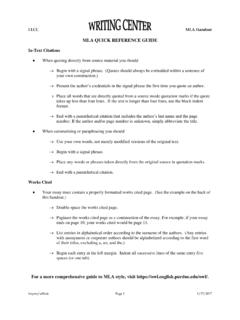
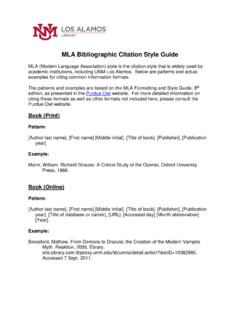
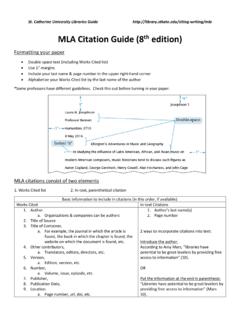
Transcription of MLA 8th Edition Quick Reference - powered by WordPress
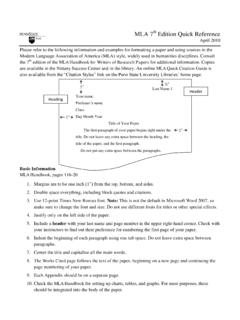
1 MLA 8th Edition Quick Reference Penn State York library, August 2016 Please refer to the following information and examples for guidance in using sources and for formatting a paper in the Modern Language Association of America (MLA) style. Consult the eighth Edition of the MLA Handbook and the MLA Style Center ( ) for additional information. Copies of this handout are available in the Nittany Success Center and in the library. An online MLA Quick Citation guide is also available from the Citation Guides link in the Research section on the Penn State University Libraries home page ( ). Formatting a Research Paper The information presented below reflects the most common formatting for a research paper. Always check with your instructor for specific requirements. 1. Use one inch (1") top, bottom, and side margins.
2 2. Double space everything, including block quotes and citations in the works-cited list. 3. Choose an easily readable font and size, such as 12-point Times New Roman. 4. Justify only on the left side of the paper. 5. Include a running head (header) with your last name and page number in the upper right-hand corner. Check with your instructors to find out their preference for numbering the first page. 6. Center the title and capitalize all the main words. 7. Indent the beginning of each paragraph using one tab space ( "). Do not leave extra space between paragraphs. 8. The Works Cited page follows the text of the paper, beginning on a new page and continuing the page numbering of your paper. 9. Use one space after a period, although you may want to check your instructor s preference. 10. Check for guidance on setting up tables and illustrations.
3 Your name Instructor s name Course number Day Month Year Title of Your Paper The first paragraph of your paper begins right under the title. Do not leave any extra space between the heading, the title of the paper, and the first paragraph. Do not put any extra space between the paragraphs. Heading Running Head Last Name 1 1 1 1 2 Citing Sources and Plagiarism MLA Handbook, pp. 6-10 In scholarship, sources are not selected to fill an arbitrary quota ( find at least five, peer-reviewed journal articles ), but are chosen for their ability to act as compelling evidence in your papers and projects. Citing evidence, therefore, is not busy work. It performs three essential and related functions: It establishes credibility. Citations help readers see the breadth and depth of your research.
4 Readers can also see if you are using appropriate evidence and if you are using that evidence appropriately. It acts as a map. Scholarship is an ongoing conversation. New findings and ideas build on previous findings and ideas; it s how a field of study advances. Citations make those connections explicit for your reader. Not only does this make you more credible, it helps interested researchers track down your evidence for use in their research. It gives credit. Acknowledging those that contribute to the conversation is an essential function of scholarship. It illustrates the debt your research owes to the research that precedes it. Citing sources is often reduced to if you don t give proper credit to the words and ideas of others, it s plagiarism. There are many types of plagiarism; such as using someone else s work and submitting it as your own, failing to appropriately acknowledge others when quoting or paraphrasing, or presenting another s line of thinking as your own.
5 Refer to the MLA Handbook for additional guidance on how to avoid plagiarism. General Guidelines for Authors and Titles MLA Handbook, pp. 61-75 1. Refer to the author by his or her full name the first time it is mentioned in the text, but by last name only thereafter, unless you have two authors with the same last name. In that case, use both the first and last names consistently. 2. Titles of books, plays, magazines, journals, newspapers, movies, television shows, albums, and Web sites are to be italicized. 3. Titles of journal articles, short stories, essays, poems, and songs are in quotation marks. 4. Capitalize the first and last words and all main words in the titles of your sources ( Eight Days a Week, Great Expectations, The Wall Street Journal, The Star-Ledger, The Simpsons, The Raven ).
6 Use of Numbers MLA Handbook, pp. 92-93 1. Spell out numbers that can be written in one or two words (four, thirty-five); use numerals to represent longer numbers (110, 5 ). 2. Do not begin a sentence with a numeral; either spell it out or revise your sentence. 3. Following are examples of the format for inclusive numbers, including page numbers in your works-cited list. The second number is given in full through ninety-nine and when necessary for clarity. 13-35 83-110 101-07 191-217 1,955-59 55-99 625-884 125-52 816-1,954 1,425-922 3 Works Cited MLA Handbook, pp. 20-53, 102-116 The eighth Edition of the MLA Handbook reflects a significant change from previous editions in terms of citing your sources. In the past, you were provided specific instructions for citing sources according to their format; such as books, journal articles, and newspapers.
7 These specific instructions have been replaced in the eighth Edition with a set of principles and a list of core elements. The principles in the eighth Edition of the MLA Handbook are: Cite simple traits shared by most works (3). Remember that there is often more than one correct way to document a source (4). Make your documentation useful to readers (4). The core elements i n the eighth Edition of the MLA Handbook, shown in the order they should appear in the works-cited list and with the appropriate punctuation, are: 1. Author. 2. Title of source. 3. Title of container, 4. Other contributors, 5. Version, 6. Number, 7. Publisher, 8. Publication date, 9. Location. Keep in mind, you will only include those elements that apply to the source you are documenting. CORE ELEMENTS 1.
8 AUTHOR This element ends with a period. MLA Handbook, pp. 21-25, 102-195 Examples: One author: Bok, Derek. Two authors: Berg, Maggie, and Barbara K. Seeber. Three or more authors: von Stumm, Sopie, et al. Editor: Gallagher, Gary W., editor. Corporate author: United Nations. Notes Reverse only the first author s name. The word editor is no longer abbreviated, as it was in the 7th Edition . You do not have to repeat the name of an organization that is both the author and the publisher. In those instances, you will begin your entry with the title; the organization will be listed as the publisher. From MLA Handbook (8th ed.), published by the Modern Language Association ( ). See last page of this handout for a practice template. 4 2. TITLE OF SOURCE This element ends with a period.
9 MLA Handbook, pp. 25-29 Titles of books and Web sites are italicized; titles of journal articles are in quotation marks. According to the MLA Handbook guideline, use italics for sources that are self-contained and independent (25-26) and quotation marks if the source is part of a larger work (25). Use a colon between titles and sub-titles. Examples: Book title: The Slow Professor: Challenging the Culture of Speed in the Academy. Journal article: The Hungry Mind: Intellectual Curiosity Is the Third Pillar of Academic Performance. Web site article: Our History and Mission. 3. TITLE OF CONTAINER This element is followed by a comma. MLA Handbook, pp. 30-36, p. 107 The term container is new to the eighth Edition and refers to the larger whole .. that holds the source (30). Citations may include more than one container.
10 Titles of containers are usually italicized. For example, if your source is a poem that appears in a book, the book is the container. If your source is a journal article accessed through a library database, you will cite two containers: the title of the journal and the name of the online database. In that case, you will follow through with all the information about the first container (the version, number, publisher, publication date, and location) before citing the information about the second container. Examples: Journal title: The Georgia Review, Web site: The Donor Sibling Registry, Journal article from library database Container 1 title: Perspectives on Psychological Science, Container 2 title: Sage Journals Online, Notes: Include articles (A, An, The) if they are part of the journal s title.