Example: marketing
Model-Fitting with Linear Regression: Exponential Functions
General Linear Models: Modeling with Linear Regression I 1 Model-Fitting with Linear Regression: Exponential Functions In class we have seen how least squares regression is used to approximate the linear mathematical function that describes the relationship between a dependent and an independent variable by minimizing the variation on the y ...
Tags:
Information
Domain:
Source:
Link to this page:
Documents from same domain
Critical Approaches to Literature - University of …
www.unm.eduCritical Approaches to Literature Deconstruction is a school of literary criticism that suggests that language is not a stable entity, and that we can never exactly say what we mean.
Step'by-step guide to critiquing research. Part 1 ...
www.unm.eduStep'by-step guide to critiquing research. Part 1: quantitative research Michaei Coughian, Patricia Cronin, Frances Ryan Abstract When caring for patients it is essential that nurses are using the

Inclusion and Exclusion Criteria - New Mexico's …
www.unm.eduPEP 604 Summer, 2010 Dr. Robergs 1 PEP507: Research Methods Inclusion and Exclusion Criteria Inclusion criteria = attributes of subjects that are essential for their
Design for Manufacturing - Guidelines
www.unm.edu1Information taken from Computer-Aided Manufacturing, Second Edition, Tien-Chien chang, Richard A Wysk, and Hsu-Pin Wang. Pages 596 to 598. Prentice Hall 1998 Design for Manufacturing - Guidelines
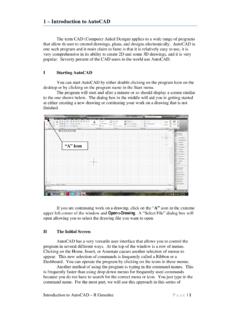
1 – Introduction to AutoCAD
www.unm.eduIntroduction to AutoCAD – R Greenlee Pag e | 1 1 – Introduction to AutoCAD The term CAD (Computer Aided Design) applies to a wide range of programs
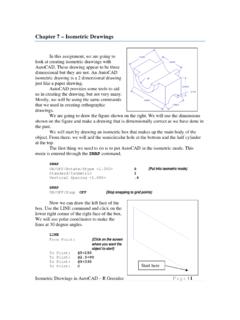
Chapter 7 – Isometric Drawings
www.unm.eduIsometric Drawings in AutoCAD – R Greenlee Page | 1 Chapter 7 – Isometric Drawings In this assignment, we are going to look at creating isometric drawings with
AUDIT OF REAL ESTATE OPERATIONS - The …
www.unm.eduAUDIT OF REAL ESTATE OPERATIONS THE UNIVERSITY OF NEW MEXICO Report 2010-08 October 11, 2011 Audit Committee Members J.E. “Gene” Gallegos, Chair

Chapter 6 – Title Blocks - The University of New …
www.unm.eduTitle Blocks in AutoCAD – R Greenlee Page | 1 Chapter 6 – Title Blocks In previous exercises, every drawing started by creating a number of layers.
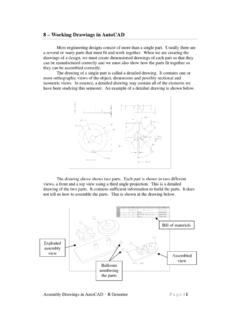
8 – Working Drawings in AutoCAD
www.unm.eduAssembly Drawings in AutoCAD – R Greenlee Pag e | 1 8 – Working Drawings in AutoCAD Most engineering designs consist of more than a single part.
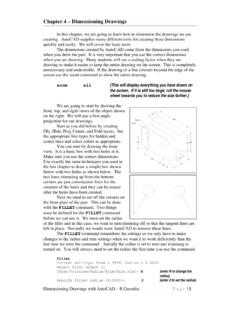
Chapter 4 – Dimensioning Drawings
www.unm.eduDimensioning Drawings with AutoCAD – R Greenlee Page | 3 Continue as we have before and complete the three views. These are shown on the right.
Related documents

Algebra 1 Unit 5 Notes: Comparing Linear, Quadratic, and ...
rikawheaton.weebly.comAlgebra 1 Unit 5: Comparing Linear, Quadratic, and Exponential Functions Notes 2 Standards MGSE9-12.F.LE.1 Distinguish between situations that can be modeled with linear functions and with exponential functions. • MGSE9-12.F.LE.1a Show that linear functions grow by equal differences over equal intervals and that exponential functions grow by equal factors over …

Chapter 2: Linear Functions - Mt. Hood Community College
www.mhcc.eduLinear Function A linear function is a function whose graph produces a line. Linear functions can always be written in the form f (x) =b +mx or f (x) =mx +b; they’re equivalent where b is the initial or starting value of the function (when input, x = 0), and m is the constant rate of change of the function Many people like to write linear functions in the form
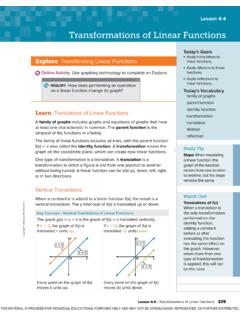
Transformations of Linear Functions - MR. JONES
cjonesmath.weebly.comopri cGraw-Hll Eucaton Example 1 Vertical Translations of Linear Functions Describe the translation in g(x) = x - 2 as it relates to the graph of the parent function. Graph the parent graph for linear functions. Since f(x) = x, g(x) = f(x) + k where . g(x) = x - 2 → The constant k is not grouped with x, so k affects the , or . The value of k is less than 0, so the graph of

EE263 homework problems Lecture 2 – Linear functions and ...
see.stanford.edu2.4 Representing linear functions as matrix multiplication. Suppose that f: Rn −→ Rm is linear. Show that there is a matrix A∈ Rm×n such that for all x∈ Rn, f(x) = Ax. (Explicitly describe how you get the coefficients Aij from f, and then verify that f(x) = Axfor any x∈ Rn.) Is the matrix Athat represents funique?

Worksheet - Review of Linear Functions (Lines)
www.rcsdk12.orgReview of Linear Functions (Lines) Find the slope of each line. 1) 2) Find the slope of the line through each pair of poi nts. 3) (10, 2), (−9, 7) 4) (−16, 11), (−19, −12) Find the slope of each line. 5) y = 3x + 2 6) y = −x + 5 Find the slope of a line parallel to …

Review of Linear Functions (Lines) Date Period
www.somerset.k12.ky.us©8 g2B0h1 e23 yK3u DtVaw FSzo1fItbw KakrOed qLEL eC7. r x LA vl Dlo 2r9i qg LhptLsS Jr Le4s meAr2v4e td y.b M XMraEdpe1 Lwi6tHhX yIWnfji jn Hibtwet gA9lWgqerb pr QaD C1 6.L Worksheet by Kuta Software LLC

Linear Functions - UH
www.math.uh.eduLinear Functions A. Definition and Examples A function f is linear if it can be expressed in the form f ( x) =mx +b where m and b are constants and x is an arbitrary member of the domain of f. Often the relationship between two variables x and y is a linear function expressed as an equation y =mx +b. Examples: