Transcription of Moisture-sensitive Components T - McDRY
1 ROBERT ROWLANDhe topic of Moisture-sensitive Components is rather boring but very important andfrequently misunder-stood. Increased mois -ture- sensitive compo-nent use, such as thin fine-pitchdevices and ball grid arrays (BGA),has increased concern for this fail-ure mechanism. When compo-nents are exposed to the elevatedtemperatures that occur duringreflow soldering, moisture trappedinside plastic surface mountdevices (SMD) produces enoughvapor pressure to damage ordestroy the device. Common fail-ure modes include internal sepa-ration (delamination) of the plas-tic from the die or lead-frame;wire bond damage; die damage;and internal cracks that do notextend to the component extreme cases, cracks willextendto the component surface; in themost severe cases, the componentwill bulge and pop (referred toas the popcorn effect).The IPC Association Con-necting Electronic Industries cre-ated and released IPC-M-109, mois -ture- sensitive component Standardsand Guideline Manual.
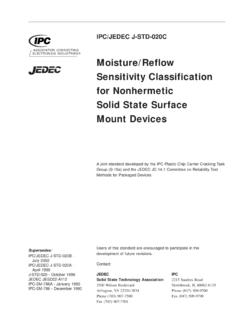
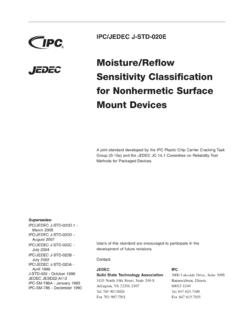
2 It includesthe following seven documents: IPC/JEDEC J-STD-020, moisture /Reflow SensitivityClassification for Plastic Inte-grated Circuit (IC) SMDs IPC/JEDEC J-STD-033, Stan-dard for Handling, Packing,Shipping and Use of MoistureReflow sensitive SMDs IPC/JEDEC J-STD-035,Acoustic Microscopy for Non-hermetic Encapsulated Elec-tronic Components IPC-9501, PWB Assembly Pro-cess Simulation for Evaluationof Electronic Components (Pre-conditioning IC Components ) IPC-9502, PWB Assembly Sol-dering Process Guideline forElectronic Components IPC-9503, moisture Sensitiv-ity Classification for Non-ICComponents IPC-9504, Assembly ProcessSimulation for Evaluation ofNon-IC Components (Precon-ditioning Non-IC Components ).The original moisture -sensitivecomponent document, IPC-SM-786, Procedures for Characterizingand Handling of moisture /ReflowSensitive ICs, no longer is J-STD-020 definesthe classification procedure formoisture- sensitive Components , ,non-hermetic packages made frommoisture-permeable materials suchas plastic.
3 The process includesexposure to reflow soldering tem-peratures followed by detailed visualinspection, scanning acousticmicroscopy, cross-sectioning andelectrical results are based on com-ponent body temperature, becausethe plastic molding is the mainconcern. The standard reflow tem-perature is 220 C +5 /-0 C, butreflow experiments discovered thatsmall volume Components reachtemperatures as high as 235 Cwhen the board is temperatureprofiled for large-volume compo-nents. When the higher temper-ature is a possibility, as would bethe case on boards that containboth small- and large-volume com-ponents, a reflow temperature of235 C is recommended for theevaluation. Convection-dominant,infrared (IR)-dominant or vapor-phase reflow equipment can beused, as long as it can achieve thedesired reflow profile according eight moisture classificationlevels and floor life are listed details regarding soak time criteria, reference J-STD-020. Level 1 unlimited floor lifeat less than or equal to 30 C/85percent RH Level 2 one year floor life atless than or equal to 30 C/60 percent RH Level 2a four week floor lifeat less than or equal to 30 C/60percent RH Level 3 168 hour floor life atless than or equal to 30 C/60 percent RHMoisture- sensitive Componentssurface mountManufacturing component moisture sensitivity is a complex subject that should be understood clearly TReprinted with revisions, from the October 2000 edition of SURFACE MOUNT TECHNOLOGYC opyright 2000 by PennWell Corporation Level 4 72 hour floor life at less thanor equal to 30 C/60 percent RH Level 5 48 hour floor life at less thanor equal to 30 C/60 percent RH Level 5a 24 hour floor life at less thanor equal to 30 C/60 percent RH Level 6 time on label floor life at lessthan or equal to 30 C/60 percent RH.
4 (For level 6, the Components must bebaked before use and reflowed within thetime limit specified on the Moisture-sensitive caution label.)Weight-gain analysis (referenceJ-STD-020) establishes an estimatedfloor life, and weight-loss analysis estab-lishes the bake time required to removeexcess component moisture . J-STD-033 provides detailed information regard-ing bake temperature and J-STD-033 provides rec-ommendations for handling, packing, ship-ping and baking Moisture-sensitive com-ponents. The emphasis is on packaging andpreventing moisture absorption bakingor desiccation should be used as a last resortafter excessive exposure has packing involves sealing Moisture-sensitive Components in moisture -barrierbags with desiccant, a humidity indicatorcard and Moisture-sensitive caution labels contain information regardingshelf life at specific temperature and humid-ity ranges, peak package body temperature(220 or 235 C), exposure time after bagis opened, details about when baking isrequired, the baking procedure, and thebag seal 1.
5 Drying before bagging is optional,bagging and desiccant are optional, andlabeling is not required unless the com-ponents are classified at the 235 C 2. Drying before bagging is optional,bagging and desiccant are required, andlabeling is 2a through 5a. Drying before bag-ging is required, bagging and desiccant arerequired, and labeling is 6. Drying before bagging is optional,bagging and desiccant are optional, and label-ing is drying uses one of two meth-ods: desiccation or baking. Room-temper-ature desiccation, an option for Components that were exposed for less than8 hours to conditions not exceeding 30 Cand 60 percent RH, uses standard dry-packmethods or a dry box capable of maintain-ing 25 5 C with less than 10 percent is a bit more complicated thanmany people realize. There are baking rec-ommendations for pre- and post-dry packbased on level and package thickness. Pre-baking is used to prepare Components fordry packing, while post-baking is used torecondition Components after floor life expi-ration.
6 Review and follow the time/temper-ature recommendations for baking in J-STD-033. Baking temperatures can decrease leadsolderability by oxidizing the leads or caus-ing excessive intermetallic growth. Do notstore Components in an oven at baking tem-perature. Remember, high-temperature trayscan be baked at 125 C, while low-temper-ature trays cannot be baked at temperatureshigher than 40 pre-bake recommendations priorto dry pack are:Package thickness less than or equal to mm:For levels 2a through 5a, bake time rangesfrom 8 to 28 hours at 125 C, or 4 to 14 hoursat 150 thickness less than or equal to mm:For levels 2a through 5a, bake time rangesfrom 23 to 48 hours at 125 C, or 11 to 24hours at 150 thickness less than or equal to mm:For levels 2a through 5a, bake time is 48hours at 125 C or 24 hours at 150 post-bake recommendations afterfloor life has expired are:Package thickness less than or equal to mm:For levels 2a through 5a, bake time rangesfrom 4 to 14 hours at 125 C, or 5 to 19days at 40 thickness less than or equal to mm:For levels 2a through 5a, bake time rangesfrom 18 to 48 hours at 125 C, or 21 to 68days at 40 thickness less than or equal to mm.
7 For levels 2a through 5a, bake time is 48hours at 125 C, or 67 or 68 days at 40 problems with moisture sensi-tivity by becoming familiar with the con-tents of IPC-M-109, moisture -sensitiveComponent Standards and ROWLAND is an SMTE ditorial AdvisoryBoard member, instructor and coauthor of thebook Applied Surface Mount Assembly. He is cur-rently the process engineering manager atRadiSys Corp. in Hillsboro, Ore., and technicalconference director of SMTA International. Heis also an active member of the SMTA and theSurface Mount Council, and a recipient of theSMTA Founders Award. Contact him at (503)615-1354; E-mail: mountManufacturing