Example: quiz answers
Multi-Agent Reinforcement Learning: A Selective Overview ...
A reinforcement learning agent is modeled to perform sequential decision-making by interacting with the environment. The environment is usually formulated as an infinite-horizon discounted Markov decision process (MDP), henceforth referred to as Markov decision process2, which is formally defined as follows.
Tags:
Information
Domain:
Source:
Link to this page:
Documents from same domain
![arXiv:0706.3639v1 [cs.AI] 25 Jun 2007](/cache/preview/4/1/3/9/3/1/4/b/thumb-4139314b93ef86b7b4c2d05ebcc88e46.jpg)
arXiv:0706.3639v1 [cs.AI] 25 Jun 2007
arxiv.orgarXiv:0706.3639v1 [cs.AI] 25 Jun 2007 Technical Report IDSIA-07-07 A Collection of Definitions of Intelligence Shane Legg IDSIA, Galleria …
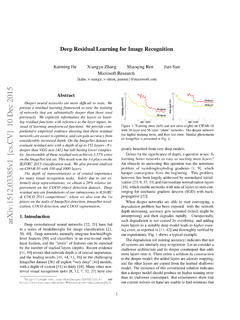
Deep Residual Learning for Image Recognition - …
arxiv.orgDeep Residual Learning for Image Recognition Kaiming He Xiangyu Zhang Shaoqing Ren Jian Sun Microsoft Research fkahe, v-xiangz, v-shren, jiansung@microsoft.com
![arXiv:1301.3781v3 [cs.CL] 7 Sep 2013](/cache/preview/4/d/5/0/4/3/4/0/thumb-4d504340120163c0bdf3f4678d8d217f.jpg)
arXiv:1301.3781v3 [cs.CL] 7 Sep 2013
arxiv.orgFor all the following models, the training complexity is proportional to O = E T Q; (1) where E is number of the training epochs, T is the number of …
![@google.com arXiv:1609.03499v2 [cs.SD] 19 Sep 2016](/cache/preview/c/3/4/9/4/6/9/b/thumb-c349469b499107d21e221f2ac908f8b2.jpg)
@google.com arXiv:1609.03499v2 [cs.SD] 19 Sep 2016
arxiv.orgwhere 1 <x t <1 and = 255. This non-linear quantization produces a significantly better reconstruction than a simple linear quantization scheme. …
A Tutorial on UAVs for Wireless Networks: …
arxiv.orgA Tutorial on UAVs for Wireless Networks: Applications, Challenges, and Open Problems Mohammad Mozaffari 1, ... to UAVs in wireless communications is the work in …
Adversarial Generative Nets: Neural Network …
arxiv.orgAdversarial Generative Nets: Neural Network Attacks on State-of-the-Art Face Recognition Mahmood Sharif, Sruti Bhagavatula, Lujo Bauer Carnegie Mellon University
Massive Exploration of Neural Machine Translation ...
arxiv.orgMassive Exploration of Neural Machine Translation Architectures Denny Britzy, Anna Goldie, Minh-Thang Luong, Quoc Le fdennybritz,agoldie,thangluong,qvlg@google.com Google Brain
Mastering Chess and Shogi by Self-Play with a …
arxiv.orgMastering Chess and Shogi by Self-Play with a General Reinforcement Learning Algorithm David Silver, 1Thomas Hubert, Julian Schrittwieser, Ioannis Antonoglou, 1Matthew Lai, Arthur Guez, Marc Lanctot,1
Going deeper with convolutions - arXiv
arxiv.orgGoing deeper with convolutions Christian Szegedy Google Inc. Wei Liu University of North Carolina, Chapel Hill Yangqing Jia Google Inc. Pierre Sermanet
Andrew G. Howard Menglong Zhu Bo Chen Dmitry ...
arxiv.orgMobileNets: Efficient Convolutional Neural Networks for Mobile Vision Applications Andrew G. Howard Menglong Zhu Bo Chen Dmitry Kalenichenko Weijun Wang Tobias Weyand Marco Andreetto Hartwig Adam
Related documents

Lecture 2: Markov Decision Processes - David Silver
www.davidsilver.ukA Markov decision process (MDP) is a Markov reward process with decisions. It is an environment in which all states are Markov. De nition A Markov Decision Process is a tuple hS;A;P;R; i Sis a nite set of states Ais a nite set of actions Pis a state transition probability matrix, Pa ss0 = P[S t+1 = s0jS t = s;A t = a] Ris a reward function, Ra

An Introduction to Markov Decision Processes
cs.rice.eduA Markov Decision Process (MDP) model contains: • A set of possible world states S • A set of possible actions A • A real valued reward function R(s,a) • A description Tof each action’s effects in each state. We assume the Markov Property: the effects of an action taken in a state depend only on that state and not on the prior history.
Lecture 14: Reinforcement Learning
cs231n.stanford.eduMarkov Decision Process 19 - Mathematical formulation of the RL problem - Markov property: Current state completely characterises the state of the world Defined by: : set of possible states: set of possible actions: distribution of reward given (state, action) pair: transition probability i.e. distribution over next state given (state, action) pair
A Tutorial for Reinforcement Learning - Missouri S&T
web.mst.eduFor Semi-Markov decision problems (SMDPs), an additional parameter of interest is the time spent in each transition. The time spent in transition from state ito state junder the influence of action ais denoted by t(i,a,j). To solve SMDPs via DP, one also needs the transition times (the t(i,a,j) terms). For SMDPs, the average reward that we seek to
Model-Agnostic Meta-Learning for Fast Adaptation of …
www.cs.utexas.eduloss or a cost function in a Markov decision process. meta-learning learning/adaptation rL 1 rL 2 rL 3 1 2 3 Figure 1. Diagram of our model-agnostic meta-learning algo-rithm (MAML), which optimizes for a representation that can quickly adapt to new tasks. In our meta-learning scenario, we consider a distribution
Statistical Decision Theory: Concepts, Methods and ...
probability.caPart I: Decision Theory – Concepts and Methods 5 dependent on θ, as stated above, is denoted as )Pθ(E or )Pθ(X ∈E where E is an event. It should also be noted that the random variable X can be assumed to be either continuous or discrete. Although, both cases are described here, the majority of this report focuses

An Introduction to the WEKA Data Mining System - CCSU
cs.ccsu.eduClassification – decision tree Top-down induction of decision trees (TDIDT, old approach know from pattern recognition): • Select an attribute for root node and create a branch for each possible attribute value. • Split the instances into subsets (one for each branch extending from the node).

ATutorialonThompsonSampling - Stanford University
web.stanford.eduATutorialonThompsonSampling DanielJ.Russo1, BenjaminVanRoy2, AbbasKazerouni2, Ian Osband3 and ZhengWen4 1ColumbiaUniversity 2StanfordUniversity 3GoogleDeepMind ...