Transcription of NC 457 Plan Highlights
1 Automatic payroll deductions. Contributions to the NC 457 plan are made through payroll deduction. You may change or stop your contributions at any time, and no minimum contribution is required. 100% vesting. You are fully vested in the plan from your first contribution to your last. To be vested means to own, which means the money is always yours. Penalty-free withdrawals. Withdrawals from your NC 457 plan account are never subject to a 10% federal income tax penalty, regardless of your age at the time of withdrawal. Remember that the NC 457 plan is a single state plan , administered by the North Carolina Department of State Treasurer, available to all eligible employees whose employers offer the plan . Withdrawal restrictions apply to participants who retire or leave a covered position at an employer that participates in the NC 457 plan , and, after doing so, transition to a covered position with another employer that participates in the plan . Convenient asset To simplify your financial life, the NC 457 plan allows for rollovers from other retirement plans you may have from former employers, including 401(k), 401(a), 403(b), governmental 457 and TSP plans, and some IRAs.
2 Online retirement planning tools. You may access your account 24 hours a day, 7 days a week. You may also access a host of information, interactive calculators and other resources at Multiple investment choices. You can invest in vehicles that range from potentially high growth to highly conservative, so you can make the most appropriate choice to help you meet your savings goals. Simple investing with GoalMaker. GoalMaker is an optional, easy-to-use asset allocation program available at no additional cost that automatically offers you an age-appropriate investment mix based on your investor style. Keep in mind that application of asset allocation and diversification concepts does not assure a profit or protect against loss in a declining market. You can lose money by investing in securities. Quarterly statements to keep you informed. Statements are provided after the end of each quarter to help you monitor activity in your account. One-on-one help. The NC 457 plan has knowledgeable Retirement Education Counselors* strategically located throughout North Carolina to help you to get the most from your participation in the plan .
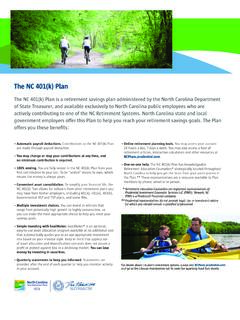
3 ** These representatives are a resource available to plan members by phone, email, in person, or through a virtual one-on-one from your smartphone or NC 457 PlanThe NC 457 plan is a deferred compensation plan administered by the North Carolina Department of State Treasurer, and available exclusively to those North Carolina public employees whose employers offer the plan . This includes full-time, part-time and temporary employees, elected and appointed officials, rehired retired employees, and North Carolina state and local government employees. The plan offers you these benefits:For details about the plan s investment options, please visit and go to the Choose Investments tab to view the quarterly fund fact sheets. 1 The account will track funds rolled over and will be subject to tax penalty rules if withdrawn before age 59 .* Retirement Education Counselors are registered representatives of Prudential Investment Management Services LLC (PIMS), Newark, NJ. PIMS is a Prudential Financial company.
4 ** Prudential representatives do not provide legal, tax or investment advice for which you should consult a qualified with Rollovers into the NC 457 PlanThe plan accepts rollovers from other qualified retirement plans you may have from former employers, including 401(k), 401(a), 403(b), governmental 457 plans and TSP plans, as well as Traditional, Conduit, SIMPLE and SEP IRAs. Under current IRS guidelines, Roth IRAs are not eligible for rollover into the plan . All rollover requests must receive pre-approval from the plan before funds can be received. Initiating a rollover into your NC 457 plan is easy, and it offers many benefits, including: Before rolling over assets from other retirement plans, you should contact those plan providers to inquire about fees or other surrender charges that may be assistance with a rollover into the NC 457 plan call 866-NCPlans (866-627-5267).Flexible ways to contributeTraditional pre-tax contributions Pre-tax contributions are automatically deducted from your paycheck before any current federal or state income taxes are taken out, therefore reducing your taxable income.
5 As a result, your take-home pay is not impacted by the full amount of your contribution. Additionally, these contributions grow tax-deferred until withdrawal. At that point, federal and state income taxes will be incurred. Roth after-tax contributions Roth contributions are automatically deducted from your paycheck after current taxes are paid and therefore reduce your take-home pay dollar for dollar. Roth contributions and earnings grow tax-deferred and can benefit members who anticipate being in a higher tax bracket while in retirement and would rather pay taxes at today s tax rate. Qualified distributions are federal income tax free.* Special One-Time Contributions If you wish to defer additional compensation that will be deducted for only one payroll cycle for reasons such as longevity payments, or final payouts of unused vacation and/or bonus leave, you may coordinate this deduction with your payroll office. You can obtain a One Time Contribution Form by visiting the Tools & Resources tab at Submit the completed form directly to your payroll office.
6 Total annual contributions may not exceed IRS limits. The simplicity of all your retirement savings reported on one quarterly statement, making it easier to monitor your accounts and stay on track toward your retirement savings goals. The potential to save money through reduced plan fees. The convenience of managing all of your retirement savings through one website, one phone number, and with one point of contact for your retirement account questions. The ease of asset allocation, since it s simpler to maintain an investment strategy among your various investments when you can see how they work together.* T here are two separate sets of rules for taking distributions from your NC 457 Roth account on a tax-free basis. The first NC 457 plan rule states you can only take a distribution after you: (i) separate from service; or (ii) attain age 59 while still in service. The second, an IRS rule, defines what is considered a qualified distribution from a Roth Account in order to be tax free.
7 ** Taken together, this means that you can withdraw money from your NC 457 Roth Account tax free once you meet the following criteria: The first Roth contribution to your account must remain in your account for at least five tax years; AND: a) you have separated from service and are age 59 or older; or b) you have separated from service due to a death or disability retirement; or c) you are still working and are at least age 59 . If your withdrawal does not meet these conditions, then the Roth earnings but not the Roth contributions may be subject to state and federal income taxes.**The criteria outlined by the IRS is for tax-free treatment for federal income tax purposes. Your withdrawal may also be eligible for state tax-free save per month$25$100$200$30010 years$4,327$17,308$34,617$51,92515 years$7,924$31,696$63,392$95,08920 years$13,023$52,093$104,185$156,27830 years$30,499$121,997$243,994$365,991 Assumes 7% annual return. The compounding concept is hypothetical and for illustrative purposes only and is not intended to represent performance of any specific investment, which may fluctuate.
8 It is possible to lose money by investing in taxes are considered in the calculations; generally, withdrawals are taxable at ordinary rates. Accessing your money while you are employedWe understand that there may be times when you need to access the funds in your retirement account sooner rather than later. The NC 457 plan gives you the flexibility to do this through: Leave your funds in the plan . Contributions to the plan will stop when you leave employment, but the investments in your account remain invested and continue to work for you. Federal rules require that you must begin taking minimum distributions by April 1 in the year following the year that you turn required minimum distribution age4 72, provided you are no longer working for the plan sponsor (employer). Take a systematic withdrawal (periodic payments to fit your need). You can opt to receive monthly, quarterly, semiannual or annual installment payments. Take a full or partial lump-sum This option allows you to withdraw all or a portion of your entire account balance on an as-needed basis at your discretion.
9 * Roll over all or a part of your balance to an eligible employer-sponsored retirement plan or to an Individual Retirement Account (IRA).3 A rollover to a qualified plan is not subject to taxes or penalties, provided the check is made payable to the financial institution receiving the funds. Generate monthly lifetime income. Transfer all or a portion of your pre-tax account balance to the North Carolina s Teachers and State Employees Retirement System (TSERS) or the Local Government Employees Retirement System (LGERS), where it can be paid as a monthly benefit for your lifetime and/or the lifetime of your designated beneficiary. At or after retirement with TSERS or LGERS, plan members can select from a variety of income stream options in addition to their monthly pension benefit. This one-time, irrevocable transfer is only applicable to pre-tax contributions, including funds rolled into the plan and any employer contributions. When you leave employment, you can choose what to do with your money in the NC 457 PlanThe NC 457 plan is a single state plan , administered by the North Carolina Department of State Treasurer, available to all eligible employees whose employers offer the plan .
10 Withdrawal restrictions apply to participants who retire or leave a covered position at an employer that participates in the NC 457 plan , and, after doing so, transition to a covered position with another employer that participates in the plan .* Please note that if you terminate from service, requests for withdrawals or distributions from your account (not associated with retirement) will not be processed for 60 days. Active employees may be eligible to borrow money from their account for any purpose. Loans are repaid through payroll deduction, with the interest paid directly to your account. The minimum loan is $1,000, and the maximum loan is 50% of your account value, up to $50,000. You have up to five years to repay a loan. There s also a 15-year repayment allowed for the purchase of a primary residence. You may only have one loan outstanding at any time. There is a $60 processing fee for taking out a loan. Please keep in mind that loans and withdrawals can affect your account balance.