Transcription of 意識障害の成因と神経系脱分極現象 - ncvc.go.jp
1 23 23 38, 2014 The mechanism of consciousness disturbance and the significance of neural depolarization in the brainNational Cerebral and Cardiovascular Research Center, Laboratory of Neurology and NeurosurgeryYanamoto Hiroji, , DMSc 2 Japan Coma Scale 4 4
2 Abstract Consciousness can be divided into two dimensions, wakefulness and awareness. Consciousness disturbances in the acute phase due to brain injury, stroke, hypoxia or any other episodes are diagnosed based primarily on the level of wakefulness. When a patient regains spontaneous awake & sleep cycles, he/she is regarded as being in the wakeful state. It is not known why wakefulness, possibly consisting of a complex system, is disturbed in a way that still allows a simple linear scale, such as the Japan coma scale, to be used to represent it, and why the disturbances of wakefulness at various severities, including the comatose state, cease within four weeks.
3 Significantly, the most prolonged recovery from the onset of conscious disturbances to the wakeful state was found to be identical in both rats and humans, when each time period was compared using a biological time scale. Here, the author hypothesizes that spreading or non-spreading depolarizations in the brain triggered by various neural injuries that transiently or persistently suppress electrical neuronal activity, are the principal cause of consciousness ( wakefulness) disturbances during the acute phase. The true condition of the disturbances, always fitting on a simple linear scale and that terminate within four weeks, is spreading depression-like neural depolarizations or membrane potential shift in the words consciousness disturbance, spreading depolarization, wakefulness, persistent vegetative state.
4 Biological time 24 consciousness wakefulness awareness 1 2 / linear scale Japan coma scale JCS 3-3-9 coma unarousable unresponsibleness failure, or silence of the arousal system 4 1 complex system awake system 4 2
5 Failure transient silence 3 1 wakefulness state unresponsive state persistent vegetative state, PVS 1 3 PVS 4 brain stem reticular formation reticular activating system, RAS ascending reticular activating system.
6 ARAS 4 isolated forebrain 5 ARAS ARAS ARAS 25 spirit mind Crick neural correlates of consciousness 6 1 4 7 11 5 7 4 16 15 24 8 4
7 Villablanca - - - 5 Dehaene global workspace brain-scale global neuronal workspace theory GWT 9 conscious processing aware Greenfield neuronal assembly 10 / 5 11 fMRI 75 12
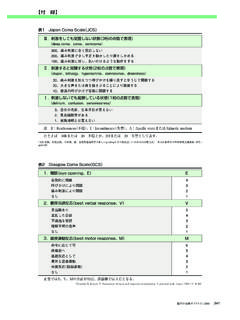
8 DNA 30 default mode network DMN 11 12 DMN conscious awareness 26 slow cortical potential fMRI 10 13 / / JCS Glasgow coma scale GCS
9 JCS wakefulness awareness gathering and understanding information with a prediction or anticipation the disturbance of the wakefulness system