Transcription of NEW ZEALAND DATA SHEET - Medsafe
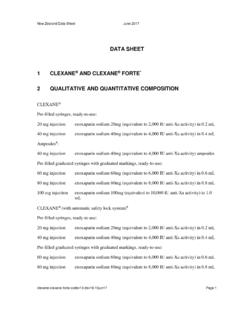
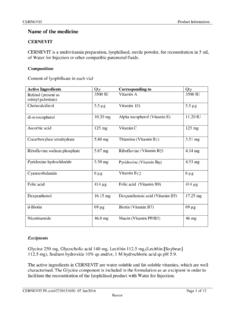
1 NEW ZEALAND data SHEET 1 CERNEVIT (injection, powder) 2 QUALITATIVE AND QUANTITATIVE COMPOSITION Content of lyophilisate in each vial. Active Ingredients Quantity Corresponding to Quantity Retinol (present as retinyl palmitate 3500IU vitamin A 3500IU Colecalciferol g vitamin D3 g dl tocopherol Alpha tocopherol ( vitamin E) Asorbic acid 125mg vitamin C 125mg Cocarboxylase tetrahydrate Thiamine ( vitamin B1) Riboflavin sodium phosphate Riboflavin ( vitamin B2) Pyridoxine hydrochloride Pyridoxine ( vitamin B6) Cyanocobalimin 6 g vitamin B12 6 g Folic acid 414 g Folic acid ( vitamin B9) 414 g Dexpanthenol Dexpantothenic acid ( vitamin B5) d Biotin 69 g Biotin ( vitamin B7) 69 g Nicotinamide 46mg Niacin ( vitamin PP/B3) 46mg The active ingredients in CERNEVIT are water soluble and fat soluble vitamins, which are well characterised. The Glycine component is included in the formulation as an excipient in order to facilitate the reconstitution of the lyophilised product with Water for Injection.)
2 For the full list of excipients, see section 3 PHARMACEUTICAL FORM Injection, powder. CERNEVIT is a multivitamin preparation, lyophilised, sterile powder, for reconstitution in 5mL of Water for Injection or other compatible parenteral fluids. CERNEVIT is a sterile dosage form for injection containing nine water soluble and three fat soluble vitamins ( vitamin K is not included in CERNEVIT), using mixed micelles (glycocholic acid and lecithin) as a solubilising agent. It is presented as a lyophilised, orange yellow, sterile powder. That is to be reconstituted with 5mL of Water for Injections or other parenteral fluids, ( as Sodium chloride, 5% Glucose or nutritional mixtures), prior to administration by parenteral route. 4 CLINICAL PARTICULARS Therapeutic indications CERNEVIT is indicated in adults and children over 11 years of age requiring parenteral multi vitamins supplementation to correct or prevent vitamin deficiencies when oral administration is contraindicated, impossible or insufficient.
3 This product does not contain vitamin K, which may be given separately if required. Cernevit data SHEET 5 April 2017 Page 1 of 11 Baxter Healthcare Ltd NEW ZEALAND data SHEET Dose and method of administration Posology Adults and children aged over 11 years: one vial/day reconstituted with Water for Injection (5mL) or other compatible IV solutions (5mL) as described under Administration and Reconstitution. If infused intravenously, CERNEVIT should be administered slowly. If injected intravenously, the injection must be administered slowly (over at least 10 minutes). The patient's clinical status and vitamin levels should be monitored to ensure maintenance of adequate levels. It should be taken into account that some vitamins, especially A, B2, and B6 are sensitive to ultraviolet light ( , direct or indirect sun light). In addition, loss of vitamins A, B1, C, and E may increase with higher levels of oxygen in the solution.
4 These factors should be considered if adequate vitamin levels are not achieved. Administration and Reconstitution CERNEVIT is a sterile preparation. Thus, aseptic procedure must be applied throughout the administration and reconstitution. The single dose vial of CERNEVIT is reconstituted by adding 5mL of sterile Water for Injection or other intravenous fluids ( Sodium Chloride Injection or 5% Glucose Injection). Five millilitres (5mL) of diluent should be added by means of sterile syringe into the vial and gently mixed to dissolve the lyophilised powder. Before transfer from the vial, CERNEVIT must be completely dissolved. Do not use product unless the reconstituted solution is clear and the original seal is intact. The entire volume of the resultant solution should then be administered by slow Intravenous Injection (at least over 10 minutes) or further diluted for intravenous infusion. Mix the final solution thoroughly when CERNEVIT is used as an admixture in parenteral nutrition.
5 Any unused portion of reconstituted CERNEVIT should be discarded and should not be stored for subsequent admixing. Parenteral medicinal products should be inspected visually for particulate matter and abnormal discoloration prior to administration, whenever solution and container permit. Use of a final filter is recommended during administration of all parenteral nutrition solutions. After reconstitution, CERNEVIT should be used immediately or stored at 2 C to 8 C for no more than 24 hours. Contraindications Hypersensitivity to the active substances or to any of the excipients listed in section CERNEVIT is contraindicated in patients with pre existing hypervitaminosis or known hypersensitivity to CERNEVIT, to any of the active ingredients, or soy/protein products in particular patients with hypersensitivity to thiamine ( vitamin B1). Thus, CERNEVIT should not be injected to patients with pre existing intolerance to thiamine.
6 Similarly, this product should not be administered to patients with impaired hepatic function. CERNEVIT should not be administered to those suffering from hyperparathyroidism due to hypercalcaemic complications. Special warnings and precautions for use Allergic reactions Anaphylactic reactions may occur in allergic subjects who are susceptible to thiamine ( vitamin B1) and nicotinamide components of this product. Mild allergic reactions such as sneezing or mild asthma are warning signs that further injection may give rise to anaphylactic shock. Cernevit data SHEET 5 April 2017 Page 2 of 11 Baxter Healthcare Ltd NEW ZEALAND data SHEET In some cases, the manifestations of a hypersensitivity reaction during intravenous administration of multivitamins may be rate related. The infusion or injection must be stopped immediately if signs or symptoms of a hypersensitivity reaction develop. CERNEVIT contains soy derived lecithin and should be used with caution in patients with peanut allergies due to potential cross reactivity.
7 vitamin toxicity The patients's clinical status and blood vitamin concentrations should be monitored to avoid overdose and toxic effects, especially with Vitamins A,D and E, and in particular in patients who receive additional vitamins from other sources or use other agents that increase the risk of vitamin toxicity. Monitoring is particularly important in patients receiving long term supplementation. Daily vitamin requirements must be calculated in order to avoid overdose and toxic effects, in particular with fat soluble vitamins, such as vitamin A. Caution should be exercised when administering CERNEVIT to patients who may be receiving vitamin A from other sources. The recommended Dietary Intakes (RDI) of vitamin A in pregnant and lactating women as recommended by the NH&MRC is 2500IU (750mcg retinol equivalents). CERNEVIT IV contains 3500IU vitamin A, administered by intravenous route, thus the use of this product in pregnant or lactating women is not recommended.
8 Teratogenic effects have been observed in isolated cases with a dose of vitamin A over 10,000IU per day. The risk for hypervitaminosis A and vitamin A toxicity ( , skin and bone abnormalities, diplopia, cirrhosis) is increased in, for example: patients with protein malnutrition, patients with renal impairment (even in the absence of vitamin A supplementation), patients with small body size ( , paediatric patients), and patients on chronic therapy. Caution should be exercised when administering CERNEVIT to patients who may be receiving vitamin A, D and E from other sources and those receiving long term supplementation. Refeeding syndrome Refeeding severely undernourished patients may result in refeeding syndrome that is characterised by the shift of potassium, phosphorus, and magnesium intracellularly as the patient becomes anabolic. Thiamine deficiency and fluid retention may also develop. Careful monitoring and slowly increasing nutrient intakes while avoiding overfeeding can prevent these complications.
9 Precipitates Pulmonary vascular precipitates have been reported in patients receiving parenteral nutrition. In some cases, fatal outcomes have occurred. Excessive addition of calcium and phosphate increases the risk of the formation of calcium phosphate precipitates. Precipitates have been reported even in the absence of phosphate salt in the solution. Precipitation distal to the in line filter and suspected precipitate formation in the bloodstream have also been reported. In addition to inspection of the solution, the infusion set and catheter should also periodically be checked for precipitates. If signs of pulmonary distress occur, the infusion should be stopped and medical evaluation initiated. Cernevit data SHEET 5 April 2017 Page 3 of 11 Baxter Healthcare Ltd NEW ZEALAND data SHEET Hepatic effects Monitoring of liver function parameters is recommended in patients receiving CERNEVIT. Close monitoring is recommended in patients with hepatic jaundice or other evidence of cholestasis.
10 In patients receiving CERNEVIT, instances of liver enzyme increases have been reported, including isolated alanine aminotransferase (ALT) increases in patients with inflammatory bowel disease. In addition, increases in bile acid levels may occur in patients receiving CERNEVIT. Hepatobiliary disorders including cholestasis, hepatic steatosis, fibrosis and cirrhosis, possibly leading to hepatic failure, as well as cholecystitis and cholelithiasis are known to develop in some patients on parenteral nutrition (including vitamin supplemented parenteral nutrition). The etiology of these disorders is thought to be multifactorial and may differ between patients. Patients developing abnormal laboratory parameters or other signs of hepatobiliary disorders should be assessed early by a clinician knowledgeable in liver diseases in order to identify possible causative and contributory factors, and possible therapeutic and prophylactic interventions.