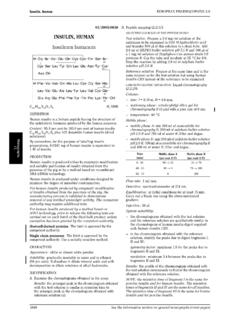
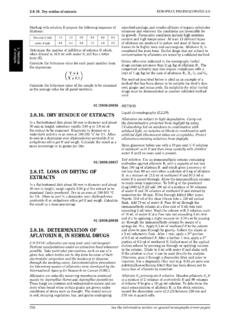
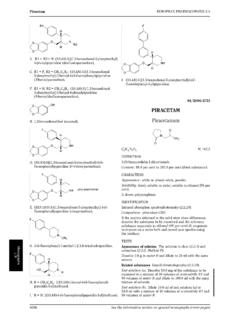
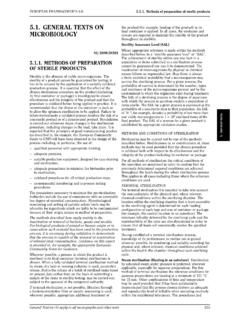
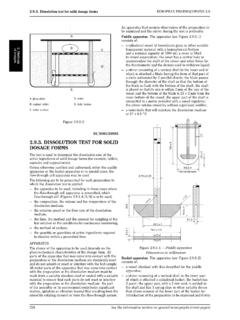
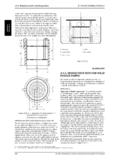
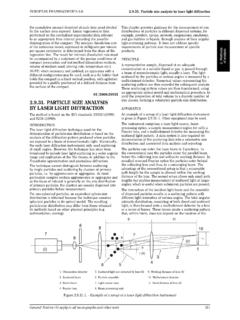
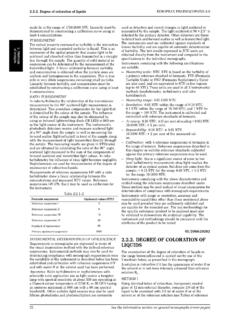
Transcription of Nitrofurantoinum - uspbpep.com
1 european pharmacopoeia ml withwater R. Prepare a reference solution in thesame manner using mg ofnitrofural ( ) of the 2 solutions at the absorptionmaximum at 375 the content of C6H6N4O4from the absorbancesmeasured and the concentrations of the from impurities: A, bis[(5-nitrofuran-2-yl)methylene]diazane ,B. (5-nitrofuran-2-yl)methylene :0101corrected [67-20-9]DEFINITIONN itrofurantoin contains not less than per cent andnot more than the equivalent of per cent of 1-[[(5-nitrofuran-2-yl)methylene]amino]i midazolidine-2,4-dione,calculated with reference to the dried yellow, crystalline powder or yellow crystals, odourlessor almost odourless, very slightly soluble in water and inalcohol, soluble in out the test protected from bright prepared for the assay.
2 Examined between220nmand400nm( ), the solution shows twoabsorption maxima, at 266 nm and 367 nm. The ratio ofthe absorbance at the maximum at 367 nm to that at themaximum at 266 nm is to 1 ml of the solution add ml M alcoholicpotassium hydroxide. A brown colour substances. Examine by thin-layer chromatography( ), usingsilica gel HF254 Ras the coating solution. Dissolve g of the substance to beexamined in a minimum ofdimethylformamide Rand diluteto 10 ml withacetone solution. Dilute 1 ml of the test solution to 100 mlwithacetone separately to the plate 10 l of each solution.
3 Developover a path of 15 cm using a mixture of 10 volumes ofmethanol Rand 90 volumes ofnitromethane plate to dry in air and heat at 100 C to 105 C for5 min. Examine in ultraviolet light at 254 nm. Spray withphenylhydrazine hydrochloride solution Cto105 ultraviolet light and after spraying, any spot in thechromatogram obtained with the test solution, apart fromthe principal spot, is not more intense than the spot in thechromatogram obtained with the reference solution ( percent).Loss on drying( ). Not more than per cent,determined on g by drying in an oven at 105 ash( ).
4 Not more than per cent,determined on out the assay protected from bright light. g in 50 ml ofdimethylformamide Rand dilute ml withwater R. Dilute ml of the solution ml with a solution containing 18 g/l ofsodiumacetate Rand per centV/Vofglacial acetic acid the absorbance ( ) at the absorption maximumat 367 nm, using the sodium acetate solution describedabove as compensation the content of C8H6N4O5, taking the specificabsorbance to be protected from light, at a temperature below 25 [7727-37-9]DEFINITIONN itrogen contains not less than per centV/Vof monograph applies to nitrogen for medicinal colourless, odourless gas.
5 At 20 C and at a pressure of101 kPa, 1 volume dissolves in about 62 volumes of waterand about 10 volumes of , determinedusing an infrared analyser ( ).Gas to be examined. The substance to be examined. It mustbe filtered to avoid stray light gas (a).Usenitrogen (1)applytoallmonographsandothertexts2513 Nitrogen, low-oxygenEUROPEAN pharmacopoeia gas (b). Use a mixture containing 300 ppmV/Vofcarbon dioxide R1innitrogen the apparatus and set the sensitivity usingreference gases (a) and (b). Measure the content of carbondioxide in the gas to be monoxide. Not more than 5 ppmV/V, determinedusing an infrared analyser ( ).
6 Gas to be filtered to avoid stray light gas (a).Usenitrogen gas (b). Use a mixture containing 5 ppmV/Vofcarbon monoxide Rinnitrogen the apparatus and set the sensitivity usingreference gases (a) and (b). Measure the content of carbonmonoxide in the gas to be , determined usingan oxygen analyser with a detector scale ranging from0ppmV/Vto 100 ppmV/Vandequippedwithanelectrochemical gas to be examined passes through a detection cellcontaining an aqueous solution of an electrolyte, generallypotassium hydroxide. The presence of oxygen in the gasto be examined produces variation in the electric signalrecorded at the outlet of the cell that is proportional to theoxygen the analyser according to the instructions of using a suitable pressure regulator and airtightmetal tubes and operating at the prescribed flow-rates untilconstant readings are Not more than 67 ppmV/V,determinedusinganelectrolytic hygrometer ( ).
7 Assay. Examine by gas chromatography ( ).Gas to be examined. The substance to be gas (a). gas (b).Usenitrogen chromatographic procedure may be carried out using: a stainless steel column 2 m long and 2 mm in internaldiameter packed with an appropriate molecular sieve forchromatography ( nm), helium for chromatography Ras the carrier gas at a flowrate of 40 ml/min, a thermal conductivity detector, a loop injector,maintaining the temperature of the column at 50 C andthat of the detector at 130 reference gas (a). Adjust the injected volumes andoperating conditions so that the height of the peak due tonitrogen in the chromatogram obtained with the referencegas is at least 35 per cent of the full scale of the a clear separation of oxygen and the gas to be examined and reference gas (b).
8 Calculatethe content of N2in the gas to be identification: identification: B, Examine the chromatograms obtained in the Assay. Theretention time of the principal peak in the chromatogramobtained with the substance to be examined isapproximately the same as that of the principal peak inthe chromatogram obtained with reference gas (b).B. In a 250 ml conical flask replace the air by the substanceto be examined. Place a burning or glowing splinter ofwood in the flask. The splinter is In a suitable test tube, place g ofmagnesium Rinturnings. Close the tube with a two-hole stopper fittedwith a glass tube reaching about 1 cm above the the substance to be examined through the glasstube for 1 min without heating, then for 15 min whileheating the test tube to a red glow.
9 After cooling, add5mlofdilute sodium hydroxide solution change the colour of moistenedred litmuspaper , determinedusing a carbon dioxide detector tube ( ).Carbon monoxide. Not more than 5 ppmV/V, determinedusing a carbon monoxide detector tube ( ).Water vapour. Not more than 67 ppmV/V, determinedusingawatervapourdetectortube( ).STORAGES tore as a compressed gas or a liquid in appropriatecontainers complying with the legal carbon dioxide,B. carbon monoxide,C. oxygen,D. :1685 NITROGEN, LOW-OXYGENN itrogenium oxygenio monograph applies to nitrogen which is used forinerting finished medicinal products which are particularlysensitive to degradation by oxygen.
10 It does not : minimum per centV/Vof N2,calculatedbydeduction of the sum of impurities found when performingthe test for and odourless : at 20 C and at a pressure of 101 kPa, 1 volumedissolves in about 62 volumes of water and about 10 volumesof :maximum5ppmV/V, determined using an oxygenanalyser with a detector scale ranging from 0 ppmV/Vto100 ppmV/Vand equipped with an electrochemical gas to be examined passes through a detection cellcontaining an aqueous solution of an electrolyte, generallypotassium hydroxide. The presence of oxygen in the gasto be examined produces variation in the electric signalrecorded at the outlet of the cell that is proportional to theoxygen the information section on general monographs (cover pages)