Transcription of NMAM 5524: METALWORKING FLUIDS (MWF) ALL …
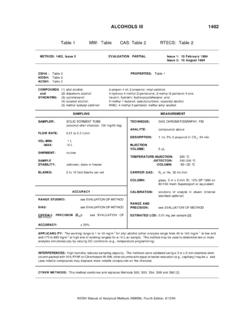
1 NIOSH Manual of Analytical Methods (NMAM), Fifth EditionMETALWORKING FLUIDS (MWF) ALL CATEGORIES5524 DEFINITION: METALWORKING FLUIDS CAS: None RTECS: NoneMETHOD: 5524, Issue 2 EVALUATION: FULL Issue 2: 29 December 2014 Issue 1: 15 March 2003 OSHA : No PELNIOSH: mg/m3 as thoracic fraction ( mg/m3 as total aerosol)OtherOELs: [1,2]*PROPERTIES: Not defined. FLUIDS may contain varying amounts of mineral oil, emulsifiers, water, alkanolamines, polyethoxyethanols, biocides, surfactants, pressure additives and boron : METALWORKING FLUIDS (MWF), metal removal FLUIDS , machining FLUIDS , mineral oils, straight FLUIDS , soluble FLUIDS , synthetic FLUIDS and semi-synthetic fluidsSAMPLINGSAMPLER: Thoracic particles: FILTER + CYCLONE (tared 37-mm, 2- m polytetrafluoroethylene (PTFE) filter + thoracic cyclone) Total particulate: tared 37-mm, 2- m PTFE filterFLOW RATE: Thoracic L/min, Total 2 L/minVOL-MIN.
2 768 L at mg/m3 or mg/m3 MAX: Not determinedSHIPMENT: Ship overnight in a refrigerated containerSAMPLE STABILITY: Refrigerate upon receipt; analyze within 2 weeks of collectionBLANKS: At least 5 field blanks per setBULKSAMPLE: One for each fluid at each site for solubility testingACCURACYRANGE STUDIED: to mg/sampleBIAS: Not determinedOVERALLPRECISION ( rT): Total weight- Extracted weight - (Estimated): Total weight - Extracted weight - : GravimetricANALYTE: Airborne METALWORKING fluid aerosol EXTRACTION: Ternary solvent: dichloromethane: methanol:toluene (1:1:1) Binary solvent: methanol: water (1:1)BALANCE: mg sensitivity.
3 Use same balance before and after sample collectionCALIBRATION: National Institute of Standards and Technology Class weights or ASTM Class 1 weightsRANGE: to 2 mg per sampleESTIMATED LOD: Total weight - mg per sample [3] Extracted weight - mg per sample weight [3]PRECISION ( ): Total weight - ( mg/sample) [4] Extracted weight - ( mg/ sample) [4]SrAPPLICABILITY: The method is applicable to all METALWORKING FLUIDS -straight, soluble, synthetic and semi-synthetic as long as they are soluble in the extraction solvent regimen [4,5]. Only one MWF (Glacier, Solutia Inc.) has thus far been found to be insoluble in the ternary extraction solvent; however, that MWF is soluble in the binary blend and tests have shown that the binary solvent in combination with the ternary solvent is effective in extracting this fluid [6].
4 Thoracic samplers meeting the International Standard ISO 7708 thoracic convention within the performance specifications of the European Standard EN13205, parts 1 through 6 [2] may be considered for this method if they have been validated for the collection of MWF. Depending on the type of thoracic sampler used, the recommended flow rate may differ from that specified above. Sampling at flow rates exceeding those recommended here may result in increased evaporative loss of sample. Welding fume may significantly interfere with proper operation of certain impactor-style Manual of Analytical Methods (NMAM), Fifth EditionMETALWORKING FLUIDS (MWF) all categories : METHOD 5524, Issue 2, dated 29 December 2014 - Page 2 of 10 INTERFERENCES: None identified.
5 However, any material that is collected on the filter and is soluble in the extraction solvents may interfere (positively) with the METHODS: T his method is similar to NMAM Method 0500 for Particulates Not Otherwise Regulated [7] and replaces NMAM Method 5026 as a general technique for analysis of MWF. NMAM Method 5026, which employs infrared analysis, may be used solely for the analysis of (straight) MWF that produce mineral oil mists; that method is not recommended for use with water-based FLUIDS [8]. ASTM D7049 is another method that may be used to analyze METALWORKING FLUIDS [9].
6 REAGENTS:1. Dichloromethane, distilled-in-glass (DIG) (See Note) 2. Methanol, distilled-in-glass (See Note) 3. Toluene, distilled-in-glass (See Note) 4. Water, filtered, double deionized (18 M cm resistivity)5. Calcium sulfate, desiccant6. Ternary solvent blend : Mix equal volumes of dichloromethane, methanol and toluene in a clean dust-free container. Use a bottle with a screw cap ( , a clean, empty solvent bottle): Mix the solvents by gentle swirling, not by violent Binary solvent blend : Mix equal volumes of methanol and water in a clean dust-free container. Use a bottle with a screw cap ( , a clean, empty solvent bottle): Mix the solvents by gentle swirling, not by violent : Lower grade solvents have not been evaluated for this method.
7 If it is desired to use ACS or liquid chromatographic grade solvents, in the interest of economy, the user must demonstrate that these solvents perform equally to the DIG grade ( blanks < those obtained with the DIG grade). See SPECIAL PRECAUTIONSEQUIPMENT:1. Sampler: 37-mm PTFE, 2- m pore size membrane filter (see Appendix 1 for PTFE filter cleanup procedure) and PTFE supporting pad in 37-mm cassette filter holder. Use a 2-piece (closed face) cassette for sampling total aerosol. For sampling the thoracic fraction, use a 3-piece cassette with thoracic cyclone that samples at L/min at the thoracic cutpoint.
8 See Evaluation of Method. Also, see page 5524-1 for discussion of alternative thoracic Personal sampling pump, to 2 L/min, with flexible connecting tubing3. Cassette shrink bands, cellulose, 37-mm size4. Microbalance, capable of weighing to Static neutralizer: , 210Po; replace nine months after the production date6. Forceps (preferably nylon or chrome-plated steel)7. Extraction funnel, See Figure 1 for specifications p. 5524-108. Desiccator9. Wash Bottle, PTFE10. Vials, 20-mL and 10-mL, glass, with leak-proof PTFE-lined caps11. Syringe, gas-tight with large bore needle, , 16-gauge needle12.
9 Graduated cylinder, glass, 20 mL13. Paper towels14. Metal screen for drying filters following extraction, approximately 550 cm2 or other convenient size. Grid size approximately 12 to 18 mm. Pre-wash screen with ternary blend solvent and allow to PRECAUTIONS: Dichloromethane is an inhalation hazard and is a suspect carcinogen. Handle all solvents in a fume hood. The solvents are flammable and have associated adverse health effects. Avoid breathing vapors. Avoid skin contact. Use extreme caution when blending the solvents together. The heat of mixing can cause pressure to develop as the solvents are blended, , blowing a stopper from a glass-stoppered container.
10 Use clean containers sealed with PTFE-lined screwcaps. NIOSH Manual of Analytical Methods (NMAM), Fifth EditionMETALWORKING FLUIDS (MWF) all categories : METHOD 5524, Issue 2, dated 29 December 2014 - Page 3 of 10 CALIBRATION AND QUALITY CONTROL:1. Zero the microbalance before all weighings. Use the same microbalance for weighing filters before and after sample collection. Maintain and calibrate the balance with National Institute of Standards and Technology Class or ASTM Class 1 Process at least three tared media blanks through the measurement process for total aerosol and the extractable OF FILTERS BEFORE SAMPLING:3.