Transcription of NMAM 7907: VOLATILE ACIDS by Ion Chromatography …
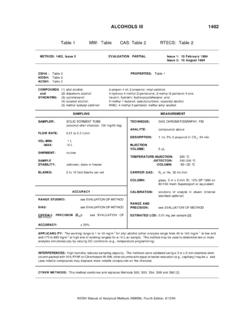
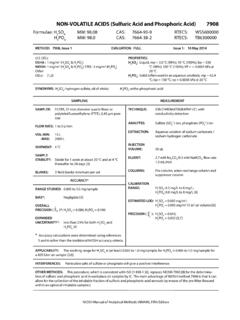
1 NIOSH Manual of Analytical Methods (NMAM), Fifth EditionVOLATILE ACIDS by Ion Chromatography ( hydrogen chloride , hydrogen Bromide, Nitric acid )7907 Formulae: HCl; HBr; HNO3 MW: Table 1 CAS: Table 1 RTECS: Table 1 METHOD: 7907, Issue 1 EVALUATION: FULL Issue 1: 20 May OELs OSHA : Table 2 NIOSH: Table 2 Other OELs: [1,2]PROPERTIES: Table 3 SYNONYMS: HCl: Hydrochloric acid , salt acid , muriatic acid ; HBr: Hydrobromic acid ; HNO3: azotic acidSAMPLINGSAMPLER: Two (2) FILTERS in series separated with a chemically inert spacer: (1) pre-filter: 37-mm diameter quartz fiber filter; (2) sampling filter: 37-mm diameter quartz fiber filter impregnated with 500 l Na2CO3 solution (1 M)FLOW RATE: 2 L/min VOL-MIN: 30 L -MAX: 600 LSHIPMENT: RoutineSAMPLESTABILITY: Stable for 1 week @ 20 C and 4 C thereafter to at least 28 days [3]BLANKS: 3 blanks minimum per setACCURACY*RANGE STUDIED: HCl: to mg/sample; HBr: to mg/sample.
2 HNO3: to mg/sampleBIAS*: Negligible [4]OVERALLPRECISION (rT S)*: HCl, ; HBr, ; HNO3, [4]EXPANDED UNCERTAINTY*: Less than 12% for HCl and HBr; less than 14 % for HNO3 [3,5]*Accuracy calculations were determined using reference 5 rather than the traditional NIOSH accuracy TECHNIQUE: ION Chromatography (IC) with conductivity detectionANALYTES: chloride (Cl-), bromide (Br -) and nitrate (NO-3) ionEXTRACTION: Aqueous solution of sodium carbonate / sodium hydrogen carbonateINJECTIONVOLUME: 25 LELUENT: mM Na2CO3 / mM NaHCO3, flow rate mL/minCOLUMNS: Pre-column, anion-exchange column and suppressor column CALIBRATION RANGE: chloride , bromide and nitrate at mg/mL to 4 mg/mL ESTIMATED LOD: mg/sample for all three ACIDS .
3 Or mg/m3 for a 240 L air volume [4] PRECISION (Sr): for all three ACIDS [3] APPLICABILITY: The working range is (at least) to mg/sample for a 240 Liter air sample [3,4].INTERFERENCES: Inorganic ACIDS can react with co-sampled particulate matter on the pre-filter, leading to low results. One such example is in the galvanizing industry, where the presence of zinc oxide can be a major confounding factor in the measurement of HCl. Potentially interfering particulate chlorides and nitrates removed by the pre-filter can react with the sampled ACIDS and liberate HCl and HNO3 that is subsequently collected on the sampling filter, leading to high results [6].
4 NIOSH Manual of Analytical Methods (NMAM), Fifth EditionVOLATILE ACIDS by Ion Chromatography : METHOD 7907, Issue 1, dated 20 May 2014 - Page 2 of 6 REAGENTS:1. Water, deionized (DI), 18 M -cm resistivity2. Sodium carbonate (Na2CO3), anhydrous, American Chemical Society (ACS) analytical grade3. Sodium hydrogen carbonate (NaHCO3), ACS analytical grade4. Extraction & eluent stock solution: M Na2CO3 / M NaHCO3; Dissolve g Na2CO3 and g NaHCO3 in 50 mL of deionized water and swirl to mix. Then bring to 200 mL in a volumetric flask, stopper and mix Extraction and eluent solution; M Na2CO3/ M NaHCO3: transfer 10 mL M Na2CO3 / M NaHCO3 stock solution to a 2 liter volumetric flask, dilute to the mark with deionized water, stopper and mix chloride (Cl-), bromide (Br -) and nitrate (NO3-) standard solutions, 1000 Calibration stock solution, 100 g/mL (as the anion): Transfer 10 mL aliquots of chloride , bromide and nitrate standard solution into a 100 mL volumetric flask, dilute to the mark with deionized water, stopper and mix Sodium carbonate solution, for impregnation of 37 mm diameter quartz fiber filters, 1 mol/L.
5 Dissolve g Na2CO3 in deionized water, quantitatively transfer the solution into a 100 ml volumetric flask, dilute to the mark with deionized water, stopper and mix Preparation of the sampling filter: Apply 500 L of the sodium carbonate solution, 1 mol/L, evenly on the 37 mm quartz fiber filter and allow to dry for 6 hours in a desiccator. (See NOTE 1, Step 1, p 7907-3.) Good for 14 days.*See Special PrecautionsEQUIPMENT: 1. Sampler: filter, 37-mm diameter quartz fiber impregnated with 500 l 1 M Na2CO3; and pre-filter, 37-mm diameter quartz fiber filter separated by a spacer in a chemically inert cassette filter holder2.
6 Spacers, of 37-mm diameter suitable for use with the samplers, manufactured from a chemically inert material, polypropylene sleeves3. Personal sampling pump, 1 to 5 L/min, with flexible connecting tubing4. Ion chromatograph (IC), with pre-column (50 mm by mm), anion-exchange column (200 mm by mm), suppressor column (4 mm) and conductivity detector; and connected to data processing unit5. Ultrasonic bath6. Vessels, 15-mL, plastic, with screw caps7. Volumetric flasks, 10- to 2000 mL8. Pipets, 10 to 5000 L9. Beakers, 25 to 100 mL10. Water purification system, to prepare 18 M -cm resistivity deionized water11.
7 Bottles, polyethylene, 100 mL12. Syringes, plastic, 5 mL13. Syringe filter cartridges, with m pore size polytetrafluoroethylene (PTFE) membrane filters14. Micro-syringes, 50 L, with 60 mm x mm needles15. Auto-sampler vials, with slotted septum, 2 mL capacity16. Analytical balance, with capability of weighing to nearest mg OTHER METHODS: This procedure, which is consistent with ISO 21438-2 [4], replaces NIOSH 7903 [7] for the determination of HCl, HBr and HNO3 in workplace air samples by IC. The main advantage of this method is that it provides for lower limits of detection and quantitation for VOLATILE ACIDS due to higher sampling flow Manual of Analytical Methods (NMAM), Fifth EditionVOLATILE ACIDS by Ion Chromatography : METHOD 7907, Issue 1, dated 20 May 2014 - Page 3 of 6 SPECIAL PRECAUTIONS: Wear gloves, lab coat, and safety glasses while handling ACIDS .
8 All work should be performed with adequate ventilation for personnel and equipment. It is imperative that acid be added to water in order to avoid a violent exothermic reaction. Avoid direct contact since ACIDS are both corrosive and irritants to eyes, skin, and the respiratory system [8,9].SAMPLING, SAMPLE TRANSPORT AND STORAGE:1. Prior to sampling, load each clean sampler, first with a sampling (impregnated) filter, then with a pre-filter, separating the filters with a spacer. Ensure that the configuration in which the filters are loaded leads to the sampled air passing first through the pre-filter and then through the sampling 1: Three-piece polystyrene cassettes are appropriate, with the middle ring section of the cassette acting as the spacer.
9 Impregnated filters that are stored in a desiccator can be prepared up to 14 days prior to their use for 2: Silica gel sorbent tubes [7] can be used in lieu of impregnated filters, but each sorbent tube must be preceded by a Calibrate each personal sampling pump with a representative sampler in the Sample accurately at 2 L/min for a total sample size of 30 to 500 L. Avoid sampler overloading [6].4. Transport the samples to the laboratory in a manner that prevents contamination or damage to the Submit at least three blank impregnated filters as field blanks for each set of samples collected per day.
10 Handle these in the same way as the field Ship all samples to the laboratory in accordance with established chain-of-custody procedures [10]. 7. The samples can be stored at room temperature for one week; for longer storage, refrigerate the samples (4 C).8. Analyze samples between 4 days and 4 weeks of sample collection. SAMPLE PREPARATION: 9. Prior to carrying out sample dissolution, store the sampling filter for at least four days (to avoid nitric acid losses).10. Remove sample cassettes from storage and bring them to room temperature. Discard the : If desired, the pre-filters can be analyzed for determination of particulate chlorides, bromides and nitrates.