Transcription of NORSOK STANDARD R-002
1 This NORSOK STANDARD is developed with broad petroleum industry participation by interested parties in the Norwegian petroleum industry and is owned by the Norwegian petroleum industry represented by The Norwegian Oil Industry Association (OLF) and The Federation of Norwegian Industry. Please note that whilst every effort has been made to ensure the accuracy of this NORSOK STANDARD , neither OLF nor The Federation of Norwegian Industry or any of their members will assume liability for any use thereof. Standards Norway is responsible for the administration and publication of this NORSOK STANDARD . Standards Norway Telephone: + 47 67 83 86 00 Strandveien 18, Box 242 Fax: + 47 67 83 86 01 N-1326 Lysaker Email: NORWAY Website: Copyrights reserved NORSOK STANDARD R-002 Draft Edition 2, December 2008 Lifting equipment NORSOK STANDARD R-002 Draft Edition 2, December 2008 NORSOK STANDARD Page 3 of 40 Foreword 4 Introduction 4 1 Scope 5 2 Normative and informative references 5 Normative references 5 Informative references 7 3 Terms.
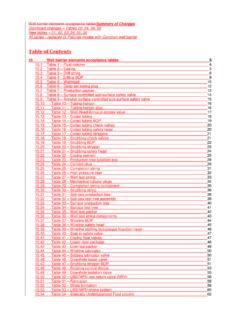
2 Definitions and abbreviations 8 Abbreviations 11 4 General safety requirements 11 Safety 11 Fitness for use 11 Reliability and availability 12 Principle of safety integration 12 Inherently safe design 12 Safeguarding and complementary protective measures 12 Information for use 12 Strength proportion 12 Maintenance 12 Quality management system 13 Risk assessment 13 Evaluation of risks 15 Risk reduction 15 Documentation of risk assessment 15 Verification 16 5 Common requirements 16 Suitability 16 Materials and products 17 Fire and explosion 17 Ergonomics 17 Environmental conditions 19 Operational loads 20 Strength and stability structure and mechanisms 20 Strength and stability classification 20 High risk applications 20 Power systems 20 Electro technical equipment 21 Non-electro technical equipment 21 Control systems and control station 21 Limiting and indicating devices 21 Emergency systems 21 Communication 22 Pneumatics 22 Hydraulics 22 Electromagnetic compatibility (EMC) 22 Exhaust and noise emissions 22 Utility systems 23 Fabrication 23 Installation and assembly 23 Corrosion protection 23 Technical construction file 23 Annex A (Normative) Launching and recovery appliances for life saving equipment 25 Annex B (Normative) Material handling principles 35 NORSOK STANDARD R-002 Draft Edition 2, December 2008 NORSOK STANDARD Page 4 of 40 Foreword The NORSOK standards are developed by the Norwegian petroleum industry to ensure adequate safety, value adding and cost effectiveness for petroleum industry developments and operations.
3 Furthermore, NORSOK standards are, as far as possible, intended to replace oil company specifications and serve as references in the authorities regulations. The NORSOK standards are normally based on recognised international standards, adding the provisions deemed necessary to fill the broad needs of the Norwegian petroleum industry. Where relevant, NORSOK standards will be used to provide the Norwegian industry input to the international standardisation process. Subject to development and publication of international standards, the relevant NORSOK STANDARD will be withdrawn. The NORSOK standards are developed according to the consensus principle generally applicable for most standards work and according to established procedures defined in NORSOK A-001. The NORSOK standards are prepared and published with support by The Norwegian Oil Industry Association (OLF), The Federation of Norwegian Industry, Norwegian Shipowners Association and The Petroleum Safety Authority Norway.
4 NORSOK standards are administered and published by Standards Norway. Introduction The main purpose of this NORSOK STANDARD is to contribute to an acceptable level of safety for humans, the environment and property in the petroleum industry by stating technical requirements for the various lifting equipment used. During development of this NORSOK - STANDARD , due consideration has been made to relevant EU Directives, Norwegian regulations, European STANDARD and International STANDARD , as well as other rule setting documents which have been found relevant and suitable. It should, however, be noted that this NORSOK STANDARD is neither a harmonised STANDARD , nor contains all the technical and administrative requirements of the applicable regulations and directives, so that it is not sufficient itself for CE-marking of products. The manufacturer needs to comply with the relevant regulations and all applicable requirements regardless of the content of this NORSOK STANDARD .
5 To a great extent references to standards have been used in this NORSOK STANDARD in order to ensure quality and safety development when standards are revised, but also to avoid that this NORSOK STANDARD is becoming very extensive and comprehensive. The expert group responsible for this NORSOK STANDARD has agreed that the main safety philosophy and principal requirements shall be based on the essential safety and health requirements stated in relevant EU directives, the Machinery directive 98/37 EEC. This shall apply regardless of the type of installation or unit where the lifting equipment is installed. However, the administrative requirements, ( CE marking, declaration of conformity, requirements for type approvals, etc.) are not part of this NORSOK STANDARD . Due consideration is also made to the requirements in the revised Machinery directive 2006/42/EC which will enter into force on 29 December 2009.
6 In addition, the PSA aim of ensuring a high level as regards health, environment and safety in the petroleum activities, has been reflected. NORSOK STANDARD R-002 Draft Edition 2, December 2008 NORSOK STANDARD Page 5 of 40 1 Scope This NORSOK STANDARD states and develops a high technical safety level on lifting equipment for use in the petroleum industry. This NORSOK STANDARD is valid for lifting equipment on all fixed and floating installations, mobile offshore units, barges and vessels, as well as on land based plants where petroleum activities are performed. 2 Normative and informative references The following standards include provisions and guidelines which, through reference in this text, constitute provisions and guidelines of this NORSOK STANDARD . Latest issue of the references shall be used unless otherwise agreed. Other recognized standards may be used provided it can be shown that they meet the requirements of the referenced standards.
7 Normative references CEN/TS 13001-3-2, Cranes - General design - Part 3-2: Limit states and proof of competence of wire ropes in reeving systems IEC 60034, Rotating electrical machines IEC 60204-1, Safety of machinery Electrical equipment of machines - Part 1: General requirements IEC 60204-32, Safety of machinery - Electrical equipment of machines - Part 32: Requirements for hoisting machines IEC 60529, Degrees of protection provided by enclosures NEK IEC 60300-3-11, Dependability management - Part 3-11: Application guide - Reliability centred maintenance NEK IEC 60812, Analysis techniques for system reliability - Procedure for failure mode and effects analysis (FMEA) NEK IEC 61000-6-4, Electromagnetic compatibility (EMC) - Part 6-4: Generic standards - Emission STANDARD for industrial environments NEK EN IEC 61131-1, Programmable controllers -- Part 1: General information NEK IEC 61892 (all parts), Mobile and fixed offshore units - Electrical installations NEK EN/TR 61831, On-line analyser systems - Guide to design and installation ISO 3864, Graphical symbols -- Safety colours and safety signs - Part 1: Design principles for safety signs in workplaces and public areas Graphical symbols -- Safety colours and safety signs -- Part 2: Design principles for product safety labels Graphical symbols -- Safety colours and safety signs -- Part 3: Design principles for graphical symbols for use in safety signs ISO 6309, Fire protection -- Safety signs iso 9001 , Quality management systems - Requirements ISO 12482-1, Cranes -- Condition monitoring -- Part 1: General ISO 13200, Cranes -- Safety signs and hazard pictorials General principles ISO 13849-1, Safety of machinery -- Safety-related parts of control systems -- Part 1.
8 General principles for design ISO 12482-1, Cranes -- Condition monitoring -- Part 1: General ISO/TR 14121-2, Safety of machinery -- Risk assessment -- Part 2: Practical guidance and examples of methods NS-EN 341, Personal protective equipment against falls from a height - Descender devices NS-EN 349, Safety of machinery - Minimum gaps to avoid crushing of parts of the human body NS-EN 361, Personal protective equipment against falls from a height - Full body harnesses NS-EN 364, Personal protective equipment against falls from a height - Test methods NS-EN 365, Personal protective equipment against falls from a height - General requirements for instructions for use and for marking NORSOK STANDARD R-002 Draft Edition 2, December 2008 NORSOK STANDARD Page 6 of 40 NS-EN 614-1, Safety of machinery - Ergonomic design principles - Part 1: Terminology and general principles NS-EN 614-2, Safety of machinery - Ergonomic design principles - Part 2: Interactions between the design of machinery and work tasks NS-EN 795, Protection against falls from a height - Anchor devices - Requirements and testing NS-EN 818-1, Short link chains for lifting purposes - Safety - Part 1: General conditions of acceptance NS-EN 818-2, Short link chain for lifting purposes - Safety - Part 2: Medium tolerance chain for chain slings - Grade 8 NS-EN 818-6, Short link chain for lifting purposes - Safety - Part 6.
9 Chains slings - Specification for information for use and maintenance to be provided by the manufacturer NS-EN 842, Safety of machinery - Visual danger signals - General requirements, design and testing NS-EN 953, Safety of machinery - Guards - General requirements for the design and construction of fixed and movable guards NS-EN 982, Safety of machinery - Safety requirements for fluid power systems and their components NS-EN 983, Safety of machinery - Safety requirements for fluid power systems and their components Pneumatics NS-EN-ISO 898, Mechanical properties of fasteners made of carbon steel and alloy steel - Part 1: Bolts, screws and studs NS-EN iso 9001 , Quality management systems - Requirements ( iso 9001 :2000) NS-EN ISO 11688-1, Acoustics - Recommended practice for the design of low-noise machinery and equipment - Part 1: Planning (ISO/TR 11688-1:1995) NS-EN ISO 11688-2, Acoustics - Recommended practice for the design of low-noise machinery and equipment - Part 2: Introduction to the physics of low-noise design (ISO/TR 11688-2:1998) NS-EN ISO 12100-1, Safety of machinery, Basic conceps, general principles for design Part 1: Basic terminology, methodology NS-EN ISO 12100-2, Safety of machinery, Basic conceps, general principles for design Part 2: Technical Principles NS-EN ISO 12944, Paints and varnishes - Corrosion protection of steel structures by protective paint systems - Part 1: General introduction NS-ISO 14121-1, Safety of machinery Risk assessment Part 1.
10 Principles NS-EN ISO 13850, Safety of machinery -- Emergency stop -- Principles for design NS-EN ISO 13857, Safety of machinery - Safety distances to prevent hazard zones being reached by upper and lower limbs NS-ISO 2631-1, Mechanical vibration and shock -- Evaluation of human exposure to whole-body vibration Part 1: General requirements NS-EN ISO 1421, Rubber- or plastics-coated fabrics -- Determination of tensile strength and elongation at break NS-EN 1127-1, Explosive atmospheres - Explosion prevention and protection Part 1: Basic concepts and methodology NS-EN 13586, Cranes Access NS-EN 12644-1, Cranes Information for use and testing - Part 1: Instructions NS-EN 12644-2, Cranes Information for use and testing - Part 2: Marking NS-EN 1037, Safety of machinery- Prevention of unexpected start-up NS-EN 13001-1, Cranes - General design - Part 1: General principles and requirements - (Corrigendum AC: 2006 incorporated) NS-EN 13001-2, Cranes - General design - Part 2: Load actions - (Corrigendum AC: 2006 incorporated) NS-EN 1679-1, Reciprocating internal combustion engines - Safety - Part 1: Compression ignition engines NS-EN 1834-1, Reciprocating internal combustion engines - Safety - Part 1: Compression ignition engines NS-EN 12198, Safety of machinery - Assessment and reduction of risks arising from radiation emitted by machinery - Part 2: Radiation emission measurement procedure NS-EN 13001-2, Cranes - General design - Part 2: Load actions - (Corrigendum AC: 2006 incorporated) NORSOK STANDARD R-002 Draft Edition 2, December 2008 NORSOK STANDARD Page 7 of 40 NS-EN 13135-1, Cranes - Safety - Design - Requirements for equipment - Part 1: Electrotechnical equipment- (Corrigendum AC: 2006 incorporated) NS-EN 13135-2, Cranes - Equipment - Part 2.