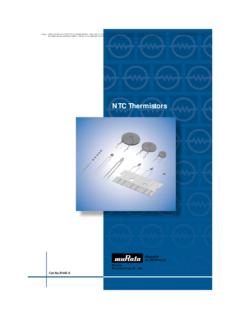
Transcription of NTC Thermistors - Vishay
1 Vishay BCCOMPONENTSR esistive ProductsApplication NoteNTC NOTE Revision: 18-Jul-171 Document Number: 29053 For technical questions, contact: DOCUMENT IS SUBJECT TO CHANGE WITHOUT NOTICE. THE PRODUCTS DESCRIBED HEREIN AND THIS DOCUMENTARE SUBJECT TO SPECIFIC DISCLAIMERS, SET FORTH AT APPLICATIONSNTC temperature sensors are widely used in motor vehicles. For example: Inlet air-temperature control Transmission oil temperature control Engine temperature control Airco systems Airbag electronic systems Temperature detection of laser diode in CD players for cars Frost sensors ABS BMS/ Charge plugs protectionDOMESTIC APPLIANCESNTC temperature sensors are in virtually all equipment in the home where temperature plays a role.
2 This includes Fridges and freezers Cookers and deep-fat fryers Washing machines and dish washers Central-heating systems Air conditioningINDUSTRIAL, TELECOMMUNICATIONS, CONSUMERIn switching, measuring and detection systems Process control Heating and ventilation Air conditioning Fire alarms Temperature protection in battery management/charging systems LCD contrast control in flat-panel displays, mobile phones and camcorders Temperature compensation of quartz oscillator frequency in, for example, mobile phones Ink-jet printer head temperature detection Video and audio equipment LED control circuits SELECTION CHARTPRODUCT RANGEOPERATING TEMP. RANGE( C) R ( %)OR ON T ( C)BTOL.
3 ( %)RESP. TIME (S)MAX. (MM)LEADDOCUMENT NUMBER (MM)L(MM)Accuracy lineNTCLE203E3-40 to +125(1 , 2, 3, 5) % to to +125(2, 3, 5) % to to + Ctwo-point to + Ctwo-point versionsNTCS0603E3-40 to +150(1, 2, 3, 5) %1----29056 NTCS0402E3-40 to +150(1, 2, 3, 5) %3----29003 NTCS0805E3-40 to +150(1, 2, 3, 5) % to +1251 %1----29151 NTC ThermistorsApplication BCcomponentsAPPLICATION NOTE Revision: 18-Jul-172 Document Number: 29053 For technical questions, contact: DOCUMENT IS SUBJECT TO CHANGE WITHOUT NOTICE. THE PRODUCTS DESCRIBED HEREIN AND THIS DOCUMENTARE SUBJECT TO SPECIFIC DISCLAIMERS, SET FORTH AT A lot of application dedicated sensors NTCA (cap types, immersion types, screw types.)
4 Are also proposed: the list is too long to be presented here. Please refer to SUMMARYACCURACY LINENTCLE203E3 and NTCLE100E3 The flagship of our ranges. The accuracy Line sensors offer real value for money. They have low tolerances (as low as 1 % on the R25-value and % on the B-value) and an operating temperature range from -40 C to +125 C. In addition, they are very stable over a long TEMPERATURE SENSROSNTCS0402, NTCS0603 and NTCS0805 seriesOur surface mount NTC sensors for temperature sensing and compensation embody all the qualities of Vishay BCcomponents NTC technology. The sensors come in a full range of R25-values from 2 k to 680 k with standard tolerances from 1 % to 5 %.
5 If special stability criteria are of application, our special series (1 R25 value per case) is highly TEMPERATURE SENSORSNTCSMELFE3 and NTCLG100E2 This range of high-quality glass-encapsulated NTC temperature sensors are price-competitive for general use. Not only can the leaded sensor be used at up to 300 C, but their glass encapsulation makes them ideal for use in corrosive atmospheres and harsh environments. This makes them an attractive alternative to other more expensive sensing methods. Two types of small glass envelopes are available: SOD 27 for sensors with leads, and SOD 80 ( MELF execution) for leadless, surface-mount sensors.
6 NTCSMELF and NTCLG are not recommended for automotive components are designed for all automotive applications (especially ECT sensors). Their coating is withstanding harsh potting conditions. These components are compliant to the AEC-Q200 bondable dieNTCC200 / NTCC300-55 to +175(1, 2, 3, 5) %1----29153 Miniature accuracy lineNTCLE300E3-40 to +125 to +125 to +125 to 1 / NTCLE428-40 to +105 (1, 2, 3, 5) % to temperatureNTCSMELFE3-40 to +1505 % to +3005 % max. long-leaded (UL2468 PVC insulation): NTCLS100E3-40 to +853 % to 3158 AWG2440029060 NTCLP100E3-40 to +853 % to 3106 AWG2440029060 NTCLE400E3-40 to +853 % to 376 AWG2440029060 Ring Tongue SensorsNTCALUG02 series-55 to +125(1, 2) % series-40 to +125 (2, 3) % to series-40 to +150 5 % to +150(long term) 2 % CHARTNTC ThermistorsApplication BCcomponentsAPPLICATION NOTE Revision: 18-Jul-173 Document Number: 29053 For technical questions, contact: DOCUMENT IS SUBJECT TO CHANGE WITHOUT NOTICE.
7 THE PRODUCTS DESCRIBED HEREIN AND THIS DOCUMENTARE SUBJECT TO SPECIFIC DISCLAIMERS, SET FORTH AT CHIP ACCURACY LINENTCLE201E3 NTCLE300E3 NTCLE305E4 These sensors combine the features of the accuracy line with non-insulated or insulated leads for remote sensing LONG-LEADED SENSORSNTCLS100E3 NTCLP100E3 NTCLE400E3 For special applications we can supply three types of long-leaded sensors: water-resistant sensors for use in humid conditions, pipe sensors for use in corrosive atmospheres and epoxy-coated sensors for general TEMPERATURE SENSORSNTCALUG01 NTCALUG01T NTCALUG02 NTCALUG03 NTCALUG02 and NTCALUG03 measure surface temperature with small gradients (difference between surface and NTC element temperature) due to low thermal conductivity of the nickel is a rugged product developed to withstand temperatures as high as 150 C during thousands of hours without any wear out sign (no insulation resistance loss).
8 HOW NTC TEMPERATURE SENSORS WORKNTC temperature sensors are made from a mixture of metal oxides which are subjected to a sintering process that gives them a negative electrical resistance versus temperature (R/T) relationship such as that shown in figure 1 - Typical resistance as a function of temperature for an NTC temperature sensor. The relatively large negative slope means that even small temperature changes cause a significant change in electrical resistance which makes the NTC sensor ideal for accurate temperature measurement and main electrical characteristics of an NTC ceramic temperature sensor are expressed by three important parameters and their tolerances (see below).
9 RESISTANCE R25 AT 25 C ( K) The resistance at 25 C (substantially at room temperature) provides a convenient reference point for Thermistors . Tolerances on R25 are due mainly to variations in ceramic material manufacture and tolerances on chip dimensions. Through the use of highly homogeneous material compositions and proprietary ceramic sawing techniques allowing precise control of chip dimensions, products are available with tolerances on R25 lower than 1 %.IMPORTANT NTC PARAMETERSPARAMETERDESCRIPTIONR25 The resistance of the sensor in at the reference temperature of 25 CB-valueA material constant, expressed in Kelvin The temperature coefficient of resistance expressed in %/K or in %/ CMSB236 - 1R25B = 3740 KB = 4570 K0 - 25 0 25 50 75 100 125T ( C)log R ( )NTC ThermistorsApplication BCcomponentsAPPLICATION NOTE Revision: 18-Jul-174 Document Number: 29053 For technical questions, contact: DOCUMENT IS SUBJECT TO CHANGE WITHOUT NOTICE.
10 THE PRODUCTS DESCRIBED HEREIN AND THIS DOCUMENTARE SUBJECT TO SPECIFIC DISCLAIMERS, SET FORTH AT CONCTANT BB is a material constant that controls the slope of the RTcharacteristic (see figure 1) which can, at least to a first approximation, be represented by the formula: (1)Where T is the absolute temperature of the sensor. In practice, B varies somewhat with temperature and is therefore defined between two temperatures 25 C and 85 C by the formula: (2)B25/85 (expressed in K) is normally used to characterize and compare different ceramics. Tolerance on B (or B25/85) is caused mainly by material composition tolerances and sintering conditions.