Example: bankruptcy
Numbers and patterns: laying foundations in mathematics
children with the skills they need to support further learning and enquiry, giving them the confidence to ‘have a go’ and to develop their understanding and skills. It provides the important start in life that will help to overcome the fears and reluctance to engage in mathematics that adults will often admit to.
Tags:
Information
Domain:
Source:
Link to this page:
Documents from same domain
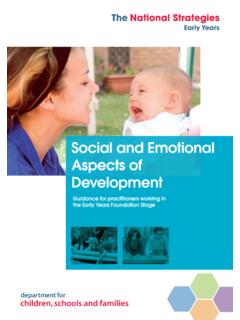
Social and Emotional Aspects of Development
foundationyears.org.ukExcellence and Enjoyment: social and emotional aspects of learning (SEAL). This is a comprehensive whole-school approach to promoting social and emotional skills. The red booklets targeted at Reception classes and older nursery children (30–50 and 40–60+ months) have been repackaged in line with the EYFS. 4.
Development Matters in the Early Years ... - …
foundationyears.org.ukChildren develop quickly in the early years, and early years practitioners aim to do all they can to help children have the best possible start in life.
Letters and Sounds: Phase Five - Foundation Years
foundationyears.org.ukletters and saying the phonemes (e.g. t-oy) and then reading the word. Check that, where appropriate, children are using joined letters, not the separate letters. Repeat with each word with an underlined grapheme. Repeat 1–4 with words without the …
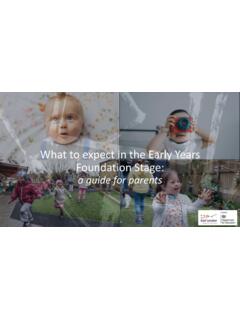
What to expect in the Early Years Foundation Stage
foundationyears.org.ukFoundation Stage (EYFS) • The Early Years Foundation Stage (EYFS) outlines what adults must do to help children learn and develop and to be healthy and safe. • This guide is for parents* of children from birth to five years old. It will help you find out more about your child’s learning and development in the EYFS.
Eat better, start better - Foundation Years
foundationyears.org.ukThe under-fives are a unique age group in that their nutritional needs change quite rapidly, and guidance regarding food groups and portion sizes is a
Principles for early years education
foundationyears.org.uksuch as an NVQ level 3 or a degree in child development and/or in teaching. Previous meetings have focused on supporting early literacy and talking with children. The current meeting is to help practitioners and parents help children to resolve conflict. In small groups, adults with different
Catering for special dietary requirements - Foundation Years
foundationyears.org.ukallergies may be given a device known as an auto-injector pen (e.g. epi-pen) containing a dose of adrenaline to be used in emergencies, the details of which should be included as part of an allergy management plan. • Food intolerances are different from food allergies. Symptoms tend to appear more slowly, often several hours after eating the ...
By working in partnership to meet the childcare need
foundationyears.org.uk*childminders may now work for 50% of their childminding time in premises other than their own home. This could mean that childminders may group together and work in a room in the school offering before and after school care. It may also be an option for childminders to provide holiday clubs on the school site during
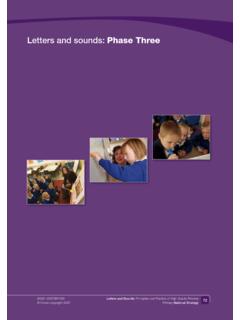
Letters and sounds: Phase Three - Foundation Years
foundationyears.org.ukwords orally. (See Appendix 3: Assessment). The purpose of this phase is to teach another 25 graphemes, most of them comprising two letters (e.g. oa), so the children can represent each of about 42 phonemes by a grapheme (the additional phoneme /zh/ found in the word vision will be taught at Phase Five).
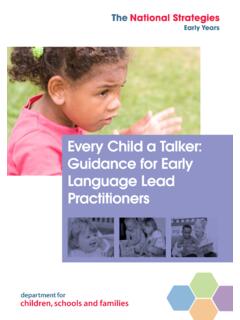
Every Child a Talker: Guidance for Early Language Lead ...
foundationyears.org.ukprogramme. Each of these LAs has selected 20 settings to participate in ECAT. You have been chosen or nominated to be the Early Language lead practitioner in one of those 20 settings which means that you and your colleagues will benefit from extra training and support to develop the very best early language provision.
Related documents

The Literacy and Numeracy Test for Initial Teacher ...
teacheredtest.acer.edu.auSkills set in context The Test assesses personal literacy and numeracy skills in contemporary Australian contexts. For this reason, the Test assesses the ability of candidates to interpret and apply their literacy and numeracy skills. With each refreshment of the test questions, new and up-to-date passages, scenarios and data
National Numeracy and Mathematics Progression …
education.gov.scotNational Numeracy Progression Framework National Mathematics Progression Framework. Awareness of size and amount Concept of estimation Concept of rounding Accuracy within rounding ... Early estimation skills allow for more refined comparisons and for approximations to be made. Estimating is the interpretation of relative size and quantities ...
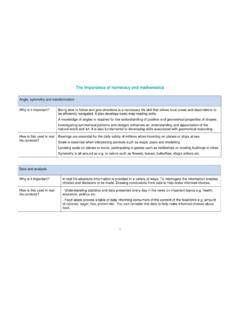
The importance of numeracy and mathematics
education.gov.scotThe importance of numeracy and mathematics 1 Angle, symmetry and transformation Why is it important? Being able to follow and give directions is a necessary life skill that allows local areas and destinations to be efficiently navigated. It also develops basic map reading skills.
Get help and support AS AND 7402 × ·V E: alevelscience@aqa ...
filestore.aqa.org.ukKeep your skills up to date with professional development. Wherever you are in your career, there’s always something new to learn. As well as subject-specific training, we offer a range of courses to help boost your skills. • Improve your teaching skills in areas including differentiation, teaching literacy and meeting Ofsted requirements.