Transcription of NVC Instruction Guide - Nonviolent Communication
1 -1- NVC Instruction Guide (Note: Much of the information in this Instruction Guide draws extensively from the work of Marshall B. Rosenberg, as presented in his book, Nonviolent Communication : A Language of Life. We strongly recommend that the best way to learn about Nonviolent Communication is to read the book and use the workbook in combination with this Guide , as well as find a group of people with whom to practice these important skills. Throughout each section of this Guide you will find references to particular sections from the book or from Lucy Leu s Companion Workbook.)
2 Jiva Manske) Introduction: Nonviolence and NVC We live in a world in which violence has become more and more accepted as the norm. It s all around us. From wars between nations to crime on the street, and even imposing on our everyday existence, violence manifests itself both explicitly and implicitly. Yet for many people, the very idea of violence seems foreign. They are not involved in physical confrontations or abuses, and thus they believe that violence is not present. But the reality is that whenever we become disconnected from our compassionate nature, whenever our hearts are not devoid of hatred in all of its forms, we have a tendency to act in ways that can cause pain for everyone in our lives, including ourselves.
3 Nonviolence, then, does not refer to the mere absence of physical harm. It is a way of life that takes its lead from a compassionate and connected heart, and can Guide us toward a more complete and happy way of being. As Mahatma Gandhi said, Nonviolence is not a garment to be put on and off at will. Its seat is in the heart, and it must be an inseparable part of our very being. It is a practice rooted in understanding, in living honestly , and in acting empathically with all beings. Of course this starts with the self. We must first understand and act empathically towards ourselves in order to impact the world in wonderful and compassionate ways.
4 This means cultivating nonviolence in every action and being present to our own needs and feelings in each and every moment. Marshall Rosenberg realized the importance of nonviolence in every day life throughout his childhood and on into his adult and professional life. He understood how nonviolence could affect the world through the individual and through nurturing relationships on a personal level. Because of his experience with clinical psychology, comparative religion, and mediation, he was able to create Nonviolent Communication (NVC) as a very simple model for transforming everyday existence and for practicing nonviolence.
5 His trainings, which began in the 1960 s, eventually grew into an institution, the Center for NVC, which was created in 1984 and which remains a vital resource for a turbulent world. -2- What is NVC? (Read Nonviolent Communication : A Language of Life, Chapter 1) NVC is a language of life that helps us to transform old patterns of defensiveness and aggressiveness into compassion and empathy and to improve the quality of all of our relationships. Studying and practicing NVC creates a foundation for learning about ourselves and our relationships in every moment, and helps us to remain focused on what is happening right here, right now.
6 Although it is a model for Communication , NVC helps us to realize just how important connection is in our lives. In fact, having the intention to connect with ourselves and others is one of the most important goals of practicing and living NVC. We live our lives from moment to moment, yet most of the time we are on autopilot, reacting out of habit rather than out of awareness and presence of mind. By creating a space for attention and respect in every moment, NVC helps create a pathway and a practice that is accessible and approachable.
7 The Model The basic model for NVC is really quite straightforward and simple. It is a process that combines four components with two parts. While the four components are specific ideas and actions that fit into the form and the model of NVC, the two parts provide a solid foundation for NVC as well as for living nonviolently. They are the basis for Marshall s ideas of giving and receiving from the heart. These brief definitions will be expounded further in the sections below: Four Components 1. Observation: Observation without evaluation consists of noticing concrete things and actions around us.
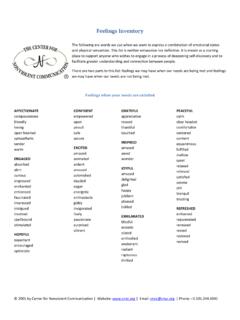
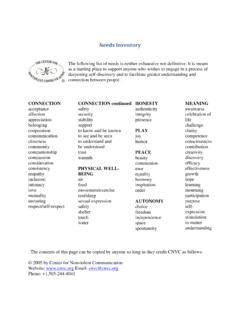
8 We learn to distinguish between judgment and what we sense in the present moment, and to simply observe what is there. 1. Feeling: When we notice things around us, we inevitably experience varying emotions and physical sensations in each particular moment. Here, distinguishing feelings from thoughts is an essential step to the NVC process. 1. Needs: All individuals have needs and values that sustain and enrich their lives. When those needs are met, we experience comfortable feelings, like happiness or peacefulness, and when they are not, we experience uncomfortable feelings, like frustration.
9 Understanding that we, as well as those around us, have these needs is perhaps the most important step in learning to practice NVC and to live empathically. 1. Request: To make clear and present requests is crucial to NVC s -3- transformative mission. When we learn to request concrete actions that can be carried out in the present moment, we begin to find ways to cooperatively and creatively ensure that everyone s needs are met. Two Parts 1. Empathy: Receiving from the heart creates a means to connect with others and share experiences in a truly life enriching way.
10 Empathy goes beyond compassion, allowing us to put ourselves into another s shoes to sense the same feelings and understand the same needs; in essence, being open and available to what is alive in others. It also gives us the means to remain present to and aware of our own needs and the needs of others even in extreme situations that are often difficult to handle. 1. Honesty: Giving from the heart has its root in honesty. Honesty begins with truly understanding ourselves and our own needs, and being in tune with what is alive in us in the present moment.