Transcription of NYC Cross Connection Backflow Prevention Handbook
1 January 2 0 1 9 BUREAU OF WATER & SEWER OPERATIONS NEW YORK CITY Cross - Connection CONTROL PROGRAM Handbook Prepared By: NYC-DEP 2019 Version D I S C L A I M E R As DEP has prepared this Handbook in good faith, practicing all due care and diligence, neither DEP nor any individual give any representation or warranty, expressed or implied, as to the relevance, completeness or fitness of this document in respect of any particular user s circumstances.
2 All users of this Handbook should satisfy themselves concerning its application to their situation and, if necessary, consult professional advice. A B S T R A C T DEP has compiled this information, to provide immense guidance, in an effort to aid all professionals and customers involved in the design and installation of containment BFP assemblies in the areas of the City of New York (NYC). This information is broken down into identifiable sections so as to be easily referenced. For fundamental knowledge and a thorough understanding of CCC/BFP requirements and design criteria for CCC plans, ordinances and polices; this entire Handbook serves as an informative reference and should be carefully studied. It presents the basics of Backflow theory and helps filing the BFP plans correctly to expedite the approval process and keep the project on schedule.
3 However, this does not impose any responsibility on the DEP for regulating plumbing. Safe, Abundant Drinking Water New York City Department of Environmental Protection Cross - Connection Control ( Backflow Prevention ) Program NYC - Cross - Connection Control Program Handbook FOR CONTAINMENT PURPOSES ONLY Please consider the environment before printing this manual NYC- Cross - Connection Control Program Handbook , January 2019 3 3 3 Page Subject 4 Section 1 4 5 6 7 8 9 10 12 Section 2 12 13 13 13 14 14 15 15 15 19 20 21 22 23 25 27 27 28 28 30 32 34 35 36 37 38 40 40 40 41 46 47 49 Section 3 51 Section 4 52 54 56 57 57 58 59 60 61 62 63 Section 5 64 65 66 67 68 69 Section 6 74 Section 7 75 Section 8 88 Section 9 90 Appendix 1 91 Appendix 2 98 Appendix 3 PREVIEW 1.
4 SCOPE 2. POLICY 3. WHO IS AFFECTED? 4. WHAT IS A Cross - Connection ? 5. BFP ASSEMBLY APPROVAL PROCESS 6. SEQUENTIAL APPROVAL PROCESS of BFP PLANS 7. HOW TO COMPLY? STANDARDS 1. Degree of Hazard 2. Roles and Responsibilities for Cross - Connection Control A. Local Authority B. Property owner/customer s liability C. Result of Non-Compliance (Enforcement Unit) D. NYC Licensed Master Plumber s liability E. Licensed Professional Engineer/Registered Architect (Applicant) liability 3. Cross - Connection Control Regulations A. Requirements and Considerations B. Water System C. Types of Water Services D. On-Site Auxiliary (Untreated) Water Source E. Characteristics of the BFP Assemblies F. Location/Installation/Requisites of BFP Assemblies G. Approved BFP Assemblies H. Orientation of BFP Assemblies I. Metering and Strainer J. Control Valves K. Water-Based Fire Protection System (FPS) L. Drainage Provisions M. Status of BFP Assemblies N. Actions and Procedures 4. DEP Policies A.
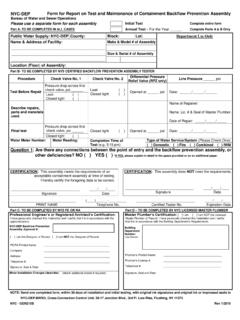
5 Types of Water Service Connections B. Types of BFP Assemblies Installations C. BFP Assemblies Installation Criteria D. Plan Review Process 1. Application Form NYC GEN236 2. Plot Plan (Site Plan) 3. Elevation View (Riser Plan) 4. Plan View (Floor Plan) 5. Time Calculation before RPZA/RPDA Floods Typical Significant Risk of Cross - Connection Hazards PROGRAM FORMS, LETTERS AND RISK ASSESSMENT CHARTS - Form GEN236 (Application for Approval of BFP Assemblies) - Form GEN215B (Report on Test and Maintenance of Containment BFP Assembly) - Review Form for BFP Plan 1. Assessment of Fire Protection Water System (SP/SD) 2. Assessment of Domestic Water System 3. Methods of Backflow Protection for premises containment/isolation 4. Cross - Connection Control Risk Assessment Charts: A. General Fire Sprinkler/Standpipe System B. General Domestic Water System C. Process of Hazard Assessment 1. Instructions for Getting a Backflow Prevention Exemption 2. DEP Regulations for Residential Dwellings 3.
6 Risk Assessment of Residential Dwellings - Exemption Letter - Example (annex to DEP Regulations for premises isolation) - Example for multiple water service lines, either separate or parallel/Annotation SAMPLE ENGINEERING REPORT NOMENCLATURE (LEGEND) EXAMPLES Things to keep in mind: Summing-up Notes (Putting All Together) Modifications to any USC Approved Backflow Prevention Assemblies GLOSSARY Bibliography (works cited) TABLE OF CONTENTS CCC Program Handbook 2019 NYC- Cross - Connection Control Program Handbook , January 2019 4 Section 1 PREVIEW 1. S C O P E The Cross - Connection Control Program Handbook is developed and optimized by the New York City Department of Environmental Protection (DEP) as general reference guidance of Standard Specifications and Procedures for Prevention of Water Contamination and made available as a courtesy to the Public.
7 This Handbook is compiled in 9 Sections and 3 Appendices as a reference document and training manual to promulgate the Code (Federal, State and City rules and regulations) and is not a how-to book. To maintain consistency of the Cross - Connection Control (CCC) system, these guidelines have been clarified in this text. Links were valid as of date of publication of this Handbook . The purpose of this Handbook is to provide background for the proper use of Backflow Prevention (BFP) Assemblies and explain the steps required to receive approval for the installation of BFP assemblies. These guidelines clearly outline what an acceptable design and installation constitutes based on experience in implementing CCC programs and policies set forth by United States Environmental Protection Agency (USEPA), Occupational Safety and Health Administration (OSHA), University of Southern California for Cross - Connection Control and Hydraulic Research (USC-FCCCHR), American Water Works Association (AWWA) and New York State (NYS) and Local Health Departments (DOH).
8 The term shall indicates a requirement, the term should indicates a recommendation for good waterworks practice and the term may is permissive. None of the examples are intended to promote any specific manufacturer, product, device or assembly. The mention of trade names and commercial products in this Handbook are for illustrative purposes only and does not constitute an endorsement or recommendation. This Handbook may be amended at any time at the discretion and approval of DEP. Hence, this Handbook supersedes any previous editions. In the event this Program Handbook is found to conflict with Federal and State law, currently or in the future, the Federal or State law will take precedence. NYC- Cross - Connection Control Program Handbook , January 2019 5 2.
9 P O L I C Y Backflow REGULATIONS Purpose To protect the public potable water supply served by NYC-DEP Water Authority from contamination or pollution which could Backflow from customers internal water distribution system, by containment. To promote the elimination or control of Cross -connections, actual or potential, temporary or permanent. To properly assess the water system to install an appropriate type of BFP assembly for the properties level of health hazard, level of actual or potential risk to the public health. This will systematically and effectively prevent the contamination or pollution of the public water supply (CWM). AUTHORITY Federal Regulations: In 1974, the United States Congress passed the Safe Drinking Water Act (SDWA) to help ensure that tap water is safe to drink.
10 Under the provisions of the SDWA, the water purveyor is held primarily responsible to ensure water quality meets national standards of safe drinking water established through the USEPA. These provisions include a warranty that the water quality provided by the purveyor is in conformance with USEPA standards at the source, and that the water is delivered to the customer without compromising its quality. Also, OSHA requires that no Cross - Connection be allowed in an installation unless it is properly protected with an approved Backflow preventer. NYS DOH The water supply is to be adequate, safe, and of sanitary quality from an acceptable source that meets the requirements of Part 5 of this Title ( Water supply). DEP POLICY To protect public health and the environment by supplying clean drinking water, collecting and treating wastewater; and reducing hazardous substances pollution.