Transcription of Obsessive-Compulsive Inventory (OCI)
1 Obsessive-Compulsive Inventory (OCI) - Reproduced & adapted by permission of the authors: Foa, , Kozak, , Salkovskis, , Coles, , & Amir, N. Foa, , Kozak, , Salkovskis, , Coles, , and Amir, N. (1998). The validation of a new Obsessive-Compulsive disorder scale: The Obsessive-Compulsive Inventory . Psychological Assessment, 10(3), 206-214. Page 1 of 5 Obsessive-Compulsive Inventory (OCI) Identifier Date Please read each statement and select a number 0, 1, 2, 3 or 4 that best describes how much that experience has distressed or bothered you during the past month. There are no right or wrong answers. Do not spend too much time on any one statement.
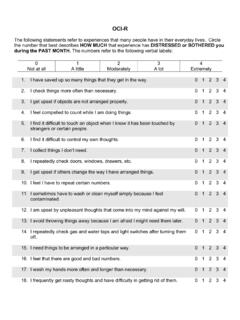
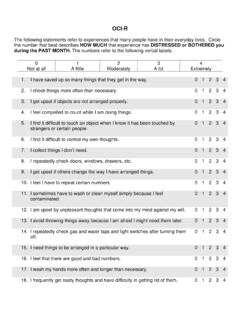
2 This assessment is not intended to be a diagnosis. If you are concerned about your results in any way, please speak with a health professional. 0 = Not at all 1 = A little 2 = Moderately 3 = A lot 4 = Extremely 1 Unpleasant thoughts come into my mind against my will and I cannot get rid of them 2 I think contact with bodily secretions (sweat, saliva, blood, urine, etc.) may contaminate my clothes or somehow harm me 3 I ask people to repeat things to me several times, even though I understood them the first time 4 I wash and clean obsessively 5 I have to review mentally past events, conversations and actions to make sure that I didn t do something wrong 6 I have saved up so many things that they get in the way 7 I check things more often than necessary 8 I avoid using public toilets because I am afraid of disease or contamination 9 I repeatedly check doors, windows, drawers etc.
3 10 I repeatedly check gas / water taps / light switches after turning them off 11 I collect things I don t need Obsessive-Compulsive Inventory (OCI) - Reproduced & adapted by permission of the authors: Foa, , Kozak, , Salkovskis, , Coles, , & Amir, N. Foa, , Kozak, , Salkovskis, , Coles, , and Amir, N. (1998). The validation of a new Obsessive-Compulsive disorder scale: The Obsessive-Compulsive Inventory . Psychological Assessment, 10(3), 206-214. Page 2 of 5 12 I have thoughts of having hurt someone without knowing it 13 I have thoughts that I might want to harm myself or others 14 I get upset if objects are not arranged properly 15 I feel obliged to follow a particular order in dressing, undressing and washing myself 16 I feel compelled to count while I m doing things 17 I am afraid of impulsively doing embarrassing or harmful things 18 I need to pray to cancel bad thoughts or feelings 19 I keep on checking forms or other things I have written 20 I get upset at the sight of knives.
4 Scissors or other sharp objects in case I lose control with them 21 I am obsessively concerned about cleanliness 22 I find it difficult to touch an object when I know it has been touched by strangers or certain people 23 I need things to be arranged in a particular order 24 I get behind in my work because I repeat things over and over again 25 I feel I have to repeat certain numbers 26 After doing something carefully, I still have the impression I haven t finished it 27 I find it difficult to touch rubbish or dirty things Obsessive-Compulsive Inventory (OCI) - Reproduced & adapted by permission of the authors: Foa, , Kozak, , Salkovskis, , Coles, , & Amir, N. Foa, , Kozak, , Salkovskis, , Coles, , and Amir, N.
5 (1998). The validation of a new Obsessive-Compulsive disorder scale: The Obsessive-Compulsive Inventory . Psychological Assessment, 10(3), 206-214. Page 3 of 5 28 I find it difficult to control my thoughts 29 I have to do things over and over again until it feels right 30 I am upset by unpleasant thoughts that come into my mind against my will 31 Before going to sleep I have to do certain things in a certain way 32 I go back to places to make sure that I have not harmed anyone 33 I frequently get nasty thoughts and have difficulty getting rid of them 34 I avoid throwing things away because I am afraid I might need them later 35 I get upset if others have changed the way I have arranged my things 36 I feel that I must repeat certain words or phrases in my mind I order to wipe out bad thoughts.
6 Feelings or actions 37 After I have done things, I have persistent doubts about whether I really did them 38 I sometimes have to wash or clean myself simply because I feel contaminated 39 I feel that there are good and bad numbers 40 I repeatedly check anything that might cause a fire 41 Even when I do something very carefully I feel that it is not quite right 42 I wash my hands more often, or for longer than necessary Washing Obsessive-Compulsive Inventory (OCI) - Reproduced & adapted by permission of the authors: Foa, , Kozak, , Salkovskis, , Coles, , & Amir, N. Foa, , Kozak, , Salkovskis, , Coles, , and Amir, N. (1998). The validation of a new Obsessive-Compulsive disorder scale: The Obsessive-Compulsive Inventory .
7 Psychological Assessment, 10(3), 206-214. Page 4 of 5 Checking Doubting Ordering Obsessions Hoarding Neutralising Mean OCI distress Total OCI Score Obsessive-Compulsive Inventory (OCI) - Reproduced & adapted by permission of the authors: Foa, , Kozak, , Salkovskis, , Coles, , & Amir, N. Foa, , Kozak, , Salkovskis, , Coles, , and Amir, N. (1998). The validation of a new Obsessive-Compulsive disorder scale: The Obsessive-Compulsive Inventory . Psychological Assessment, 10(3), 206-214. Page 5 of 5 The Obsessive-Compulsive Inventory (OCI) was developed to help determine the severity of Obsessive-Compulsive disorder (OCD).
8 The scale is copyright and is reproduced here with the permission of the authors. The OCI consists of 42 items composing 7 subscales: Washing, Checking, Doubting, Ordering, Obsessing ( having obsessional thoughts), Hoarding, and Mental Neutralising. Each item is rated on a 5-point (0-4) scale of symptom distress. Mean scores are calculated for each of the seven subscales, and an overall mean distress score is provided (rounded to 2 decimal places). Each score is presented as a mean out of a possible maximum of 4 . Lower scores are better. A total score of 42 or more, or a mean score of or more in any of the subscales suggests the presence of OCD, but is not diagnostic.
9 Privacy - please note - this form does not transmit any information about you or your assessment scores. If you wish to keep your results, either print this document or save this file locally to your computer. If you click save before closing, your results will be saved in this document. These results are intended as a guide to your health and are presented for educational purposes only. They are not intended to be a clinical diagnosis. If you are concerned in any way about your health, please consult with a qualified health professional.