Transcription of ODS ODS Tip Sheet - SAS
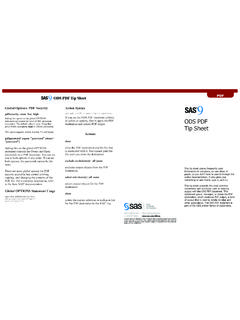
1 ODS ODS Tip SheetSAS Institute Inc. World Headquarters +1 919 677 8000 and all other SAS Institute Inc. product or service names are registered trademarks or trademarks of SAS Institute Inc. in the USA and other countries. indicates USA registration. Other brand and product names are trademarks of their respective companies. Copyright 2008, SAS Institute Inc. All rights reserved. Tip Sheet Output Destination Basic Usage ods output output-object-name=data-set-name;.. procedure code .. ods output close; Useods trace on; to determine the output object names. Customizing Reports ods proclabel text ;Specifies text to use in place of the procedure label in the table of contents. ods proctitle; or ods noproctitle; Specifies whether or not the procedure title should be printed. ods select selection(s);ods exclude selections(s); Specifies the output objects to show or exclude from the report, respectively. ods show; Displays current select and exclude lists.
2 Ods trace on; Displays information about output objects as they are created. This information includes the name of the object, the name of the template, labels, paths, and label paths. Locating Style Definitions odstemplates Enteringodstemplates in the command bar opens the Template Browser. The styles supplied by SAS are in the folder. proc template; list styles; run; Lists the SAS-supplied styles to the log. Example* Open several ODS destinations; ods html frame=" " file=" " contents=" " style= ; ods pdf file=" " notoc; ods rtf file=" " bodytitle; ods file=" "; ods output variables= ; * Select only the "variables" table; ods select variables; * Turn off proc titles; ods noproctitle; * Run the Contents Procedure; proc contents data= ; run; * Close all ODS destinations; ods _all_ close; * Re-open the listing destination; ods listing;QuickTime and aTIFF (LZW) decompressorare needed to see this Techniques For more information on advanced techniques such as the DOCUMENT destination which allows extensive manipulation of reports, or PROC TEMPLATE which allows you to modify styles as well as create table templates or modify table templates used by SAS procedures, see for logo, address, and trademark info For complete information, refer to the Base SAS documentation at ODS:Output Delivery SystemTip Sheet This tip Sheet places frequently used information in one place, on one Sheet of paper, so you don t have to search through the online documentation.
3 It also gives you something to take home, type in, and try. ODS allows you to format your reports in various formats such as HTML, PDF, RTF, Microsoft Excel, and many others. It enables you to customize your reports by selecting only the results you want to see. It even lets you apply styles to your reports including many supplied by SAS or those that you create. This tip Sheet presents the most common statements and options in ODS. ODS Tip Sheet Output Destination Basic Usage ods output output-object-name=data-set-name;.. procedure code .. ods output close; Useods trace on; to determine the output object names. Customizing Reports ods proclabel text ;Specifies text to use in place of the procedure label in the table of contents. ods proctitle; or ods noproctitle; Specifies whether or not the procedure title should be printed. ods select selection(s);ods exclude selections(s); Specifies the output objects to show or exclude from the report, respectively. ods show; Displays current select and exclude lists.
4 Ods trace on; Displays information about output objects as they are created. This information includes the name of the object, the name of the template, labels, paths, and label paths. Locating Style Definitions odstemplates Enteringodstemplates in the command bar opens the Template Browser. The styles supplied by SAS are in the folder. proc template; list styles; run; Lists the SAS-supplied styles to the log. Example* Open several ODS destinations; ods html frame=" " file=" " contents=" " style= ; ods pdf file=" " notoc; ods rtf file=" " bodytitle; ods file=" "; ods output variables= ; * Select only the "variables" table; ods select variables; * Turn off proc titles; ods noproctitle; * Run the Contents Procedure; proc contents data= ; run; * Close all ODS destinations; ods _all_ close; * Re-open the listing destination; ods listing;QuickTime and aTIFF (LZW) decompressorare needed to see this Techniques For more information on advanced techniques such as the DOCUMENT destination which allows extensive manipulation of reports, or PROC TEMPLATE which allows you to modify styles as well as create table templates or modify table templates used by SAS procedures, see for logo, address, and trademark info For complete information, refer to the Base SAS documentation at ODS:Output Delivery SystemTip Sheet This tip Sheet places frequently used information in one place, on one Sheet of paper, so you don t have to search through the online documentation.
5 It also gives you something to take home, type in, and try. ODS allows you to format your reports in various formats such as HTML, PDF, RTF, Microsoft Excel, and many others. It enables you to customize your reports by selecting only the results you want to see. It even lets you apply styles to your reports including many supplied by SAS or those that you create. This tip Sheet presents the most common statements and options in ODS. ODS Tip Sheet Output Destination Basic Usage ods output output-object-name=data-set-name;.. procedure code .. ods output close; Useods trace on; to determine the output object names. Customizing Reports ods proclabel text ;Specifies text to use in place of the procedure label in the table of contents. ods proctitle; or ods noproctitle; Specifies whether or not the procedure title should be printed. ods select selection(s);ods exclude selections(s); Specifies the output objects to show or exclude from the report, respectively. ods show; Displays current select and exclude lists.
6 Ods trace on; Displays information about output objects as they are created. This information includes the name of the object, the name of the template, labels, paths, and label paths. Locating Style Definitions odstemplates Enteringodstemplates in the command bar opens the Template Browser. The styles supplied by SAS are in the folder. proc template; list styles; run; Lists the SAS-supplied styles to the log. Example* Open several ODS destinations; ods html frame=" " file=" " contents=" " style= ; ods pdf file=" " notoc; ods rtf file=" " bodytitle; ods file=" "; ods output variables= ; * Select only the "variables" table; ods select variables; * Turn off proc titles; ods noproctitle; * Run the Contents Procedure; proc contents data= ; run; * Close all ODS destinations; ods _all_ close; * Re-open the listing destination; ods listing;QuickTime and aTIFF (LZW) decompressorare needed to see this Techniques For more information on advanced techniques such as the DOCUMENT destination which allows extensive manipulation of reports, or PROC TEMPLATE which allows you to modify styles as well as create table templates or modify table templates used by SAS procedures, see for logo, address, and trademark info For complete information, refer to the Base SAS documentation at ODS:Output Delivery SystemTip Sheet This tip Sheet places frequently used information in one place, on one Sheet of paper, so you don t have to search through the online documentation.
7 It also gives you something to take home, type in, and try. ODS allows you to format your reports in various formats such as HTML, PDF, RTF, Microsoft Excel, and many others. It enables you to customize your reports by selecting only the results you want to see. It even lets you apply styles to your reports including many supplied by SAS or those that you create. This tip Sheet presents the most common statements and options in ODS. ODSTip SheetOutput DestinationBasic Usage ods output output-object-name=data-set-name;.. procedure code .. ods output close;Use ods trace on; to determine the output object Reportsods proclabel text ;Specifies text to use in place of the procedure label in the table of proctitle; or ods noproctitle;Specifies whether or not the procedure title should be select selection(s);ods exclude selections(s);Specifies the output objects to show or exclude from the report, show;Displays current select and exclude trace on;Displays information about output objects as they are created.
8 This information includes the name of the object, the name of the template, labels, paths, and label Style DefinitionsodstemplatesEntering odstemplates in the command bar opens the Template Browser. The styles supplied by SASare in the template; list styles; run;Lists the SAS-supplied styles to the * Open several ODS destinations;ods html frame=" " file=" " contents=" " style= ;ods pdf file=" " notoc;ods rtf file=" " bodytitle;ods file=" ";ods output variables= ;* Select only the "variables" table;ods select variables;* Turn off proc titles;ods noproctitle;* Run the Contents Procedure;proc contents data= ; run;* Close all ODS destinations;ods _all_ close;* Re-open the listing destination;ods listing;Advanced TechniquesFor more information on advanced techniques such as the DOCUMENT destination which allows extensive manipulation of reports, or PROC TEMPLATE which allows you to modify styles as well as create table templates or modify table templates used by SAS procedures, see for logo, address, and trademark infoFor complete information, refer to the Base SAS documentation at : Output DeliverySystemTip SheetThistip Sheet places frequently used information in one place, on one Sheet of paper, so you don t have to search through the online documentation.
9 It also gives you something to take home, type in, and allows you to format your reports in various formats such as HTML, PDF, RTF, Microsoft Excel, and many enables you to customize your reports by selecting only the results you want to even lets you apply styles to your reports including many supplied by SAS or those that you create. This tip Sheet presents the most common statements and options in ODS. ODS Tip SheetODS Tip Sheet Common Destinations Destination is a term for the ODS driver that generates a specific output format. Destination Name Description Listing Plain text HTML Primary format used on the World Wide Web (WWW) XML Plain text data interchange format PDF Works well for printing as well as on-screen viewing Postscript Works well for printing RTF Used by most word processors Share SAS data with Microsoft Excel Output Creates SAS data sets from ODS tables Opening and Closing Destinations odsdestination-name <option(s)>;Opens the ODS destination, destination-name, with options, option(s).
10 Odsdestination-name close; Closes the ODS destination, _all_ close; Closes all ODS destinations (including Listing). Basic ODS Usage ods destination-name; .. procedure code .. ods destination-name close; HTML Destination Basic Usage ods html <option(s)>;.. procedure code .. ods html close; File Options file= filename or body= filename Specifies the name of the file that will contain the output tables. contents= filename Specifies the name of the file that will contain a table of contents for the output. frame= filename Specifies the name of the file that includes the body file and table of contents into a set of scrollable frames. stylesheet= filename Specifies an external filename for styles. The following file sub-options can be specified in parentheses following each of the above options. no_top_matter no_bottom_matter Specifies that no beginning or ending markup, respectively, should be inserted into the output file. url= URL Specifies a URL to be used in place of the filename in links to the file.