Transcription of Online Cognitive-Behavioral Therapy Workshop
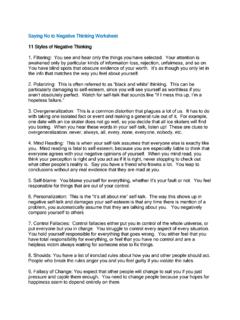
1 Online Cognitive-Behavioral Therapy Workshop thinking styles The following styles in thinking can be subtle yet very powerful in causing us to experience needless emotional distress. Interestingly, the more distressed we become, the more our thinking can become narrowed and focused, making it difficult to think in balanced ways. Many times, simply identifying which thinking Style/s we are using can be very liberating, allowing us to break free from narrowed, unhealthy thinking patterns. All-Or-Nothing: Events are only good or only bad. They are black or white with no gray areas between the extremes. If something falls short of perfection, then it is seen as a complete failure. "My work today was a total waste of time." Overgeneralization: You draw general conclusions based on one event or a single piece of evidence. If something bad happens one time, you see it as an unending cycle of defeat.
2 "People are always mean to me." Mind Reading: Even though they have not told you so, you believe you know what people think and feel about you, as well as why they behave the way they do towards you. "He thinks I'm stupid." Catastrophizing: You expect things to turn out badly. "If I ask my boss for a raise he will yell at me." Chain Reaction: You continue down the chain, link by link, with how one bad thing will lead to another bad thing, ending in a larger bad outcome with regard to an overall goal. "If I fail this test I won't pass this class, then I will fail out of school, then I won't graduate, then I won't get a good job, then I will be unhappy in a dead-end job forever." What If's: You ask questions about bad or fearful things that could possibly happen in the future, while being unsatisfied with any answers. "What if something happens to her?" Personalization: You think that things people say or do are in reaction to you, or you believe you are responsible for things people do or say.
3 "He looked at his watch because I'm boring." Shoulds/Musts: You have strict rules about how you and others should/must feel and behave. You feel angry if others break these rules and guilty if you break them. "I shouldn't take any time off. I must work hard all the time." Filtering: You magnify or dwell on the negative details of a situation while ignoring all the positive ones. "Look at all the things I have done badly." Jumping to Conclusions: You make illogical leaps in believing that A causes B without enough evidence or information to support your conclusions. "My boyfriend was late in picking me up. He doesn't really want to go out with me tonight." Comparisons: You compare yourself to other people, trying to figure out who is better, smarter, more attractive, etc. "She is so talented. I'll never amount to anything." Discounting Positives: You automatically discount or reject positive actions or events as if they don't matter.
4 If you did something well, you tell yourself that it doesn't count, it wasn't good enough, or anyone could have done it as well or better. You don't allow yourself to enjoy even small accomplishments. "If I had spent more time preparing for my presentation it could have been better." Maximization/Minimization: You maximize your problems or blow the effects of them out of proportion to the situation. Or, you minimize the value of your positive qualities. "This is the worst thing that could happen. I can t manage it." Blaming: You blame yourself for things that are not in your control. Or, you hold others responsible for your misfortunes. "It's my fault that my husband drinks. If I were a better wife he wouldn't do that." Emotional Reasoning: You automatically believe that what you feel is true for you. If you feel strange, boring, stupid, etc. then you believe you are these things.
5 "I feel embarrassed. I am so awkward and foolish." Being Right: You are always trying to prove that your opinions and behaviors are the right ones. You cannot accept that you might be wrong or inaccurate, and you will go to great lengths to prove that you are right or others are wrong. "You don't know what you're talking about. We have to do it my way or it won't work." Reward Fallacy: You expect to receive rewards or payoffs as a result of your own deeds or sacrifices, as if someone is keeping score. You feel angry or resentful if your actions do not reap rewards. "I spent all that time fixing a nice dinner and no one appreciated it." Change Fallacy: You believe that if you pressure people enough they will change to suit you. You also believe they must change since you let your happiness depend on them. "If she told me she loved me more often, then I could feel happy.
6 " Fairness Fallacy: You believe you know what is fair, but since others don't agree with you, you feel resentful or angry. "I deserve a day off from work since I worked hard over the weekend, but my boss won't allow it." Copyright 1999-2010 All About Self Help, LLC. All rights reserved.