Transcription of ORGANIC CHEMISTRY I – PRACTICE EXERCISE Alkene …
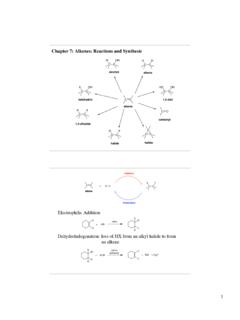
1 ORGANIC CHEMISTRY I PRACTICE EXERCISEA lkene reactions and mechanismsFOR QUESTIONS 1-24, GIVE THE MAJOR ORGANIC PRODUCT OF THE REACTION,PAYING PARTICULAR ATTENTION TO REGIO- AND STEREOCHEMICAL )OHClCH3OH2)HClCH33)HCl4)HCl5)HBr6)HCl7) CH3H3O+8)H3O+9)H3O+10)Hg(OAc)2, H2 ONaBH4CH311)Hg(OAc)2, H2 ONaBH412)Hg(OAc)2, CH3 OHNaBH413)CH3BH3 THFH2O2OH-14)(Z)-3-hexene1) BH3 / THF2) H2O2 / OH-?15)H2Pt16)Br2CH2Cl2 (solvent)CH317)Cl2CH2Cl2 (solvent)18)Cl2H2O19)CH31) CH3CO3H2) H3O+20)PhCO3 HCH2Cl2 (solvent)21)CH3 OsO4H2O222)CH31) O32) (CH3)2S23)KMnO4(hot, conc.)24)1) O32) (CH3)2S25) Treatment of cyclopentene with peroxybenzoic acidA) results in oxidative cleavage of the ring to produce an acyclic compoundB) yields a meso epoxideC) yields an equimolar mixture of enantiomeric epoxidesD) gives the same product as treatment of cyclopentene with OsO4E) none of the above26) Provide a detailed, step-by-step mechanism for the reaction shown +HBr27) Provide a detailed, step-by-step mechanism for the reaction shown +HO28) Provide the reagents necessary to complete the following transformation.
2 The synthesis may involvemore than one ) Provide the reagents necessary to complete the following transformation. The synthesis may involvemore than one +enantiomer30) Provide the reagents necessary to convert 3-methyl-2-butanol to 2-methyl-2-butanol. The synthesismay involve more than one ) Both (E)- and (Z)-hex-3-ene are subjected to a hydroboration-oxidation sequence. How are theproducts from these two reactions related to each other?A) The (E)- and (Z)-isomers generate the same products but in differing ) The (E)- and (Z)-isomers generate the same products in exactly the same ) The products of the two isomers are related as constitutional ) The products of the two isomers are related as ) The products of the two isomers are not structurally ) What Alkene would yield the following products upon ozonolysis?
3 CH3CH2CH2CH2 CHO + CH2O33) Addition of Br2 to (E)-hex-3-ene producesA) a meso dibromideB) a mixture of enantiomeric dibromides which is optically activeC) a mixture of enantiomeric dibromides which is optically inactiveD) (Z)-3,4-dibromo-3-hexeneE) (E)-3,4-dibromo-3-hexene34) The mechanism for the acid-catalyzed hydration of alkenes is the reverse of the acid-catalyzeddehydration of alcohols. This illustrates the principle of ) Which of the following is the best reaction sequence to accomplish a Markovnikov addition of water toan Alkene with minimal skeletal rearrangement?A) water + dilute acidB) water + concentrated acidC) oxymercuration-demercurationD) hydroboration-oxidationE) none of the above36) Which of the following additions to alkenes occur(s) specifically in an anti fashion?
4 A) hydroboration-oxidationB) addition of Br2C) addition of H2D) addition of H2O in dilute acidE) both A and B37) Which of the following additions to alkenes occur(s) specifically in an syn fashion?A) dihydroxylation using OsO4, H2O2B) addition of H2C) hydroborationD) addition of HClE) A, B, and C38) HBr can be added to an Alkene in the presence of peroxides (ROOR). What function does the peroxideserve in this reaction?A) nucleophileB) electrophileC) radical chain initiatorD) acid catalystE) solventANSWERS1)OHOCH3+enantiomer2)CH3Cl 3)Cl4)Cl5)Br6)Cl7)OHCH38)OH9)OH10)HOCH31 1)OH12)OCH313)CH3OH+enantiomer14)HOHor simplyHO15)16)BrCH3Br+enantiomer17)ClClH 3 CHHCH2CH3+enantiomer18)OHCl19)OHCH3OH+en antiomer20)OH3 CHCH2CH3H+enantiomer21)OHOHCH3+enantiome r22)CHOOH3C23)O+OHO24)CHO+HO25) B26) This mechanism is best approached by working backwards.
5 The product shown is an ether-bromide,with the oxygen and the bromine atoms on adjacent carbons. Every time two functional groups are onadjacent carbons it suggests the possibility that they might be formed by an addition to the C=C doublebond. This can be represented generically thus:+ABABAn addition of bromine in the presence of water produces such result, adding Br to one carbon andOH to the other (section 8-11 in the textbook).OHBrBr2H2 OThis suggests the possibility that an alcohol could be used instead of water, with similar results,except that this would add Br to one carbon and RO to the other mechanism of this reaction would be similar to that with water. Bromine adds first to form athree memebered ring intermediate, followed by nucleophilic attack by the alcohol from the s use an unsymmetrical Alkene to illustrate the point that the most highly substituted carbon getsthe RO group preferentially.
6 +BrBrBrHOROHRBrBrROBr+HBrThe molecule in question has an oxygen (ether group) and a bromine on adjacent carbons. We canmake a similar reasoning as above that such arrangement forms from the reaction between a C=Cbond and Br2 in the presence of an alcohol, a group that also happens to be present in the ether and bromine groups are on adjacentcarbons, suggesting that the original double bondwas between C1 and C2. Notice the oxygen on C51234512345 The starting material also happens to have5 carbons, with the double bond on C1 and C2,and the oxygen on this scenario in place, we can now start the mechanism from the first step, which would be theattack of the pi-bond on bromine to form a three membered ring +BrBrHO12345Br+BrThe alcohol group is now poised to attack the three membered ring at the most highly substitutedcarbon.
7 The carbon chain is long enough to allow for flexibility of movement without +BrOHHBr12345 OBr12345+HBr27) When the starting material gets placed in acid, two (basic) sites can get protonated: the oxygen atomand the pi-bond. The pi-bond is a weak base,. Energy must be expended to break it in order to protonate itand form a carbocation. The oxygen is also basic, but its unshared electrons are not tied up in bonding andare ready to react. Protonation occurs at the oxygen +H+OHThe pi-bond is now poised to attack the three membered ring from the back at the most highlysubstituted carbon, to open it. At the same time, a tertiary carbocation forms at one of the carbonsoriginally sharing the pi-bond. A new bond forms between carbons 2 and 7, which results information of a new 6-membered cationThe tertiary cation undergoes an elimination reaction, losing the adjacent proton to make the newpi-bond present in the +H3O+28)BrOHOHNaOCH3 / CH3OH(E2)OsO4 / H2O2or KMnO4 / OH-(syn hydroxylation)29)BrOHOH+enantiomerNaOCH3 / CH3OH(E2)1) CH3CO3H2) H3O+ or OH-(anti hydroxylation)30)OH3-methyl-2-butanolH2S O4(acid-cat.
8 E1)1) Hg(OAc)2 / H2O2) NaBH4( )OHMarkovnikov alcohol(2-methyl-2-butanol)31) B 32) CH3CH2CH2CH2CH=CH2 33) A 34) microscopic reversibility35) C 36) B 37) E 38) C