Transcription of Paediatric emergency algorithms & resources
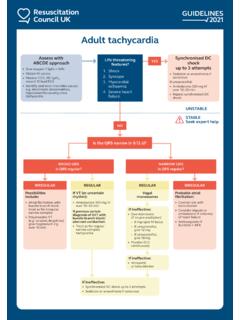
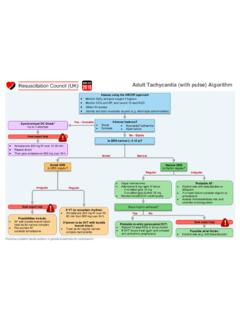
1 Paediatric emergency algorithms & resources March 2022. version 1. Paediatric emergency algorithms & resource folder 2022. Contents Paediatric emergency drug chart page 3. Paediatric basic life support page 4. Paediatric out-of-hospital basic life support page 5. Paediatric advanced life support page 6. Paediatric foreign body airway obstruction page 7. Anaphylaxis algorithm page 8. Refractory anaphylaxis page 9. Paediatric cardiac arrhythmias algorithm page 10. Acute asthma in children page 11. Treating convulsive status epilepticus in children page 12. Early management of diabetic ketoacidosis (DKA) in children page 13.
2 Septic shock and sepsis-associated organ dysfunction in children page 14. emergency Paediatric tracheostomy management page 15. Resuscitation Council UK. Paediatric emergency drug chart Adrenaline Fluid bolus Glucose Sodium bicarbonate Tracheal tube Defibrillation Uncuffed Cuffed Strength 1:10 000 Balanced isotonic 10% crystalloid OR, Saline Dose 10 mcg kg -1 10 mL kg -1 2 mL kg -1 1 mmol kg -1 4 joules kg -1. Route IV, IO IV, IO IV, IO IV, IO, UVC IV, IO Transthoracic Notes Consider warmed fluids For known hypoglycaemia Monitor Monophasic or cuff pressure biphasic Age Weight kg mL mL mL (recheck glucose after mL mL ID mm ID mm Manual dose and repeat as required).
3 < 1 month 35 7 7 20. 1 month 4 40 8 8 20. 3 months 5 50 10 10 20. 6 months 7 70 14 7 30. 1 year 10 100 20 10 40. 2 years 12 120 24 12 50. 3 years 14 140 28 14 60. 4 years 16 160 32 16 60. 5 years 18 180 36 18 70. 6 years 20 200 40 20 80. 7 years 23 230 46 23 100. 8 years 26 260 50 26 100. 10 years 30 300 50 30 120. 12 years 38 380 50 38 7 120. 14 years 50 500 50 50 7 8 120 150. Adolescent 50 500 50 50 7 8 120 150. Adult 70 500 50 50 7 8 120 150. Cardioversion Synchronised Shock, joules kg -1 escalating to joules kg -1 if unsuccessful. Weights averaged on lean body mass Amiodarone 5 mg kg -1 IV or IO bolus in arrest after 3rd and 5th shocks.
4 Flush line with saline or 5% glucose (max dose 300 mg). from 50th centile weights for males and females. Atropine 20 mcg kg -1, maximum dose 600 mcg. Drug doses based on Resuscitation Calcium gluconate 10% mL kg -1 for hypocalcaemia, hyperkalaemia (max dose 20 mL); IV over 2 5 min if unstable, over 15 20 min if stable. Council UK Guidelines 2021. Lorazepam 100 mcg kg -1 IV or IO for treatment of seizures. Can be repeated after 10 min. Maximum single dose 4 mg. recommendations. Adenosine IV or IO for treatment of SVT: 150 mcg kg -1 (0 11 months of age); 100 mcg kg -1 (1 11 years of age) Increase dose in steps 50 100 mcg kg -1 every 1 2 min for repeat Recommendations for tracheal tubes are doses.
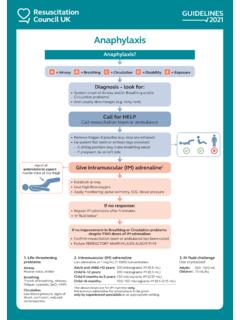
5 12 17 years: 3 mg, followed by 6 mg after 1 2 min if required, followed by 12 mg after 1 2 min if required. Requires large saline flush and ECG monitoring. based on full term neonates. Anaphylaxis Adrenaline 1:1000 IM: < 6 months 100 150 mcg ( mL), 6 months 6 years 150 mcg ( mL), 6 12 years 300 mcg ( mL), > 12 years 500 mcg ( mL); For newborns glucose at mL kg -1. can be repeated after 5 min. After 2 IM injections treat as refractory anaphylaxis and start low dose adrenaline infusion IV. is recommended. 3. Paediatric basic life support Unresponsive Call for help / activate 2222.
6 Open airway Breathing normally, YES. signs of life? NO Assess ABCDE. or any doubt O2 monitoring, vascular access 5 rescue breaths Competent providers should use Call further bag-mask ventilation with oxygen assistance as appropriate If unable/unsafe to ventilate perform continuous chest compressions, ventilate as soon as possible If no signs of life observed during rescue breaths, immediately commence chest compressions 15 chest compressions: 2 breaths Attach ECG monitoring/defibrillator when available Follow Paediatric ADVANCED LIFE SUPPORT. ALGORITHM. on arrival of in-hospital clinical emergency team 4.
7 Paediatric out-of-hospital basic life support Unresponsive Second rescuer or Shout for help single rescuer suspecting a primary cardiac arrest Call EMS on 999. Collect and apply AED. Open airway if feasible YES. Breathing normally? Observe NO and re-assess as or any doubt necessary 5 rescue breaths Single rescuer Infant: mouth to nose/mouth Call EMS if phone Child: mouth to mouth available, using speaker function If unable/unsafe to ventilate, perform If no phone available continuous chest compressions continue with CPR for 1. Add rescue breaths as soon as possible minute before calling EMS.
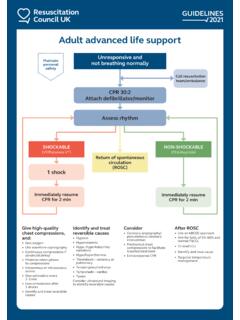
8 If no signs of life observed during rescue breaths 30 chest compressions 2 rescue breaths Clear signs of life? YES. Keep child in safe position, NO continue to assess and await EMS. Those trained only in adult' BLS (may include healthcare providers and lay rescuers) who have no specific knowledge of Paediatric resuscitation, should use the adult sequence they are familiar with, including Paediatric modifications. 5. Paediatric advanced life support Recognise cardiac arrest Call for help 2222. Commence/continue CPR. (5 initial breaths then CV ratio 15:2). Attach defibrillator/monitor Minimise interruptions Assess rhythm SHOCKABLE NON-SHOCKABLE.
9 VF/Pulseless VT PEA/asystole/brady < 60 min -1. Return of spontaneous 1 shock 4 J kg-1 circulation Immediately resume CPR. for 2 min (ROSC) Minimise interruptions Immediately resume CPR. for 2 min Post cardiac arrest care: Minimise interruptions Give adrenaline IV/IO. Use an ABCDE approach 10 mcg kg-1. Aim for SpO2 of 94 98% as soon as possible and normal PaCO2 and then every 3 5 min Avoid hypotension After 3 shocks give: Targeted temp management Adrenaline IV/IO 10 mcg kg-1. (and every alternate cycle Glucose control thereafter). AND. Amiodarone IV/IO 5 mg kg-1. (and repeat 5 mg kg-1 once more only after 5th shock).
10 During CPR Identify and treat reversible causes Ensure high quality chest compressions are delivered: Hypoxia Correct rate, depth and full recoil Hypovolaemia Provide BMV with 100% oxygen (2 person approach) Hyperkalaemia, hypercalcaemia, Provide continuous chest compressions when a tracheal tube is in place. hypermagnesemia, hypoglycaemia Competent providers can consider an advanced airway and capnography, Hypo-/hyperthermia and ventilate at a rate (breaths minute -1) of: Thrombosis coronary or pulmonary Infants: 25 1 8 years: 20 8 12 years: 15 > 12 years: 10 12 Tension pneumothorax Tamponade cardiac Vascular access IV/IO.