Example: bachelor of science
Personal Protective Equipment (PPE) Program
Personal protective equipment (PPE) is used to create a protective barrier between a worker and hazards in the workplace. PPE includes such equipment as chemical resistant gloves, safety shoes, hard hats, safety glasses, respirators, and clothing such as gowns and aprons.
Tags:
Information
Domain:
Source:
Link to this page:
Documents from same domain

IATA Dangerous Goods Identification Chart - …
ehs.research.uiowa.eduIATA Dangerous Goods Identification Chart . Shipment Type and Description UN Number Proper Shipping Name Hazard Class or Division Hazard Label Packing
Powered Industrial Trucks (Forklifts) - ehs.research.uiowa.edu
ehs.research.uiowa.eduOnly trained and certified operators are permitted to operate a powered industrial truck. No one under the age of 18 may operate a powered industrial truck. Training shall consist of a combination of formal instruction (e.g., lecture, discussion,
Compatible Chemical Storage Reference
ehs.research.uiowa.eduAppropriate chemical storage plans are designed to control physical and health hazards associated with laboratory chemical storage. There are several chemical compatibility schemes or methods available.

Appendix C Forklift Operator’s Daily Checklist
ehs.research.uiowa.eduForklift Operator’s Daily Checklist . Inspection Performed by: Week beginning 20 Note: This check must be made by the truck operator daily at the start of the shift. Check ( ) OK or Needs repair or adjustments (give details in comments section below). Retain this form for …
Related documents

Guidelines on Rational Use of Personal Protective Equipment
www.mohfw.gov.in4. Personal Protective Equipment (PPE) Personal Protective Equipments (PPEs) are protective gears designed to safeguard the health of workers by minimizing the exposure to a biological agent. 4.1 Components of PPE Components of PPE are goggles, face-shield, mask, gloves, coverall/gowns (with or without aprons),

Steps to put on personal protective equipment (PPE)
www.who.intSteps toput onpersonal protective equipment (PPE) 5 Place the impermeable gown over the scrubs. 6 Put on face protection: 6a Put on a medical mask. 6b Put on goggles or a face shield. OR, IF BOOTS UNAVAILABLE 7 If available, put a head cover on at this time. 8 Perform hand hygiene. 9 Put on gloves* (over cuff).
gloves - HSE
www.hse.gov.ukbuying chemical protective gloves to use as personal protective equipment (PPE). Such gloves are available in a wide selection of natural and synthetic materials and range in price from 25p to £60 a pair (March 2000). This leaflet provides practical advice to how to select the best chemical protective gloves to withstand exposure to chemical
Heavy Equipment Movement Safety Procedure
www.tatapower.comas some free space above any equipment the load will be slew over. Non Routine Job / Task: Where an SOP / SMP is not available or the conditions of the SOP / SMP have changed PPE - Personal Protective Equipment PTW - Permit to Work Periodic Inspection - Detailed safety and maintenance inspection performed by

Taking off (Doffing) Personal Protective Equipment (PPE)
albertahealthservices.cat Put in hamper or, if disposable, t put in garbage. Gown A Grasp the outside edge of the glove near the wrist and peel away from the hand, turning the glove inside-out. t Hold the glove in the opposite gloved hand. B Slideanunglovedfingeror remaining glove. C Peel the glove off and over firstglove,makingabag for both gloves. Put the gloves in ...
Personal Protective Equipment (PPE) 103
www.cdc.govPersonal protective equipment –or PPE as I mentioned earlier– are worn to disrupt this chain of infection. PPE should be selected based on the type of precautions the patient is under. And, staff should always follow Standard Precautions in addition to any transmission-based precautions when caring for patients.

Personal Protective Equipment Manual (PPE)
www.ryerson.ca5. Personal Protective Equipment (provide gloves/goggles) The use of PPE does not prevent accidents or eliminate hazards. Make every effort to control all hazards at the source. Training is also important. PPE cannot achieve its full-protection potential without worker knowledge and cooperation. Several controls may have to be put in place.
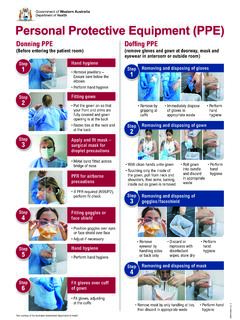
Personal Protective Equipment (PPE) poster
ww2.health.wa.gov.auPersonal Protective Equipment (PPE) Donning PPE (Before entering the patient room) Doffing PPE (remove gloves and gown at doorway, mask and eyewear in anteroom or outside room) • Remove jewellery – Ensure bare below the elbows • Perform hand hygiene • •Put the gown on so that your front and arms are fully covered and gown