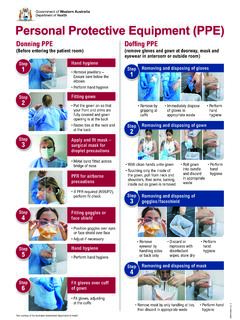
Transcription of Personal Protective Equipment (PPE) 103
1 1 Personal Protective Equipment (PPE): Coaching and Training Frontline Health Care ProfessionalsPresenterLona Mody, MD, MScAmanda Sanford Hickey Professor of MedicineUniversity of Michigan Ann Arbor VA Ann Arbor GRECCC ontributions byLinda R. Greene, RN, MPS, CICU niversity of Rochester Medical CenterHighland HospitalKaren Jones, RN, MPHSt. John Hospital and Medical Center2 Learning Objectives Review the basic principles of Personal Protective Equipment (PPE) use in health care settings Discuss models of engagement to enhance staff education for PPE use3 Infection TransmissionChain of Infection4(Adapted by R. Olmsted from Principles of Epidemiology in Public Health Practice, CDC, 2012)Types of PPE in Health CareGloves protect hands and allow efficient removal of organisms from handsGowns and Aprons protect skin and clothing Face masks protect mucous membranes of mouth and noseRespirators-prevent inhalation of infectious materialGoggles protect eyesFace shields mucous membranes of face, mouth, nose and eyes5 Principles for PPE UseDon before contact with the patient Generally before entering the roomRemove and discard PPE carefully After doffing, immediately perform hand hygiene6 PRECEDE Model7(Mody L et al.)
2 , CID, 2011)Apply 4 E Model8(PrenovostP et al., BMJ, 2008; Saint S et al., ICHE, 2010)EngageHave a conversationUse team meetings or huddlesSolicit feedback from staff: Why is PPE use important? What are the barriers to consistent PPE use? Use recent outbreaks as conversation starters Ebola epidemic C. diff outbreak Discuss facility-specific MDRO challenges9 How Will You Help Engage Your Facility? Nominate unit champions Assess staff knowledge Use this as your Quality Improvement project Audit adherence Give positive feedback Hold unit level competitions, give some simple prizes to winners10(CDC, Transmission-Based Precautions, #anchor_1564058318)Take the (APIC Take the Pledge is available at: )Educate: Share evidence12 Contamination After CareMRSAVREG loves18-24%12-63%Gown6-14%4-37%Hands After Glove Removal3%0-4%(Snyder G et al., ICHE, 2008; RoghmannM et al., ICHE 2015; GrabschE et al.
3 , ICHE, 2006; Zachary K et al., ICHE, 2001)Healthcare Contamination Varies by Type of Care13(RoghmannM et al., ICHE, 2015)Execute Engage senior leaders Share content at your next in-service Make posters of your staff engaging in positive behaviors, hang them up in key common areas Hold live demonstrations on appropriate PPE use14 Role model positive behaviorsDemonstrate Appropriate PPE UseDon PPE correctly and in the correct orderRemove and dispose of PPE correctly and without contaminationRemember hand hygiene before and after!Simulate contamination ( fluorescent glow solution, iodine solution , chocolate syrup, etc.)15 Contamination During PPE Removal16(Tomas M et al., JAMA Intern Med, 2015)Evaluate17(WHO: Toolkit: : )Key PointsSafe PPE use has captured national attentionAppropriate use is critical to prevent transmission of pathogensApply innovative models such as 4E or PRECEDE Models to enhance staff training and education18 ReferencesCDC Dialysis Collaborative.
4 Audit Tool: Hemodialysis Hand Hygiene Observations. Centers for Disease Control and Prevention, CDC. Available Hands Save Lives. Observation Form. World Health Organization, WHO. Revised 2009. Available at EA, Burrell LJ, Padiglione A, et al. Risk of environmental and healthcare worker contamination with vancomycin-resistant enterococci during outpatient procedures and hemodialysis. Infect Control Hosp Epidemiol. 2006; 27(3): 287-93. Hand Hygiene Monitoring Tool. Tip Toolkit. Available at L, Bradley SF, Galecki A, et al. Conceptual model for reducing infections and antimicrobial resistance in skilled nursing facilities: focusing on residents with indwelling devices. Clinical Infectious Diseases. 2011; 52(5): of Epidemiology in Public Health Practice, Third Introduction to Applied Epidemiology and Biostatistics. Centers for Disease Control and Prevention, CDC. Reviewed May 18, 2012.
5 Accessed July 1, 2016. Available at , BerenholtzSM, Needham DM. Translating evidence into practice: a model for large scale knowledge translation. ; 337: a1714. Roghmann MC, Johnson JK, Sorkin JD, et al. Transmission of Methicillin-Resistant Staphylococcus aureus (MRSA) to Healthcare Worker Gowns and Gloves During Care of Nursing Home Residents. Infect Control Hosp Epidemiol. 2015; 36(9): 1050-7. Saint S, Kowalski CP, Banaszak-Holl J, et al. The importance of leadership in preventing healthcare-associated infection: results of a multisite qualitative study. Infect Control Hosp Epidemiol. 2010; 31(9): 901-7. Siegel JD, RhinehartE, Jackson M, et al. 2007 Guideline for Isolation Precautions: Preventing Transmission of Infectious Agents in Healthcare Settings. Available at: GM, Thom KA, FurunoJP, et al. Detection of methicillin-resistant Staphylococcus aureus and vancomycin-resistant enterococci on the gowns and gloves of healthcare workers.
6 Infect Control HospEpidemiol. 2008; 29(7): the Pledge. Association for Professionals in Infection at: )TomaME, KundrapuS, ThotaP, et al. Contamination of Health Care Personnel During Removal of Personal Protective Equipment . JAMA Intern Med. 2015; 175(12): KC, Bayne PS, Morrison VJ, et al. Contamination of gowns, gloves, and stethoscopes with vancomycin-resistant enterococci. Infect Control ; 22(9): NotesSpeaker Notes: Slide 1 Welcome to today s training module, titled Personal Protective Equipment : Coaching and Training Frontline Health Care Professionals. During this training module, we will review strategies to coach and train frontline health care professionals in the use of Personal Protective Equipment and health care precautions to prevent healthcare-associated infections or Notes: Slide 2 This module was developed by national infection prevention experts devoted to improving patient safety and infection prevention efforts.
7 22 Speaker Notes: Slide 3 There are two main objectives for this module. The first is to review the basic principles of Personal Protective Equipment , also known as PPE, use in health care settings. The second is to discuss models of engagement to enhance staff education for PPE use. Understanding these two core objectives will set the groundwork to improve the culture of safety related to infection prevention in your health care organization. 23 Speaker Notes: Slide 4 Correct use of appropriate PPE is an essential component to disrupt the chain of infection and stop disease transmission. Helping personnel understand infection transmission can facilitate correct PPE use to break the chain of a review, infectious agents live and grow in a reservoir, like a patient s GI tract, nose or wounds. Pathogens exit the reservoir via a portal of exit. This might be in feces, by coughing or sneezing, or by wound drainage.
8 Microbes can go mobile and move from place to place they may be transmitted by health care worker s hands, contaminated environmental surfaces or Equipment that is shared among the patients. Once a harmful microbe reaches that person it only takes a portal of entry, a way in, to infect somebody else. That person can serve as a reservoir. 24 Speaker Notes: Slide 5 Personal Protective Equipment or PPE as I mentioned earlier are worn to disrupt this chain of infection. PPE should be selected based on the type of precautions the patient is under. And, staff should always follow Standard Precautions in addition to any transmission-based precautions when caring for patients. It is important that all staff are trained in correct PPE use, including when to use different types of PPE, both putting on and taking off procedures, reviewing where different PPE items are kept and how supplies should be restocked if they are running low.
9 During staff training it is essential to review your hospital s policies for initiating various precautions. 25 Speaker Notes: Slide 6 This slide shows a couple key points to emphasize with staff during training. First, when indicated, you should put on the appropriate PPE before any contact with the patient. Many times this will be directly before entering the patient s room. Hand hygiene should be done before putting on PPE. After providing care, PPE for contact precautions should be removed carefully; as this is often when the contamination occurs. PPE, for contact precautions, should be removed at the doorway of the patient s room or immediately outside the room. Lastly, hand hygiene should be performed immediately after removing the PPE. For more about hand hygiene, please review the Hand Hygiene course. 26 Speaker Notes: Slide 7 The remainder of this module will explore innovative strategies that can be used to enhance your staff training and education around PPE use.
10 I will begin by discussing the PRECEDE Model and how it can be adapted for strengthening your PPE program and staff training. In this model we can break the educational diagnosis stage into predisposing aspects, enabling factors and reinforcing factors. These issues, if identified, modified and strengthened will lead to behavior change and sustained program success. 27 Speaker Notes: Slide 7 ContinuedPredisposing aspects are personnel s beliefs, attitudes and opinions about PPE practices. Enabling factors are elements in the environment that empower staff to model a certain behavior, in this instance proper PPE use. This includes PPE placement, access and ease of use. Lastly we reinforce desired behaviors with regular feedback on appropriate PPE use, leadership engagement, behavior modeling and rewards for consistent and effective PPE use. Furthermore, evaluating outcomes will inform you if your efforts are Notes: Slide 8 Similarly, a 4E Model is a framework to guide leaders in their change efforts.