Transcription of PHILOS AND PHILOS LONG
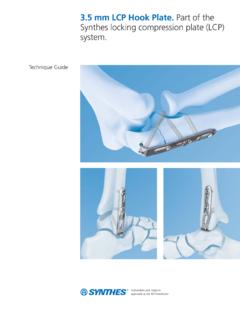
1 SURGICAL TECHNIQUEPHILOS AND PHILOS LONG The anatomic fixation system for the proximal humerusInstruments and implants approved by the AO publication is not intended for distribution in the intensifier controlThis description alone does not provide sufficient background for direct use of DePuy Synthes products. Instruction by a surgeon experienced in handling these products is highly , Reprocessing, Care and MaintenanceFor general guidelines, function control and dismantling of multi-part instruments, as well as processing guidelines for implants, please contact your local sales representative or refer to: general information about reprocessing, care and maintenance of Synthes reusable devices, instrument trays and cases, as well as processing of Synthes non-sterile implants, please consult the Important Information leaflet (SE_023827) or refer to: and PHILOS Long Surgical Technique DePuy Synthes 1 TABLE OF CONTENTSINTRODUCTION PHILOS and PHILOS Long 2AO Principles 4 Indications 5 SURGICAL TECHNIQUE Patient Positioning and Approach 6 Implantation 8 Implant Removal 25 PRODUCT INFORMATION Implants 26 Instruments 28 Sets 32 BIBLIOGRAPHY 33 MRI INFORMATION 342 DePuy Synthes PHILOS and PHILOS Long Surgical TechniquePHILOS
2 AND PHILOS LONGPHILOS PROXIMAL HUMERAL INTERNAL LOCKING SYSTEMPHILOS 9 proximal screw holes in section A E for LCP locking screws B mm enable an angular stable construct to enhance the grip in osteoporotic bone and multi- fragment fractures Carefully apply for osteoporotic bone Optimal screw placement 10 proximal holes for suturing to help maintain fracture reductionPHILOS Long Shaft reinforced to mm Distal LCP long holes for maximum adaptability Plate length up to 290 mmABCFGHDEPHILOS and PHILOS Long Surgical Technique DePuy Synthes 3 PHILOS INSTRUMENTSO uter sleeveRestricted drill bitOne sleeve for all:drilling, measuringand screw insertionWings for improved sleeve hold in aiming deviceRestriction at 20 mmfor controlled drillingBlunt tip for depth probing gives feedback on bone densityEnlarged shaft ensures guidance in outer sleeveClear and well readable scalefor depth measuringEnlarged shaft ensuresguidance in outer sleeveLength 1 12:084 DePuy Synthes PHILOS and PHILOS Long Surgical TechniqueAO PRINCIPLESIn 1958, the AO formulated four basic principles, which have become the guidelines for internal fixation1, M ller ME, M Allg wer, R Schneider, H Willenegger.
3 Manual of Internal Fixation. 3rd ed. Berlin Heidelberg New York: Springer. R edi TP, RE Buckley, CG Moran. AO Principles of Fracture Management. 2nd ed. Stuttgart, New York: Thieme. reductionFracture reduction and fixation to restore anatomical , active mobilizationEarly and safe mobilization and rehabilitation of the injured part and the patient as a fixationFracture fixation providing abso-lute or relative stability, as required by the patient, the injury, and the personality of the of blood supplyPreservation of the blood supply to soft tissues and bone by gentle reduction techniques and careful and PHILOS Long Surgical Technique DePuy Synthes 5 INDICATIONSPHILOS indications Dislocated two-, three-, and four-fragment fractures of the proximal humerus, including fractures involving osteo penic bone Pseudarthroses in the proximal humerus Osteotomies in the proximal humerusPHILOS long indications As for PHILOS .
4 But for fractures extending to the shaft or without medial support6 DePuy Synthes PHILOS and PHILOS Long Surgical TechniqueNote: For information on fixation principles using conventional and locked plating techniques, please refer to the LCP Locking Compression Plate Surgical Technique (DSEM/ TRM/0115/0278).1 Position the patientPlace the patient in the beach chair position or supine position on a radiolucent the fluoroscope is positioned in a way that allows visualization of the proximal humerus in two axes (AP and lateral/axial).Prepare the patient s arm so that it can be mobilized POSITIONING AND APPROACHPHILOS and PHILOS Long Surgical Technique DePuy Synthes 72 ApproachA deltopectoral or transdeltoid approach is the transdeltoid approach is performed, the use of the LCP Percutaneous Aiming System for PHILOS is r nings: Do not injure the axillary nerve.
5 The axillary nerve can be palpated at the lower margin of the incision. To avoid damaging the axillary nerve, do not split the deltoid more than 4 cm distal to its DePuy Synthes PHILOS and PHILOS Long Surgical Technique1 Reduce fracture and fix temporarilyProper reduction of the fracture is crucial for good bone healing and function. In some cases closed reduction before prepping the patient is the head fragments and check the reduction under image intensifier : The locking screws are not suitable for reduc-tion since they cannot exert compression. The head fragments must be reduced before insertion of lock-ing wires can be used for reduction as joysticks in the fragments as well as for temporary fixation. Ensure that Kirschner wires do not interfere with correct plate ANTATIONS uturingProvisionally reduce the tubercles using sutures through the insertions of the musculi subscapularis, infra- and supra-spinatus.
6 The sutures will help to maintain the stability of the reconstruction when fixing them to the plate later. PHILOS and PHILOS Long Surgical Technique DePuy Synthes 92 Attach aiming device to PHILOS Aiming Device, without PHILOS Aiming Device Stardrive, without PHILOS Aiming Device, with PHILOS Aiming Device Stardrive, with Nose Handle with Quick Screwdriver Shaft, hexagonal, small, B Screwdriver Shaft Stardrive , T15, self-holding, for AO/ASIF Quick CouplingInsert the stabilization pin of the aiming device in the specially provided hole on the PHILOS plate. Use the screwdriver to tighten the securing screw of the aiming : Intraoperative bending of the proximal portion of the plate is not recommended for maintai-ning proper alignment between the aiming device and the DePuy Synthes PHILOS and PHILOS Long Surgical Technique3 Position platePosition the plate 2 4 mm posterior to the bicipital groove and 5 7 mm distal to the top of the greater tubercule.
7 Align the plate properly to the humeral : Placing the plate too high increases the risk of subacromial impingement. Placing the plate too low can prevent the optimal distribution of screws in the humeral r nings: Do not injure the axillary nerve. The axillary nerve can be palpated at the lower margin of the incision. To avoid damaging the axillary nerve, do not split the deltoid more than 4 cm distal to its and PHILOS Long Surgical Technique DePuy Synthes 11 Alternative PHILOS Aiming Device, with PHILOS Aiming Device Stardrive, with NoseOption A: Determine the position of the plate using the PHILOS aiming device with nose. Insert a Kirschner wire into the proximal guide hole below the rotator cuff so that the Kirschner wire aims at the proximal joint B: Insert two positioning Kirschner wires 2 4 mm lateral to the bicipital groove and 5 7 mm below the tip of the greater tubercule.
8 Position the plate between the Kirschner DePuy Synthes PHILOS and PHILOS Long Surgical Technique4 Fix plate Drill Bit B mm, length 110/85 mm, 2-flute, for Quick Universal Drill Guide Depth Gauge for Screws B to mm, measuring range up to 60 Screwdriver, hexagonal, small, mm, with Screwdriver Shaft Stardrive , T15, self-holding, for AO/ASIF Quick Handle with Quick CouplingOptional Tap for Cortex Screws B mm, length 110/50 mmFix the plate temporarily with a cortex screw in the elongated combi-hole in the plate shaft. Use the B mm drill bit with the universal drill guide to drill the bone through both cortices. Determine the required length of the cortex screw using the depth the appropriate B mm cortex screw using the and PHILOS Long Surgical Technique DePuy Synthes 13 Option: Temporary fixation with Kirschner Outer Sleeve for PHILOS Aiming Drill Sleeve , for No.
9 Centering Sleeve for Kirschner Wire B mm, for No. If required, use Kirschner wires through the triple sleeve system for temporary fixation of the humeral r ning: Do not penetrate the joint surface with the Kirschner : Temporarily reduce with pull reduction Pull Reduction Device for use with No. for Drill Wing Nut for Pull Reduction for use with No. for Drill SleevesIn good bone stock, the pull reduction device can op-tionally be used for temporary reduction. Using a power tool, insert the pull reduction device through the drill sleeve to the desired depth. Slide the wing nut over the wire and tighten. In this way, bone fragments are pulled towards the plate. Wa r ning: Do not penetrate the joint surface with the pull reduction DePuy Synthes PHILOS and PHILOS Long Surgical Technique5 Drill the lateral cortex and determine proximal screw length5a Technique for osteoporotic bone:The following technique describes screw depth measur-ing optimized for osteoporotic bone.
10 In good bone stock, change to options A or B for drilling the screw hole and depth Outer Sleeve for PHILOS Aiming Drill Bit B mm, with Stop, for Quick Length Probe for Nos. and the outer sleeve in the desired hole of the aiming device. Drill the lateral cortex using the drill bit with stop through the outer r ning: In porotic bone, only drill the lateral instrument Drill Sleeve with threadUse the drill sleeve with thread independently from the aiming r nings: Do not drill through the joint surface. Do not insert overly long screws in order to prevent primary or secondary screw and PHILOS Long Surgical Technique DePuy Synthes 15 Use the length probe through the outer sleeve and push it carefully into the humeral head. Stop pushing when increased bone density is felt. Read off the required screw length from the length r ning: Do not push the length probe through the joint : The tip of the length probe should be located approximately 5 8 mm below the joint surface for locking screws.