Transcription of Physical Setting/ Earth Science - NYSED
1 Physical Setting/ Physical Setting/ Earth ScienceEarth Science Core Curriculum THE UNIVERSITY OF THE STATE OF NEW YORK THE STATE EDUCATION DEPARTMENT THE UNIVERSITY OF THE STATE OF NEW YORK Regents of The University CARL T. HAYDEN, Chancellor, , ..Elmira DIANE O NEILL MCGIVERN, Vice Chancellor, , , ..Bayside J. EDWARD MEYER, , ..Chappaqua ADELAIDE L. SANFORD, , , ..Hollis SAUL B. COHEN, , , ..New Rochelle JAMES C. DAWSON, , , , ..Peru ROBERT M. BENNETT, , ..Tonawanda ROBERT M. JOHNSON, , ..Lloyd Harbor ANTHONY S. BOTTAR, , ..Syracuse MERRYL H. TISCH, , ..New York HAROLD O. LEVY, , (Oxon.), ..New York ENA L. FARLEY, , , ..Brockport GERALDINE D. CHAPEY, , , ..Belle Harbor RICARDO E. OQUENDO, , ..Bronx ELEANOR P. BARTLETT, , ..Albany ARNOLD B. GARDNER, , ..Buffalo President of The University and Commissioner of Education RICHARD P. MILLS Chief Operating Officer RICHARD H. CATE Deputy Commissioner for Elementary, Middle, Secondary, and Continuing Education JAMES A.
2 KADAMUS Assistant Commissioner for Curriculum, Instruction, and Assessment ROSEANNE DEFABIO The State Education Department does not discriminate on the basis of age, color, religion, creed, dis ability, marital status, veteran status, national origin, race, gender, genetic predisposition or carrier sta tus, or sexual orientation in its educational programs, services, and activities. Portions of this publica tion can be made available in a variety of formats, including braille, large print or audio tape, upon request. Inquiries concerning this policy of nondiscrimination should be directed to the Department s Office for Diversity, Ethics, and Access, Room 152, Education Building, Albany, NY 12234. CONTENTS Acknowledgments ..iv Core Curriculum ..1 Preface ..3 Process Skills Based on Standards 1, 2, 6, and 7 ..4 Standard 4 ..8 Appendices ..17 Earth Science iii ACKNOWLEDGMENTS The State Education Department acknowledges the assistance of teachers and school administrators from across New York State and the Earth Science Mentor Network.
3 In particular, the State Education Department would like to thank: John Bartsch Amsterdam High School James R. Ebert SUC Oneonta Kathleen Champney Colton, NY Dennis Conklin Columbia High School Edward Denecke Multidisciplinary Resource Center, Whitestone, NY Dennis DeSain Averill Park High School Lois Gundrum Watervliet Junior-Senior High School Fran Hess Cooperstown High School Susan Hoffmire Victor High School Andrea Hyatt Rush-Henrietta High School Thomas McGuire Briarcliff Middle/High School David Mills Holland Central High School Glenn Olf Columbia High School Len Sharp Liverpool High School Bernadette Tomaselli Lancaster High School Brian Vorwald Sayville High School Marion Gaita Zachowski Office of Superintendent of Manhattan High Schools The Physical Setting/ Earth Science Core Curriculum was reviewed by many teachers and administrators across the State including Earth Science Mentors. The State Education Department thanks those individuals who provided feedback both formally and informally.
4 In addition, the following individuals responded to a joint request by the Science Teachers Association of New York State and the State Education Department to review the document from their perspectives as scientists, Science pro-fessors, and/or Science education professors. Thanks to Brian Vorwald for organizing this effort. Nancy Allen University of Texas, Austin, TX Lloyd Barrow University of Missouri, Columbia, MO Eugene Chiappetta University of Houston, Houston, TX Gerald Krockover Purdue University, W. Lafayette, IN Don Lindsey State University of New York, Stony Brook, NY Victor Mayer Ohio State University, Columbus, OH Barbara Schulz Bard School, Seattle, WA Michael J. Smith American Geological Institute, Alexandria, VA David Williams Camden, DE The project manager for the development of the Physical Setting/ Earth Science Core Curriculum was Elise Russo, Associate in Science Education, with content and assessment support provided by Sharon Miller, Associate in Educational testing .
5 Diana K. Harding, Associate in Science Education, provided additional support. Special thanks go to Jan Christman for technical expertise and to John Bartsch, Amsterdam High School, for preliminary drafts of the document. Earth Science iv Physical Setting/ Physical Setting/ Earth ScienceEarth Science Core Curriculum Earth Science 2 PREFACE This Physical Setting/ Earth Science Core Curriculum has been written to assist teachers and supervisors as they prepare curriculum, instruction, and assessment for the Earth Science content and process skills of the New York State Learning Standards for Mathematics, Science , and Technology. This Core Curriculum should be seen as part of a continuum that elaborates the Science content of Standard 4. The learning standards document identi-fies Key Ideas and Performance Indicators. This docu-ment is essential for interpretation by the teacher in implementing the core understandings. Key Ideas are broad, unifying, general statements of what students need to know.
6 The Performance Indicators for each Key Idea are statements of what students should be able to do to provide evidence that they understand the Key Idea. As part of this continuum, this Core Curriculum presents Major Understandings that give more specific detail to the concepts underlying each Performance Indicator. This Core Curriculum is not a syllabus. It addresses the content and process skills as applied to the rigor and relevancy to be assessed by the Regents examination in Physical Setting/ Earth Science . Focus will also be on application skills related to real-world situations. The Core Curriculum has been prepared with the assump-tion that the content as outlined in the Learning Standards for Mathematics, Science , and Technology at the elementary and intermediate levels has been taught previously. This is a guide for the preparation of com-mencement-level curriculum, instruction, and assess-ment, the final stage in a K-12 continuum of Science education. Teachers should recognize that what is found in this document is the minimum of the content to be taught.
7 Teachers are expected to provide for hori-zontal and vertical enrichment. Rather, the focus on conceptual understanding in the guide is consistent with the approaches recommended in the National Science Education Standards and Benchmarks of Science Literacy: Project 2061. It is essential that instruction focus on student under-standing and demonstration of important relationships, processes, mechanisms, and applications of concepts. Students, in attaining scientific literacy, will be able to demonstrate these explanations, in their own words, exhibiting creative problem solving, reasoning, and informed decision making. Future assessments will test students ability to explain, analyze, and interpret Earth Science processes and phenomena, and generate Science inquiry. The general nature of these statements will encourage the teaching of Science for this understand-ing, instead of for memorization. The Major Understandings in this guide will also allow teachers more flexibility, making possible richer creativity in instruction and greater variation in assessment.
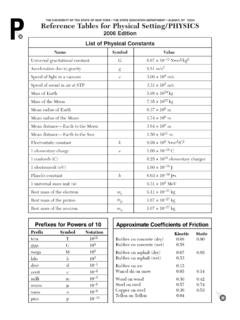
8 The order of presentation and numbering of all state-ments in this guide are not meant to indicate any rec-ommended sequence of instruction. Ideas have not been prioritized, nor have they been organized to indi-cate teaching time allotments or test weighting. Teachers are encouraged to find and elaborate for stu-dents the conceptual cross-linkages that interconnect many of the Key Ideas to each other and to other math-ematics, Science , and technology learning standards. Material found on the Earth Science Reference Tables should also be considered part of the Core Curriculum. Laboratory Requirements: Critical to understanding Science concepts is the use of scientific inquiry to develop explanations of natural phenomena. Therefore, as a prerequisite for admission to the Regents examina-tion in Physical Setting/ Earth Science , students must have successfully completed 1200 minutes of labora-tory experience with satisfactory written reports for each laboratory investigation. It is expected that laboratory experiences will provide the opportunity for students to develop the scientific inquiry techniques in Standard 1, Standard 2, and the interconnectedness of content and skills, and the problem-solving approaches in Standards 6 and 7.
9 Earth Science 3 PROCESS SKILLS BASED ON STANDARDS 1, 2, 6, AND 7 Science process skills should be based on a series of discoveries. Students learn most effectively when they have a central role in the discovery process. To that end, Standards 1, 2, 6, and 7 incorporate in the Physical Setting/ Earth Science Core Curriculum a student-centered, problem-solving approach to Earth Science . The following is a sample of Earth Science process skills. This list is not intended to be an all-inclusive list of the content or skills, but rather a sample of the types of activities that teachers are expected to incorporate into their curriculum. It should be a goal of the instructor to encourage Science process skills that will provide students with background and curiosity to investigate important issues in the world around them. STANDARD 1 Analysis, Inquiry, and Design Students will use mathematical analysis, scientific inquiry, and engineering design, as appropriate, to pose ques-tions, seek answers, and develop solutions.
10 STANDARD 1 Analysis, Inquiry, and Design MATHEMATICAL ANALYSIS: Key Idea 1: Abstraction and symbolic representation are used to communicate mathematically. For example: use eccentricity, rate, gradient, standard error of measurement, and density in context Key Idea 2: Deductive and inductive reasoning are used to reach mathematical conclusions. For example: determine the relationships among: velocity, slope, sediment size, channel shape, and volume of a stream understand the relationships among: the planets distance from the Sun, gravitational force, period of revolution, and speed of revolution Key Idea 3: Critical thinking skills are used in the solution of mathematical problems. For example: in a field, use isolines to determine a source of pollution STANDARD 1 Analysis, Inquiry, and Design SCIENTIFIC INQUIRY: Key Idea 1: The central purpose of scientific inquiry is to develop explanations of natural phenom-ena in a continuing, creative process. For example: show how our observation of celestial motions supports the idea of stars moving around a stationary Earth (the geocentric model), but further investigation has led scientists to understand that most of these changes are a result of Earth s motion around the Sun (the heliocentric model) Key Idea 2: Beyond the use of reasoning and consensus, scientific inquiry involves the testing of proposed explanations involving the use of conventional techniques and procedures and usually requiring considerable ingenuity.