Transcription of Polyphase Induction Machines
1 CHAPTER Polyphase Induction Machines T he objective of this chapter is to study the behavior of Polyphase Induction Machines . Our analysis will begin with the development of single-phase equiv- alent circuits, the general form of which is suggested by the similarity of an Induction machine to a transformer. These equivalent circuits can be used to study the electromechanical characteristics of an Induction machine as well as the loading presented by the machine on its supply source, whether it is a fixed-frequency source such as a power system or a variable-frequency, variable-voltage motor drive. INTRODUCTION TO Polyphase Induction Machines As indicated in Section , an Induction motor is one in which alternating current is supplied to the stator directly and to the rotor by Induction or transformer action from the stator.
2 As in the synchronous machine, the stator winding is of the type discussed in Section When excited from a balanced Polyphase source, it will produce a magnetic field in the air gap rotating at synchronous speed as determined by the number of stator poles and the applied stator frequency fe (Eq. ). The rotor of a Polyphase Induction machine may be one of two types. A wound rotor is built with a Polyphase winding similar to, and wound with the same number of poles as, the stator. The terminals of the rotor winding are connected to insulated slip rings mounted on the shaft. Carbon brushes bearing on these rings make the rotor terminals available external to the motor , as shown in the cutaway view in Fig.
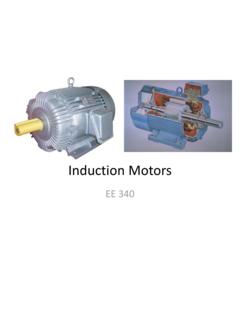
3 Wound-rotor Induction Machines are relatively uncommon, being found only in a limited number of specialized applications. On the other hand, the Polyphase Induction motor shown in cutaway in Fig. has a squirrel-cage rotor with a winding consisting of conducting bars embedded in slots in the rotor iron and short-circuited at each end by conducting end rings. The 306 Introduction to Polyphase Induction Machines 307 Figure Cutaway view of a three-phase Induction motor with a wound rotor and slip rings connected to the three-phase rotor winding. (General Electric Company.) Figure Cutaway view of a three-phase squirrel-cage motor . The rotor cutaway shows the squirrel-cage laminations.
4 (Rockwell Automation~Reliance Electric.) 308 CHAPTER 6 Polyphase Induction Machines (a) (b) Figure (a) The rotor of a small squirrel-cage motor . (b) The squirrel-cage structure after the rotor laminations have been chemically etched away. (Athens Products.) extreme simplicity and ruggedness of the squirrel-cage construction are outstanding advantages of this type of Induction motor and make it by far the most commonly used type of motor in sizes ranging from fractional horsepower on up. Figure shows the rotor of a small squirrel-cage motor while Fig. shows the squirrel cage itself after the rotor laminations have been chemically etched away. Let us assume that the rotor is turning at the steady speed of n r/min in the same direction as the rotating stator field.
5 Let the synchronous speed of the stator field be ns r/min as given by Eq. This difference between synchronous speed and the rotor speed is commonly referred to as the slip of the rotor; in this case the rotor slip is ns - n, as measured in r/min. Slip is more usually expressed as a fraction of synchronous speed. The fractional slip s is ns -n s = ( ) ns The slip is often expressed in percent, simply equal to 100 percent times the fractional slip of Eq. The rotor speed in r/min can be expressed in terms of the slip and the synchronous speed as n --- (1 - s)ns ( ) Similarly, the mechanical angular velocity COm can be expressed in terms of the syn- chronous angular velocity COs and the slip as COm ~-- (1 -- S)COs ( ) The relative motion of the stator flux and the rotor conductors induces voltages of frequency fr fr = Sfe ( ) Introduction to Polyphase Induction Machines 309 called the slip frequency, in the rotor.
6 Thus, the electrical behavior of an Induction machine is similar to that of a transformer but with the additional feature of frequency transformation produced by the relative motion of the stator and rotor windings. In fact, a wound-rotor Induction machine can be used as a frequency changer. The rotor terminals of an Induction motor are short circuited; by construction in the case of a squirrel-cage motor and externally in the case of a wound-rotor motor . The rotating air-gap flux induces slip-frequency voltages in the rotor windings. The rotor currents are then determined by the magnitudes of the induced voltages and the rotor impedance at slip frequency. At starting, the rotor is stationary (n = 0), the slip is unity (s = 1), and the rotor fl~equency equals the stator frequency fe.
7 The field produced by the rotor currents therefore revolves at the same speed as the stator field, and a starting torque results, tending to turn the rotor in the direction of rotation of the stator-inducing field. If this torque is sufficient to overcome the opposition to rotation created by the shaft load, the motor will come up to its operating speed. The operating speed can never equal the synchronous speed however, since the rotor conductors would then be stationary with respect to the stator field; no current would be induced in them, and hence no torque would be produced. With the rotor revolving in the same direction of rotation as the stator field, the frequency of the rotor currents is sfe and they will produce a rotating flux wave which will rotate at Sns r/min with respect to the rotor in the forward direction.
8 But superimposed on this rotation is the mechanical rotation of the rotor at n r/min. Thus, with respect to the stator, the speed of the flux wave produced by the rotor currents is the sum of these two speeds and equals sns + n = Sns + ns(1 - s) = ns ( ) From Eq. we see that the rotor currents produce an air-gap flux wave which rotates at synchronous speed and hence in synchronism with that produced by the stator currents. Because the stator and rotor fields each rotate synchronously, they are stationary with respect to each other and produce a steady torque, thus maintaining rotation of the rotor. Such torque, which exists for any mechanical rotor speed n other than synchronous speed, is called an asynchronous torque.
9 Figure shows a typical Polyphase squirrel-cage Induction motor torque-speed curve. The factors influencing the shape of this curve can be appreciated in terms of the torque equation, Eq. Note that the resultant air-gap flux ~sr in this equation is approximately constant when the stator-applied voltage and frequency are constant. Also, recall that the rotor mmf Fr is proportional to the rotor current Ir. Equation can then be expressed in the form T = - K Ir sin ~r ( ) where K is a constant and r is the angle by which the rotor mmf wave leads the re- sultant air-gap mmf wave. The rotor current is equal to the negative of the voltage induced by the air-gap flux divided by the rotor impedance, both at slip frequency.
10 The minus sign is required because the induced rotor current is in the direction to demagnetize the air-gap flux, whereas the rotor current is defined in Chapter 4 as being in the direction to magnetize 310 CHAPTER 6 Polyphase Induction Machines 300 = 250 o 200 o 150 ~" 100 o o o ~ 50 0 I I I I 0 20 40 60 80 Speed, percent of synchronous speed Slip as a fraction of synchronous speed ),, 100 Figure Typical Induction - motor torque-speed curve for constant-voltage, constant-frequency operation. the air gap. Under normal running conditions the slip is small: 2 to 10 percent at full load in most squirrel-cage motors. The rotor frequency (fr = Sfe) therefore is very low (of the order of 1 to 6 Hz in 60-Hz motors).