Transcription of POLYSORBATE 20 - uspbpep.com
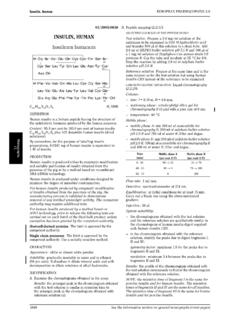
1 EUROPEAN PHARMACOPOEIA 20 Calculate the percentage content of polymyxin B3, ofpolymyxin B1-I, and of the sum of polymyxins B1, B2, B3and B1-I, using the following expression:CBi=percentage content of polymyxin Bi;ABi=area of the peak due to polymyxin Biin thechromatogram obtained with the test solution;m1=mass of the substance to be examined (driedsubstance) in the test solution, in milligrams;BBi=area of the peak due to polymyxin Biinthe chromatogram obtained with referencesolution (a);m2=mass ofpolymyxin B sulphate CRSin referencesolution (a), in milligrams;DBi=declared percentage content for polymyxin Biinpolymyxin B sulphate an airtight container, protected from light. If thesubstance is sterile, store in a sterile, airtight, :0426 POLYSORBATE 20 Polysorbatum 20 DEFINITIONM ixture of partial esters of fatty acids, mainly lauric(dodecanoic) acid, with sorbitol and its anhydridesethoxylated with approximately 20 moles of ethylene oxidefor each mole of sorbitol and sorbitol : oily, yellow to brownish-yellow, clear or slightlyopalescent : soluble in water, in ethanol, in ethyl acetate andin methanol, practically insoluble in fatty oils and in : about 400 mPa s at 25 identication: A, :B,C,D, Infrared absorption spectrophotometry ( ).
2 Comparison:Ph. Eur. reference spectrum ofpolysorbate It complies with the test for hydroxyl value (see Tests).C. It complies with the test for saponification value (seeTests).D. It complies with the test for composition of fatty acids(see Tests). chloride thiocyanate Rand g ofcobalt nitrate with a glass rod. The solution becomes value( ): maximum value( , Method A): 96 to g into a 100 ml beaker, dissolve withglacialacetic acid Rand dilute to 20 ml with the same solvent. Add1mlofsaturated potassium iodide solution Rand allow tostand for 1 min. Add 50 ml ofcarbon dioxide-free water Rand a magnetic stirring bar. Titrate M sodiumthiosulphate, determining the end-point potentiometrically( ). Carry out a blank the peroxide value using the following expression:n1=volume M sodium thiosulphaterequiredfor the substance to be examined, in millilitres,n2=volume M sodium thiosulphaterequiredfor the blank, in millilitres,M=molarity of the sodium thiosulphate solution, inmoles per litre,m=mass of substance to be examined, in value( ): 40 to 50, determined on ml M alcoholic potassium hydroxideanddilute with 50 ml ofalcohol Rbefore carrying out thetitration.
3 Heat under reflux for 60 of fatty acids( , Method C). Preparereference solution (a) as indicated in Table : material:fusedsilica, dimensions:l=30m, = , stationary phase:macrogol 20 000 R(filmthickness m).Carrier gas:helium for chromatography velocity:50 :Time(min)Temperature( C)Column0-1480 22014 - 54220 Injection port250 Detector250 :1 of the fatty acid fraction of the substance: caproic , caprylic acid: maximum per cent, capric acid: maximum per cent, lauric acid: per cent to per cent, myristic acid: per cent to per cent, palmitic , stearic , oleic acid: maximum per cent, linoleic oxide and dioxan( , Method A): maximum1 ppm of ethylene oxide and 10 ppm of metals( ): maximum 10 g complies with limit test C. Prepare the standard using2mloflead standard solution (10 ppm Pb) (1)applytoallmonographsandothertexts2709 POLYSORBATE 40 EUROPEAN PHARMACOPOEIA ( ): maximum per cent, determined on ash( ): maximum per cent, determined an airtight container, protected from :1914 POLYSORBATE 40 Polysorbatum 40 DEFINITIONM ixture of partial esters of fatty acids, mainlyPalmiticacid (1904), with sorbitol and its anhydrides ethoxylatedwith approximately 20 moles of ethylene oxide for each moleof sorbitol and sorbitol : oily, viscous, yellowish or : miscible with water, with ethanol, with ethylacetate and with methanol, practically insoluble in fatty oilsand in liquid : about 400 mPa s at 30 identication: A, :B,C,D, Infrared absorption spectrophotometry ( ).
4 Comparison:Ph. Eur. reference spectrum ofpolysorbate It complies with the test for hydroxyl value (see Tests).C. It complies with the test for saponification value (seeTests).D. It complies with the test for composition of fatty acids(see Tests). chloride thiocyanate Rand g ofcobalt nitrate with a glass rod. The solution becomes value( ): maximum g in 50 ml of the prescribed mixture of value( , Method A): 89 to g into a 100 ml beaker, dissolve withglacialacetic acid Rand dilute to 20 ml with the same solvent. Add1mlofsaturated potassium iodide solution Rand allow tostand for 1 min. Add 50 ml ofcarbon dioxide-free water Rand a magnetic stirring bar. Titrate M sodiumthiosulphate, determining the end-point potentiometrically( ). Carry out a blank :n1=volume M sodium thiosulphaterequiredfor the substance to be examined, in millilitres,n2=volume M sodium thiosulphaterequiredfor the blank, in millilitres,M=molarity of the sodium thiosulphate solution, inmoles per litre,m=mass of substance to be examined, in value( ): 41 to 52, determined on ml M alcoholic potassium hydroxideanddilute with 50 ml ofalcohol Rbefore carrying out thetitration.
5 Heat under reflux for 60 of fatty acids( , Method C). Preparereference solution (a) as indicated in Table : material:fusedsilica, size:l=30m, = , stationary phase:macrogol 20 000 R(filmthickness m).Carrier gas:helium for chromatography velocity:50 :Time(min)Temperature( C)Column0-1414 - 5480 220220 Injection port250 Detector250 :1 of the fatty acid fraction of the substance: palmitic acid: minimum per oxide and dioxan( , Method A): metals( ): maximum 10 g complies with limit test C. Prepare the standard using2mloflead standard solution (10 ppm Pb) ( ): maximum per cent, determined on ash( ): maximum per cent, determined an airtight container, protected from :0427 POLYSORBATE 60 Polysorbatum 60 DEFINITIONM ixture of partial esters of fatty acids, mainlyStearicacid 50 (1474), with sorbitol and its anhydrides ethoxylatedwith approximately 20 moles of ethylene oxide for each moleof sorbitol and sorbitol : yellowish-brown gelatinous mass whichbecomes a clear liquid at temperatures above 25 the information section on general monographs (cover pages)