Transcription of Post Shoulder Protocol - UW Health
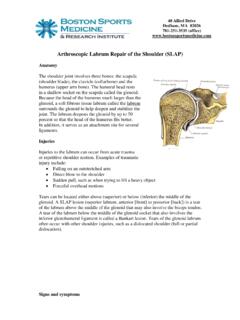
1 UW Health SPORTS REHABILITATIONThe world class Health care team for the UW Badgers and proud sponsor of UW 621 SCIENCE DRIVE MADISON, WI 53711 4602 EASTPARK BLVD. MADISON, WI 53718 Rehabilitation Guidelines for Posterior Shoulder Reconstruction with or without Labral RepairThe anatomic configuration of the Shoulder joint (glenohumeral joint) is often compared to a golf ball on a tee. This is because the articular surface of the round humeral head is approximately four times greater than that of the relatively flat Shoulder blade face (glenoid fossa).1 The stability and movement of the Shoulder is controlled by the rotator cuff muscles, ligaments, and the capsulolabral complex of the Shoulder (Figure 1).
2 The labrum is a fibrocartilagenous ring, which attaches to the bony rim of the glenoid The labrum doubles the depth of the glenoid fossa to help provide stability. An analogy includes a parked car on a hillside with a chop block under the tire such that the round tire is the humeral head, the road is the glenoid fossa and the chop block is the anatomy of the Shoulder allows for great mobility, yet this anatomical structure also sacrifices stability. The Shoulder is one of the most commonly dislocated joints in the body. Shoulder dislocations can occur from trauma or from hyper-laxity (genetic or acquired looseness of the capsule and ligaments). Traumatic posterior Shoulder dislocations most often occur when significant force is placed through the arm when it is front of the body (Figure 2).
3 When the Shoulder dislocates posteriorly the capsule, ligaments and labrum often tear (Figure 3). Shoulder dislocations often lead to recurrent dislocation or subluxation, and posterior Shoulder instability occurs when the humeral head subluxes or dislocates posteriorly on the glenoid. Sport activities that lead to posterior should instability include heavy bench pressing and football linemen blocking again with that mechanism of the arm straight out in front of the chest with force being applied through the arm to the some athletes posterior instability can be treated non-operatively with rehabilitation. This often involves strengthening the rotator cuff and scapular muscles as well as improving the body s neuromuscular reaction to sudden changes of position Figure 1 rotator cuff anatomyImage property of Primal Pictures, Ltd.
4 , Use of this image without authorization from Primal Pictures, Ltd. is ViewSupraspinatusInfraspinatusSubscapula risTeres MinorFront ViewFigure 2 Common mechanism of injury for posterior instability, arm straight out from chest with the body moving forward and a backward (posterior) force applied to the Shoulder through the Guidelines for Posterior Shoulder Reconstruction with or without Labral 621 SCIENCE DRIVE MADISON, WI 53711 4602 EASTPARK BLVD. MADISON, WI 53718or movement. Altering sport-specific techniques also is used in combination with rehabilitation. When these approaches are unsuccessful and posterior instability continues, the athlete may be left with the option of changing sports or having surgery.
5 Surgical correction for posterior instability consists of capsulolabral repair and addressing the labral injury. This may mean debriding or removing frayed portions of the labrum or repairing tears with suture materials (Figure 4). After surgery, rehabilitation plays a crucial role in maximizing the individual s functional outcome. In the early phases of rehabilitation after surgery it is necessary to protect the surgical repair to allow healing. This is done by allowing the patient to only move the Shoulder in to certain ranges of motion and wear a sling most of the time that they are not doing rehabilitation exercises. The range of motion restrictions are outlined in Phase I. The rehabilitation guidelines are presented in a criterion based progression.
6 General time frames are given for reference to the average, but individual patients will progress at different rates depending on their age, associated injuries, pre-injury Health status, rehabilitation compliance and injury severity. Specific time frames, restrictions and precautions may also be given to protect healing tissues and the surgical head, covered with articular cartilageGlenoid Labrum, with suture material now fixing it back firmly to the bony glenoidGlenoid Fossa, covered with articular cartilageFigure 4 Posterior labral repairFigure 3 Posterior labral tearGlenoid Labrum, torn and no longer connected to the bony fossaGap between the tissuesGlenoid Fossa, covered with articular cartilage3 Rehabilitation Guidelines for Posterior Shoulder Reconstruction with or without Labral 621 SCIENCE DRIVE MADISON, WI 53711 4602 EASTPARK BLVD.
7 MADISON, WI 53718 PHASE I (surgery to 3 weeks after surgery)Appointments Rehabilitation appointments begin at 7-14 days after surgeryRehabilitation Goals Protection of the post-surgical Shoulder Activation of the stabilizing muscles of the gleno-humeral and scapulo-thoracic joints Maintain range of motion (ROM) at the elbow and wristPrecautions Sling immobilization required for soft tissue healing for 6 weeks after surgery; remove the sling during post-operative week 6 in safe environments and discontinue 6 weeks after surgery Hypersensitivity in axillary nerve distribution is a common occurrence No Shoulder internal rotation past neutral for 6 weeks after surgery and no Shoulder internal rotation with abduction for 8 weeks after surgery to protect repaired tissuesSuggested Therapeutic Exercise Begin at post-operative week 3, including sub-maximal Shoulder isometrics for Shoulder internal rotation and external rotation; flexion and extension.
8 Abduction and adduction Passive ROM for Shoulder elevation in the sagittal and frontal plane as well as Shoulder external rotation to 40 in neutral Hand gripping Elbow, forearm, and wrist Active ROM Cervical spine and scapular Active ROM Desensitization techniques for axillary nerve distribution Postural exercisesCardiovascular Exercise Walking and stationary bike with the sling on; avoid running and jumping due to the distractive forces that can occur at landing No treadmillProgression Criteria 3 weeks 621 SCIENCE DRIVE MADISON, WI 53711 4602 EASTPARK BLVD. MADISON, WI 53718 Rehabilitation Guidelines for Posterior Shoulder Reconstruction with or without Labral RepairPHASE II (begin after meeting Phase I criteria, usually 3-8 weeks after surgery)Appointments Rehabilitation appointments are 1-2 times per weekRehabilitation Goals Full Active ROM in all cardinal planes, except Shoulder internal rotation Progress Shoulder internal rotation ROM gradually to prevent overstressing the repaired posterior tissues of the Shoulder Strengthen Shoulder and scapular stabilizers in protected position (0 45 Shoulder abduction)
9 Begin proprioceptive and dynamic neuromuscular control retraining, making sure to avoid closed chain exercises due to stress to posterior repairPrecautions Sling immobilization required for soft tissue healing for 6 weeks after surgery Remove sling during the post-operative week 6 in safe environments and discontinue after 6 weeks after surgery Hypersensitivity in axillary nerve distribution is a common occurrence No Shoulder internal rotation past neutral for 6 weeks after surgery and no Shoulder internal rotation with abduction for 8 weeks after surgery to protect repaired tissues Avoid passive and forceful movements into Shoulder internal rotation and horizontal adductionSuggested Therapeutic Exercise Active assistive and active ROM in all cardinal
10 Planes, making sure to assess scapular rhythm and respect Shoulder internal rotation ROM guidelines rotator cuff strengthening in non-provocative positions (0 - 45 Shoulder abduction) Scapular strengthening and dynamic neuromuscular control Cervical spine and scapular active ROM Postural exercises Core strengtheningCardiovascular Exercise Walking, stationary bike, Stairmaster No swimming or treadmill Avoid running and jumping until the athlete is at least 8 weeks after surgery and has full rotator cuff strength in a neutral position due to the distractive forces that can occur at landing Progression Criteria Full Active ROM, except Shoulder internal rotation Normal (5/5) Shoulder internal rotation and external rotation strength at 45 Shoulder 621 SCIENCE DRIVE MADISON, WI 53711 4602 EASTPARK BLVD.