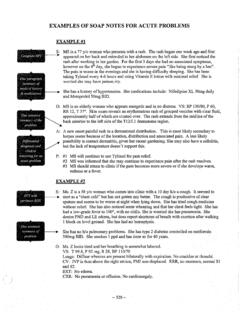
Transcription of PRIMARY CARE CLERKSHIP PRACTICE EXAMS 1. …
1 PRIMARY care CLERKSHIP PRACTICE EXAMS 1. PRACTICE Exam: (requires log in) 2. PRACTICE OSCE Scenarios (below) OSCE Scenarios Introduction Students: The following PRACTICE OSCE scenarios are provided to help prepare you for the end of the rotation exam. Although these are not the exact stations that you will encounter, the scenarios are representative of the types of problems that will be tested. Scenario A contains an-depth assessor checklist to give you a more detailed guide to the depth of knowledge and skills expected; the remaining scenarios have a more general list of assessor criteria. To maximize your learning, we suggest that you: PRACTICE these scenarios in groups of 3, alternating among Patient, Student, and Assessor roles.
2 Complete and review each scenario individually--it will maximize your learning if the Student does not view the other roles before the performance. You may wish to print out the patient information, assessor form and any linked/attached materials for each scenario. Limit your time to 10 minutes per scenario. Assessor should keep time and give a 2-minute warning. Assessor should note questions asked/not asked during the interviews; consider video or audiotaping to improve recollection and feedback. For Scenarios B-G, review and discuss the likely components of the assessor checklist. Give each other honest feedback about performance. PRACTICE OSCE Scenario A Student Directions: A 27-year old woman comes into the office complaining of chest pain.
3 Obtain a complete history of this complaint. After obtaining the history to your satisfaction, excuse yourself to go talk with your preceptor. PRACTICE OSCE Scenario A Assessor Checklist Reminder: Keep time and give a 2-minute warning before the 10 minutes is up Introduces self appropriately Clarifies reason for visit Obtains history of chest pain Onset Location Precipitating factors Alleviating factors Associated symptoms Quality Radiation Severity Timing/duration Identifies risk factors for heart disease Past medical history Family history of heart disease or risk factors Smoking history Illicit Drug use (especially cocaine)
4 Hypertension Lipids/cholesterol Recent stressors Exercise tolerance Focused review of systems Heartburn/GERD symptoms Pain with movement/palpation Medications Allergies Summarizes history Checks for any other concerns or missed information Overall performance Communication skills performance Ask Standardized Patient: How likely would you be to go back to him/her ? PRACTICE OSCE Scenario A Patient information You are a previously healthy 27 year-old woman. You have been having chest discomfort about twice a week for the last 2 weeks. It is sharp, associated with difficulty getting a deep breath. It seems to come on mostly at work or when you are driving.
5 It lasts about a half-hour at a time. You ve tried Tylenol, Advil, drinking cold water, and antacids without much benefit. It doesn t radiate. It is severe enough to interrupt your work but not excruciating. You haven t had any heartburn or stomach symptoms. You are concerned that it could be a heart problem. You smoke 15 cigarettes a day. You re trying to quit; had cut down from 1 pack/day to pack but recently went back up to PPD, probably from stress. No drug use. You ve never been in the hospital or been told you had any chronic illnesses, never had anything like this before, never had a cholesterol test. You are separated from your husband of two years, which is very stressful.
6 You had argued a lot and just grown apart, no history of domestic violence. You work as a bank supervisor, no children, not currently sexually active or using birth control. You do aerobics 3-4 times a week and haven t had any problems with chest pain or breathing while exercising; Actually that s when I feel best. Your father had a heart attack last year when he was 64, which is one of the reasons you are worried about these pains. He also smokes and has high blood pressure. Your mother and older brother are healthy. You take a multivitamin daily, no other meds, no allergies. PRACTICE OSCE Scenario C Student Information: A 51-year old man comes into the office for right shoulder pain, progressive over the last 3 weeks, aggravated by his work sanding car hoods.
7 Perform a focused physical exam of the shoulders, explaining what you are doing, what you are looking for, and what you are finding as you go. When you are finished examining the patient, summarize your findings to him and explain that you will go talk with your preceptor. PRACTICE OSCE Scenario C Assessor Criteria Reminder: Keep time and give a 2-minute warning before the 10 minutes is up Introduction/agenda Shoulder exam Inspection Palpation Range of Motion Strength Special tests: Summarizes findings/Checks for any other concerns or missed information Overall performance, Communication skills, attention to patient comfort PRACTICE OSCE Scenario C: Patient Information You are a 50 year-old man coming in for right shoulder pain for the last 3 weeks.
8 It seems to be getting worse and worse. About a month ago you began a job in an autobody shop; your PRIMARY job is sanding the paint off of car hoods. It hurts the most when you have to lean over the car and reach across the hood holding the heavy sander. Ibuprofen helps a bit. On the exam you will have a slight pain on palpation over the lateral aspect of the shoulder joint. Abduction is limited actively to about 110 degrees, passively to about 130 degrees. Strength is good, some pain with supraspinatus testing. Neers and Hawkins maneuvers elicit pain. Otherwise normal exam. PRACTICE OSCE Scenario D Student information Mr. Jones, a 27 year-old previously healthy man, is seen with a 1-day history of low back pain.
9 You obtained his history and learned that the pain is non-radiating, worse with bending/twisting, and not associated with any bladder/bowel incontinence. He has no symptoms or signs of systemic illness. It started after he helped a friend move some furniture. Aspirin and a hot shower have helped transiently. His exam showed moderate right paralumbar muscle tenderness, normal lower extremity strength and reflexes. You discussed this with your preceptor, who agrees with you that this seems like an uncomplicated back muscle strain, and asks you to now present your assessment and plan to the patient. PRACTICE OSCE Scenario D Assessor Criteria Reminder: Keep time and give a 2-minute warning before the 10 minutes is up Re-introduces Gives diagnosis, rationale Treatment recommendations Acknowledges concerns, probes, negotiates Overall performance Communication skills Standardized Patient: Would you go back to him/her?
10 PRACTICE OSCE Scenario D Patient Information You are a 27-year old man, self-employed as a carpenter, and have always been healthy as a horse. This weekend you were helping a friend move, including carrying a very heavy sleeper-sofa up 2 flights of stairs. Yesterday you woke up with bad pain in your right lower back; you could hardly get out of bed. You took some aspirin and a hot shower, which loosened it up enough to go to work. It got more and more painful; you barely made it through the day. Another hot shower and aspirin helped when you got home. This morning it was really stiff again; there s no way you can go through another day like yesterday. You have an associates degree from the local state university.