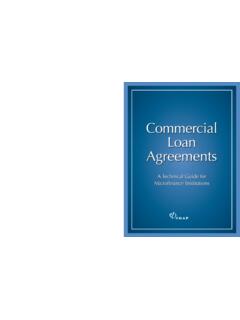
Transcription of Product Development for Microfinance - CGAP
1 Product Development . FOR. Microfinance INSTITUTIONS. 2009 Consultative Group to Assist the Poor/The World Bank. All rights reserved. Consultative Group to Assist the Poor 1818 H Street, Washington, DC 20433. Internet: Email: Telephone: + Table of Contents Overview of the Course ..vii References for the Course ..ix Course Materials Session 1: Welcome and Introduction ..PD-1. Session 2: What is Product Development ?..PD-27. Session 3: Product Development An Overview ..PD-43. Session 4: Market Research ..PD-69. Session 5: Product Concept and Design ..PD-117. Session 6: Session 7: Pricing ..PD-177. Session 8: Pilot Testing and Rollout ..PD-197. Session 9: Case Study Epilogue and Summary ..PD-217. Session 10: Action Plan, Evaluation, and Closure ..PD-219. Case Study: The UNIbank Chronicles ..PD-231. iii Acknowledgments CGAP would like to thank those who were instrumental in the Development and design of the Product Development for Microfinance course: Janis Sabetta, Brigit Helms, Monica Brand, Kim Craig, Monique Cohen, Javier Fernandez, Lorna Grace, Imran Matin, Mike McCord, Benedito Murambire, Zan Northrip, Elma Valenzuela, Niraj Vermat, Graham Wright, Nicola Young, Jennifer Isern, Leslie Barcus, and all CGAP training hubs and partners.
2 Iv Introduction BACKGROUND OF THE CGAP SKILLS FOR Microfinance MANAGERS COURSE SERIES. In 1997, Jennifer Isern and Brigit Helms of CGAP launched a pilot program in Africa to provide financial management courses to Microfinance institutions (MFIs), based on industry-wide observation that the greatest constraint to the Development of Microfinance in the region was the lack of management capacity. The Pilot initiative had two complementary long-term objectives: 1) to improve the institutional viability of MFIs in Africa and 2) to enhance the human resource base in Microfinance in Africa through sustainable training programs that would help develop stronger MFIs and increase the market for local training services. By 1999, the Africa Pilot program had become the MFI Training Program, with new partners in South and South-East Asia, Central Europe, and the Newly Independent States (NIS).
3 In addition, CGAP launched AFCAP, an East/Southern Africa program focusing on 12. countries and CAPAF, the Francophone Africa program focusing on 19 countries, to build the capacity of national training service providers to offer training and consulting services. During the early years, Jennifer Isern and Brigit Helms served as overall coordinators of the MFI Training Program and regional programs with colleagues Tiphaine Crenn, Nathalie D'Ambrosio-Vitale, Mike Goldberg, and Joyita Mukherjee, and primary consultants Janis Sabetta, Ruth Goodwin, and Kim Craig. Through this initiative, CGAP developed seven courses for MFI managers conceived to be globally relevant, short and practical, and incorporating adult training design. These courses are collectively called the Skills for Microfinance Managers series. Based on feedback from trainers and participants from hundreds of courses, the courses were revised and improved over several years.
4 As the program matured, Jennifer Isern, Leslie Barcus, and Tiphaine Crenn managed the Global MFI Training Program. By the time CGAP transferred its training activities to the Microfinance Management Institute in January 2007, CGAP's 39 training partners had trained more than 12,000 people in 52. In 2007 2008, Tiphaine Crenn coordinated revisions and overall editing of the MFI courses to reflect changes in Microfinance standards, especially in financial statements and ratios. In line with CGAP's role as a global resource center on Microfinance , the full trainer materials for the seven courses developed under the MFI Training Program are now being made publicly available. NOTICE ABOUT USING THE CGAP SKILLS FOR Microfinance MANAGERS COURSE MATERIALS. In parallel to developing course materials, the program aimed to identify qualified national and regional training institutions and help build their capacity to deliver high-quality courses, expand their training markets, and offer courses on a cost-recovery basis.
5 Hundreds of training of trainer (ToT) sessions were organized for the seven courses throughout the world. In some regions, CGAP also developed a certification process, and certified trainers were given broad access to the training materials. Certified training partners invested heavily in building their reputation for offering high-quality, useful courses and building up their businesses. Although the CGAP Skills for Microfinance Managers course materials are now publicly available, CGAP recognizes only those partners and trainers who went through the certification process as CGAP. training partners. Others who offer a course using materials from one of the CGAP Skills for Microfinance Managers course should not refer to themselves as CGAP trainers or CGAP-certified. CGAP also requests that all those who offer the Product Development course use the following text in their marketing materials and course descriptions: The Product Development course is based on the materials developed by CGAP which are publicly available on CGAP is a leading 1.
6 By December 2008, the number of people trained was closer to 14,000, given the ongoing training activities of CAPAF's 19 training partners in Francophone Africa. v independent resource for objective information, expert opinion, and innovative solutions for Microfinance . CGAP works with the financial industry, governments, and investors to effectively expand access to financial services for poor people around the world.. HOW TO WORK WITH THE COURSE MATERIALS. The CGAP Skills for Microfinance Managers course materials are all organized in the same manner, with eight to twelve sessions in each course. Each session generally consists of the following sections: 1. Trainer Instructions give step-by-step instructions to trainers on how to lead the session, including when to show which PowerPoint slide, distribute handouts, organize participant activities, discuss during short lectures or general discussions, etc.
7 The instructions include suggested timing, although this should be adapted according to the context. The first page (Session Summary) of the Trainer Instructions section in each session lists all the supplies, technical materials, overheads, handouts, and case study sections that will be required for that specific session. Optional overheads and handouts, which are included in the course material for use at the discretion of the trainer, are clearly identified within shaded boxes in the Session Summary. If there are additional technical materials in the session, the Trainer Instructions include a section called Trainer Materials, marked M in the right-hand top corner. Trainer Instructions are not intended for participants. If technical explanations are included in the Trainer Instructions, they are also generally provided in the handouts for the participants. 2. Overheads introduce topics, underscore key messages, and summarize issues.
8 Overheads are clearly marked O in the right-hand top corner. (For example, PD3-O2 means that this is the second overhead of the third session in the Product Development course.) Optional overheads are identified by black (as opposed to white) reference numbers. The overheads are in PowerPoint format but can be printed out on transparencies and shown using an overhead projector. Overheads are not meant to be distributed to participants since the handouts in the same session will cover the same points, generally in greater detail. 3. Handouts are marked H in the top right-hand corner, in the same manner as the overheads. Handouts include exercises, instructions, and financial statements, as well as additional reading and in-depth information on the topic. Some handouts give instructions to the trainers about a publication to distribute, and these publications may need to be ordered or downloaded separately.
9 4. Case studies are used in most of the CGAP courses. Files for the case study are sometimes kept separate from the other handouts. The instructions in the Trainer Notes explain the section of the case study at each point in the session. Printing case studies on colored paper (and using different colors for different sections of the case) makes it easier for participants to organize their materials. 5. Reference materials and additional reading are listed for each course. Excerpts or the entire document are often included in the handouts. On the Web site, each course home page contains a box on the right-hand side with links to download the documents, if they are available publicly, or information on how to purchase them. Please note that the overheads in PowerPoint format need to be downloaded separately. The course file contains the trainer instructions, the trainer technical materials, the overview of the overheads, the handouts, and the case study.
10 The pages are formatted to be printed double-sided and blank pages are included as necessary. vi Overview of the Course The Product Development for Microfinance Institutions course is one of the four courses in the Operational Management Curriculum, along with Business Planning, Information Systems, and Operational Risk Management. The need to develop increasingly flexible and responsive financial products constitutes perhaps the most compelling challenge facing the Microfinance industry today. In response to this growing need, a number of donors, practitioner networks, and projects are in the process of developing operational tools that practitioners can use to design demand-responsive Microfinance products. This four- to six-day course covers both the process of developing a new Product (market definition, market research, Product prototype, costing and pricing, pilot testing, rollout, marketing, lifecycle management, and so forth) as well as the impact of introducing new products on the MFI (human resources, corporate culture, operations and systems, financial results, operating results, and the like).